

Fixed Dock Leveler DCQ Series
Product Introduction
The DCQ series fixed dock leveler is a dedicated auxiliary device designed for rapid cargo loading and unloading. Featuring electro-hydraulic height adjustment, it creates a stable bridge between the truck trailer and the warehouse dock, allowing forklifts and electric flat cars to drive directly into the trailer for continuous loading or unloading operations. The unit is fully hydraulically driven, with a high-strength "U"-shaped main girder structure. The rated dynamic load ranges from 5 to 15 tons, and platform sizes of 2000×2000mm or 2500×2000mm are available. The height adjustment range reaches up to +400mm to -300mm.
The fixed dock leveler is suitable for a wide range of logistics and warehousing operations. Installed at the front edge of the loading dock, it is embedded flush with the floor. Forklifts no longer need to travel up and down the dock ramp; instead, they enter and exit the trailer directly via the leveler, boosting single-cycle loading efficiency by over 50% while significantly reducing operator effort and safety risks. The DCQ series is designed and manufactured in strict compliance with the industry standard JB/T 11294-2012 for fixed dock levelers.
Product Gallery
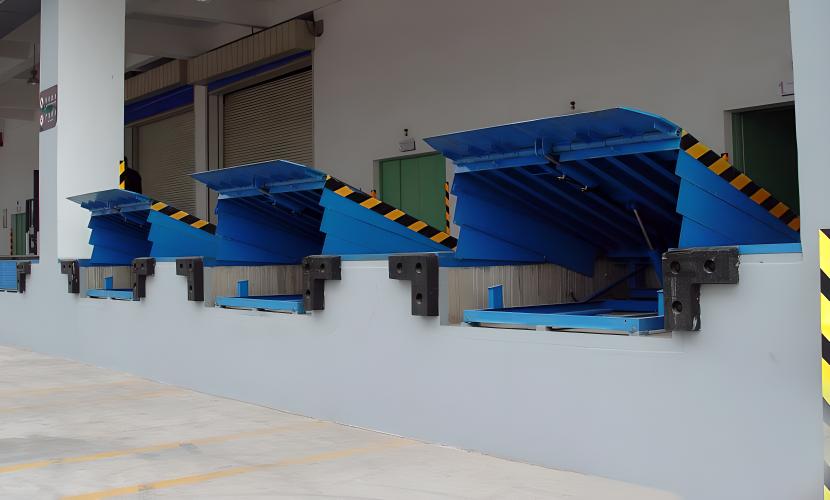
Scope of Application
The fixed dock leveler is applicable to loading positions in factory buildings, logistics warehouses, railway freight yards, ports and docks, distribution centers, postal sorting hubs, e-commerce fulfillment centers, and any fixed dock equipped with auxiliary equipment such as the SJY towable hydraulic lift platform. It is especially well-suited for logistics nodes with high daily truck turnaround and frequent forklift traffic, enabling rapid dock connection and immediate loading or unloading upon truck arrival. The leveler operates reliably in all conventional environments; for cold storage, explosion-proof zones, or corrosive atmospheres, customized models with the appropriate protection rating (IP) are available.
Product Features
1. Electro-hydraulic height adjustment is infinitely variable, with fully hydraulic drive for easy operation and reliable performance.
2. The lip plate and platform are connected via a full-length shaft, ensuring high strength and dependable operation.
3. An imported, integrated modular Hydraulic Power Unit delivers superior sealing and an extended service life.
4. The high-strength "U"-shaped girder design prevents deformation even under heavy loads over extended periods.
5. A checkered steel plate surface provides excellent anti-slip performance.
6. Side toe guards prevent feet from slipping under the platform, reducing the risk of accidental injury.
7. A safety strut is provided to protect maintenance personnel when working beneath the leveler.
8. The lip plate remains in constant contact with the trailer bed, allowing forklifts to travel in and out smoothly.
9. In addition to standard rubber bumpers, alternative sizes are available to ensure safe trailer positioning.
Structural Diagram
Technical Parameters
| Model | dynamic load(t) | Adjustable Range(mm) | platform Dimensions(mm) | Overall Dimensions (mm) | Lifting Method |
|---|---|---|---|---|---|
| DCQ-5t | 5t | +300-250 | 2000×2000 | 2000×2000×600 | Electric Lifting |
| DCQ-6t | 6t | +300-250 | 2000×2000 | 2000×2000×600 | Electric Lifting |
| DCQ-8t | 8t | +300-250 | 2000×2000 | 2000×2000×600 | Electric Lifting |
| DCQ-10t | 10t | +300-250 | 2000×2000 | 2000×2000×600 | Electric Lifting |
| DCQ-12t | 12t | +300-250 | 2000×2000 | 2000×2000×600 | Electric Lifting |
| DCQ-15t | 15t | +300-250 | 2000×2000 | 2000×2000×600 | Electric Lifting |
| DCQ-5t | 5t | +400-300 | 2500×2000 | 2500×2000×600 | Electric Lifting |
| DCQ-6 | 6t | +400-300 | 2500×2000 | 2500×2000×600 | Electric Lifting |
| DCQ-8t | 8t | +400-300 | 2500×2000 | 2500×2000×600 | Electric Lifting |
| DCQ-10t | 10t | +400-300 | 2500×2000 | 2500×2000×600 | Electric Lifting |
| DCQ-12t | 12t | +400-300 | 2500×2000 | 2500×2000×600 | Electric Lifting |
| DCQ-15t | 15t | +400-300 | 2500×2000 | 2500×2000×600 | Electric Lifting |
Working Principle
The DCQ fixed dock leveler operates on an electro-hydraulic drive principle. Pressing the control button starts the motor, which drives the hydraulic pump to deliver hydraulic oil into the main cylinder. The piston rod extends, raising the platform to the preset height. The operator uses the adjustment buttons to raise or lower the platform so the lip plate at the front aligns perfectly with the truck bed. The lip plate is connected to the platform via a full-length hinge shaft, allowing it to self-adjust its angle as the platform moves, maintaining full contact with the truck floor at all times.
During loading, a forklift truck (or other material handling vehicle) crosses the lip plate, drives onto the platform, and enters the truck trailer directly. The platform is fabricated from high-strength U-shaped main girders and checkered steel plate, with a built-in relief valve in the hydraulic system to prevent overload. When lowering, the solenoid valve shifts direction, hydraulic oil returns to the oil tank through the return filter element, and the platform descends slowly back into the dock pit. The anti-roll guards on both sides rise and lower with the platform, preventing personnel from accidentally stepping underneath.
Product Structure
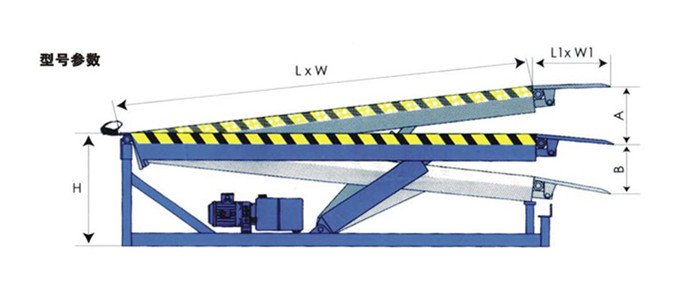
- Platform Assembly — Welded platform with anti-skid checkered steel plate, high-strength U-shaped main girders, and grid-pattern anti-skid treatment on the load surface.
- Lip Plate Mechanism — Front hinged lip plate connected to the platform via a full-length shaft, automatically conforming to truck bed height.
- Hydraulic System — Modular hydraulic power unit (motor + gear pump + cylinder + solenoid valve) with relief valve and return filter element.
- Anti-Roll Guards — Hanging protective plates on both sides of the platform that extend and retract automatically with platform movement to prevent accidental entry.
- Safety Support Strut — Inserted between the platform and base during maintenance to prevent accidental fall and ensure maintenance personnel safety.
- Rubber Bumper — Standard configuration at the front edge of the loading dock, protecting the truck tail and platform edge from impact.
Selection Guide
Selection of the DCQ series fixed dock leveler is based on three key parameters: rated dynamic load (5–15 t), height adjustment range (+300/−250 mm or +400/−300 mm), and platform dimensions (2000 × 2000 mm or 2500 × 2000 mm). When combined with an HSS electric hydraulic freight lift, it enables full-chain vertical goods transfer from the truck to every floor of the warehouse. The dynamic load rating should account for the heaviest daily load plus the forklift's dead weight — 5 t to 8 t suits electric pallet trucks and compact forklifts; 10 t to 12 t accommodates standard 3–5 t internal combustion forklifts; 15 t is intended for heavy-duty forklifts and container interior operations. The height adjustment range depends on the height difference between the dock and the truck bed — standard box trucks have a bed height of approximately 1000–1300 mm off the ground, so a +300/−250 mm range with a standard 1200 mm dock height is sufficient; containers and low-chassis trucks require the +400/−300 mm option. The 2000 × 2000 mm platform suits confined working spaces, while the 2500 × 2000 mm platform is better for wider truck trailers.
Installation Instructions
The fixed dock leveler requires a pre-cast pit at the front edge of the loading dock, with pit dimensions determined by the selected model's overall dimensions (2000 × 2000 × 600 mm or 2500 × 2000 × 600 mm). A waterproofing layer and drainage channel should be installed around the pit, with anchor bolts pre-embedded in the pit floor. During installation, lift the dock leveler into the pit, align and tighten the anchor bolts, connect the power cord (380 V three-phase), commission the hydraulic power unit's working pressure and lip plate angle, and finally install sealing rubber strips around the pit edge to prevent debris from entering. The installation typically takes 2–3 days (including concrete curing time), and it is recommended that the manufacturer dispatch professional technicians for on-site guidance.
Precautions
(1) Before each use, check that the hydraulic oil level is within the gauge range, the power cord is free of damage, and the bumpers and side guards are intact.
(2) No personnel are allowed beneath the platform or in front of the lip plate while the dock leveler is raising or lowering.
(3) Loading may begin once the lip plate is in full contact with the truck bed. Never exceed the rated dynamic load (no more than 110% of the rated load).
(4) The dock leveler must be lowered to its lowest position and the lip plate confirmed clear of the truck before the vehicle departs.
(5) Always insert the safety support strut before entering beneath the platform for maintenance. Never substitute bricks or wooden blocks for the support strut.
(6) Replace the hydraulic oil and clean the return filter element every 500 hours of operation, and perform an annual inspection of all hinge pins and U-shaped girder weld seams.
Manufacturer Services
Henan Kelude Heavy Industry Co., Ltd. specializes in manufacturing the DCQ series fixed dock leveler, offering standard and non-standard customization across the full 5–15 t range, with a production lead time of 10–20 days. Every unit undergoes no-load commissioning, rated load testing, and a 125% dynamic load safety test before delivery. We provide a one-year free warranty, lifetime spare parts supply, and ongoing technical support. For quotations, pit drawings, or installation guidance on specific models, please contact our customer service team.
FAQ
Q: What's the difference between a fixed dock leveler and a mobile dock leveler?
A: A fixed dock leveler is recessed into the loading dock, operates hydraulically, and sits flush with the floor so forklifts can drive straight on. It's ideal for high-frequency loading at a permanent dock position. A mobile dock leveler is a standalone, movable unit that adapts to different dock positions—perfect for low-frequency use across multiple bays. Fixed units offer higher load capacity (up to 15t) and a longer service life, while mobile units provide flexibility but typically max out around 10t.
Q: Does installing a dock leveler require civil construction? How long does it take?
A: Yes. A fixed dock leveler requires excavating a pit at the dock edge (dimensions based on the unit's overall size), with waterproofing and Anchor Bolts set into the pit floor. Civil work takes about 1–2 days, followed by 7 days of concrete curing before installation. Electrical wiring and commissioning take roughly half a day. We recommend designing the pit during new dock construction to avoid costly retrofits later. We provide pit drawings and installation guidance.
Q: Are the platform dimensions the same for 5t and 15t models?
A: In the DCQ series standard configuration, models from 5t to 15t offer two platform size options: 2000×2000mm and 2500×2000mm. Platform size is determined by dock width and typical vehicle dimensions, not directly by load capacity. However, the 15t model features a larger U-beam cross-section and hydraulic cylinder diameter to meet structural strength requirements under heavy-load operating conditions.
Q: Can the hydraulic power unit run on 220V power?
A: DCQ series units come standard with a 380V three-phase motor because the hydraulic pump requires higher motor power (typically 2.2–3.0kW). Three-phase operation runs smoother and draws lower current. If 220V single-phase is the only option, a custom single-phase motor or VFD is required—but single-phase motors have higher startup current and may deliver slightly slower lifting speeds. We recommend having a 380V power supply available at the dock position.
Q: What should I consider for cold-climate operation?
A: For environments that stay below freezing year-round, we recommend low-temperature Hydraulic Oil (L-HV32 or L-HS32) and an electric heating element on the Hydraulic Power Unit to maintain proper oil flow. The pit should include a drainage channel to prevent ice buildup from interfering with platform lifting. Bumpers should use low-temperature rubber. For freezer applications (below -20°C), please order the cold-storage-specific model.
Q: What routine maintenance does a dock leveler require?
A: Daily inspection: check Hydraulic Oil level and tighten all Connection bolts. Monthly inspection: lubricate the lip hinge pivot points along the full width with Grease. Every 500 hours: replace Hydraulic Oil and clean or replace the return filter element. Quarterly: inspect the toe-guard Guide rail and bumper wear. Annually: check the U-shaped Main Girder Weld Seams, all hinge pins, and Hydraulic Cylinder Seals. With regular maintenance, a dock leveler can last 10+ years.
