

DCQY Series Mobile Dock Ramp
Product Introduction
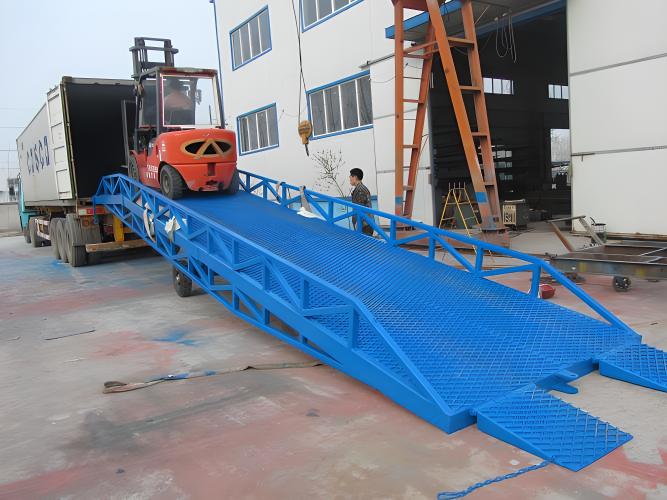
The DCQY series mobile dock ramp is a loading/unloading aid designed to be used in conjunction with forklift trucks. The ramp angle can be manually adjusted to match the bed height of any delivery truck, allowing forklifts to drive directly into the trailer for continuous loading or unloading. Powered by a manual hydraulic pump with no external power supply required, a single operator can have the ramp set up and ready in minutes—dramatically improving turnaround efficiency while cutting labor costs.
Compared to the DCQ series fixed dock ramp, the standout feature of the DCQY mobile ramp is its portability—it can be moved to any loading bay as needed, with one unit serving multiple dock positions and adapting to trucks of varying heights. The deck is fabricated from diamond-pattern anti-slip steel plate with a smooth transition slope for stable forklift travel. The DCQY series is rated for loads from 6 to 12 tons and is applicable to a wide range of environments, including factory warehouses, logistics distribution centers, railway stations, and port terminals. Designed and manufactured in accordance with JB/T 11294-2012.
Product Gallery
Scope of Application
The mobile hydraulic dock ramp is ideal for operations with frequent loading activity and multiple dock positions that are used on a rotating basis: factory buildings and warehouses, logistics parks and distribution centers, railway stations and port terminals, postal sorting hubs, e-commerce warehousing and consolidation facilities, and agricultural wholesale markets. Its mobile design makes it particularly well suited to sites with numerous loading bays where each individual dock sees only moderate throughput—a single DCQY unit can be rotated across multiple positions, eliminating the need for a fixed ramp at every dock and significantly reducing capital investment.
Product Features
1. The deck is fabricated from specially formed diamond-pattern steel plate with high strength and long-term resistance to deformation. The serrated steel grid structure delivers exceptional anti-slip performance, providing excellent climbing capability and maneuverability for forklifts, even in rain or snow.
2. Adjustable tie chains hook securely onto the rear of the trailer, keeping the ramp in constant, tight contact with the truck bed and preventing gaps that could cause forklift jarring during loading operations.
3. Powered by a manual hydraulic pump, height adjustment requires no external power supply, making the ramp fully usable in outdoor or temporary unloading areas with no electrical hookup available.
4. Equipped with brake pads that effectively prevent ramp shifting while trucks are being loaded or unloaded, enhancing overall operational safety.
Structural Diagram
Technical Parameters
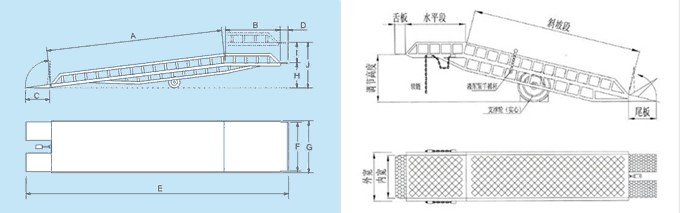
| Model | Load(t) | platform Dimensions(mm) | working height(mm) | Weight | ||||||||
|---|---|---|---|---|---|---|---|---|---|---|---|---|
| A | B | C | D | E | F | G | H | I | J | |||
| DCQY6-0.8 | 6 | 7000 | 2200 | 1000 | 400 | 10500 | 1900 | 2000 | 900 | 900 | 1800 | 2.1T |
| DCQY8-0.8 | 8 | 7000 | 2200 | 1000 | 400 | 10500 | 1900 | 2000 | 900 | 900 | 1800 | 2.3T |
| DCQY10-0.8 | 10 | 7000 | 2200 | 1000 | 400 | 10500 | 1900 | 2000 | 900 | 900 | 1800 | 2.5T |
| DCQY12-0.8 | 12 | 7500 | 2400 | 1500 | 400 | 11200 | 2000 | 2100 | 1000 | 800 | 1800 | 2.8T |
Working Principle
The mobile dock ramp operates on a manual hydraulic pump system: pumping the handle drives the pump plunger in a reciprocating motion, forcing hydraulic oil into the lift cylinder. The cylinder piston extends and raises the deck. To lower the ramp, the release valve is opened, allowing hydraulic oil to flow back into the oil tank under the deck's dead weight, and the deck descends gradually. The front of the deck is fitted with a hinged lip plate connected to the truck tail by chains. Once the height is adjusted, the lip plate rests flush against the truck bed, creating a smooth transition slope.
The unit has no electric drive or hydraulic motor — it is a purely manual hydraulic system that offers high reliability and low-maintenance cost. The deck is fabricated from welded diamond-pattern anti-slip steel plate, and the underside is fitted with swivel travel wheels and a tow bar, allowing the ramp to be easily repositioned on flat ground. Once in position, the brake pads are lowered to lock the ramp in place, and the handle is pumped to reach the required height before putting it into operation.
Product Structure
- Deck Assembly — Welded deck of diamond-pattern anti-slip steel plate with high-strength steel main girders; the load-bearing surface receives anti-skid treatment.
- Lip Plate (Hinged Ramp) — Pivoting front plate connected to the truck by chains; self-aligns to the truck bed.
- Hydraulic System — Manual hydraulic pump, lift cylinder, release valve, and hydraulic oil lines; fully manual operation with no electrical dependency.
- Travel Mechanism — Two swivel travel wheels plus a tow bar on the underside for easy repositioning to any work station.
- Brake Pads — Anti-slip brake pads on the underside; lowered after positioning to lock the ramp and prevent shifting.
Selection Guide
The DCQY series offers four standard models from 6 to 12 tons. Selection is primarily based on the maximum load weight handled on a daily basis and the forklift model used in conjunction. The DCQY6-0.8/8-0.8 (6–8 t) suits electric forklifts and 2–3 t internal combustion forklifts, with a dead weight of 2.1–2.3 t. The DCQY10-0.8 (10 t) is designed for 3–5 t internal combustion forklifts, with a dead weight of 2.5 t. The DCQY12-0.8 (12 t) accommodates 5–8 t heavy-duty forklifts, with a dead weight of 2.8 t. Platform dimensions and height adjustment range are identical across all models (A = 10,500–11,200 mm, H = 900–1,000 mm), providing coverage for the vast majority of standard trucks.
Operating Instructions
Positioning: Move the dock ramp to the front of the unloading area, aligning the front edge of the deck with the truck's rear door. Lower the brake pads to ensure the ramp does not slide.
Connecting: Hook the chains onto the fixing points on both sides of the truck tail and tighten them so the lip plate rests flush against the truck bed.
Height Adjustment: Pump the manual hydraulic pump handle to raise the deck until the lip plate is level with the truck bed and under slight compression.
Loading/Unloading: Once the chains are taut, the brake pads are on the ground, and the deck is stable, the forklift can drive across the ramp into the truck for loading or unloading.
Removal: Open the release valve to lower the deck to its lowest position, release the chains, retract the brake pads, and move the ramp to the next work station or storage location.
Precautions
(1) Before use, check the hydraulic oil level, inspect the chains for any signs of fracture, and verify the brake pads are in good condition.
(2) After the lip plate contacts the truck bed, confirm the chains are securely hooked and taut. Never load or unload while the chains are unhooked.
(3) Do not exceed the rated load (max 110% of rated load). The forklift must travel at low speed across the ramp and avoid sharp turns.
(4) Bleed air from the hydraulic system periodically and replace the hydraulic oil every 500 hours or every six months. Apply grease to all pivot points monthly.
(5) When not in use for extended periods, lower the deck to its lowest position, store the ramp indoors in a dry area, and cover the hydraulic pump with a tarpaulin.
Manufacturer Services
Henan Kelude Heavy Industry Co., Ltd. specializes in the manufacturing of the DCQY series mobile dock ramps, offering standard models and non-standard customization across the full 6–12 t range, with a production lead time of 7–15 days. Before delivery, every unit undergoes no-load commissioning, rated load testing, and a 125% dynamic load safety test. We provide a one-year free warranty, lifetime spare parts supply, and ongoing technical support. For quotations and technical solutions on specific models, please contact our customer service team.
FAQ
Q: Which is better, a mobile dock ramp or a fixed dock ramp?
A: The two types serve different applications. Fixed dock levelers are ideal for loading bays with a set position and high loading/unloading frequency. They are installed flush with the dock floor, allowing forklifts to transition smoothly. Mobile dock levelers, on the other hand, are suited for rotating between multiple loading docks or for temporary unloading points, requiring no civil works and offering easy portability. If your warehouse has several loading docks but each handles a relatively low volume, a single DCQY unit can replace multiple fixed units. DCQ fixed dock levelers and DCQY mobile units can also be combined to create a complete solution.
Q: Does a mobile dock leveler require electric power?
A: No. The DCQY series uses a manual hydraulic pump, so the entire lifting adjustment is performed through manual operation, with no need for an external power supply or charging. This makes it fully functional in outdoor job sites, temporary yards, and other locations without access to electricity. The manual hydraulic mechanism is simple and dependable, with a far lower failure rate than electric hydraulic systems and minimal maintenance cost.
Q: How much do the 6-ton and 12-ton models differ in size?
A: The DCQY6-0.8 and DCQY12-0.8 have similar platform lengths (7000mm vs. 7500mm) and comparable widths (2200mm vs. 2400mm), but the total machine weight increases from 2.1t to 2.8t. The main structural differences lie in the main girder cross-section and the thickness of the deck steel plate, which are reinforced to meet the structural strength requirements of a higher load capacity.
Q: Can a mobile dock leveler be used in rain or snow?
A: Yes. The deck is made of diamond-pattern anti-slip steel plate, which provides excellent drainage and maintains safe traction for forklifts even in wet weather. However, in rain or snow, operators should slow down the forklift and verify that the safety chains and brake pads are in good working condition. If snow has accumulated, clear the deck surface before putting the unit into operation.
Q: Does the manual hydraulic pump require periodic maintenance?
A: Yes. Replace the hydraulic oil every 500 hours or every six months, and clean or replace the return filter element. Perform a monthly inspection of the lubrication condition at all pivot points and the piston rod connections of the hydraulic cylinder, and apply grease as needed. Check the safety chains quarterly for any signs of wire break or wear. Also, keep the deck's anti-slip grid plate clear of debris to ensure proper drainage.
