
FEM 9.841 Coating & Anti-Corrosion Standard Explained
FEM 9.841 – Coating and Corrosion Protection Specification is a key technical standard in the crane industry. This standard is a dedicated technical specification governing the anti-corrosion coating of cranes. It defines the coating system, corrosion protection level, surface preparation, coating thickness, and recoating intervals for crane steel structures.
The standard provides a unified technical basis for design personnel, inspection bodies, and end users. Kelude Heavy Industry strictly follows the technical requirements of this standard throughout its product development and manufacturing processes.
Scope and Application of the Standard
FEM 9.841 – Coating and Corrosion Protection Specification primarily defines the technical requirements and safety indicators for crane coating and corrosion protection. It applies to all types of lifting appliances with a rated lifting capacity of 0.5 t and above.

Core Technical Parameter Framework
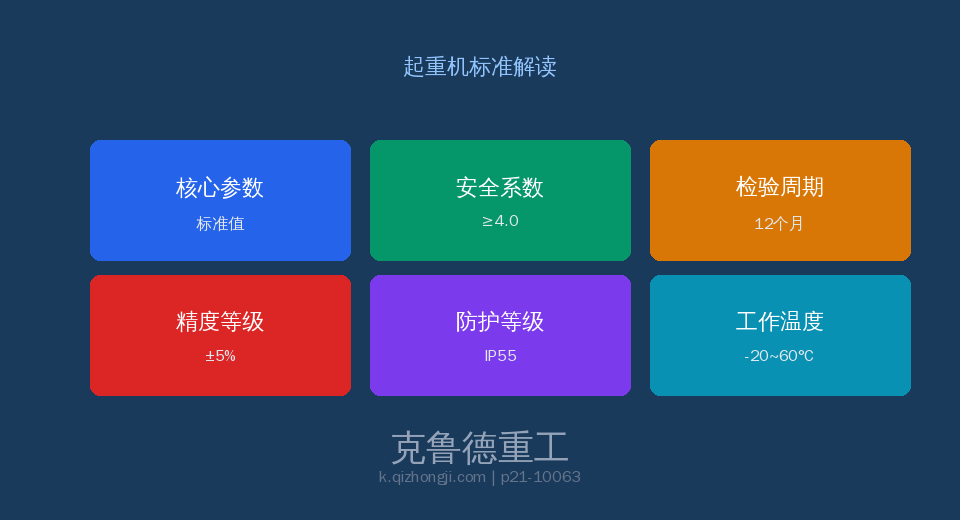
Under the technical provisions of FEM 9.841, the design and manufacturing of coating and corrosion protection systems must meet a rigorous set of technical parameters. These parameters are established based on extensive test data and safety engineering theory, covering the entire process from material selection to structural design. The safety factor ranges specified in the standard fully account for the fatigue life and limit load conditions of cranes operating in severe operating conditions. In engineering practice, design personnel must translate the standard's requirements into concrete design parameters to ensure that the load capacity of every component meets the required safety requirements. The parameter cards below summarize the core technical indicators of the standard:
Comparative Analysis of Key Technical Parameters
| Item | technical requirements | Description |
|---|---|---|
| corrosion protection level | C3(City)/C4(Industrial)/C5(Marine) | Selection by Service Environment |
| Surface Treatment | Sa2.5Sandblasting(Level) | Removal Corrosion+Oil and Grease, Rz≥75μm |
| coating system | Primer+Intermediate+Three-Coat Topcoat | Distinct Dry Film Separation per Coat |
| Total Film Thickness | Indoor240μm/Outdoor320μm | Corrosive Environment580μm |
| Zinc Coating | Thermal Sprayed Zinc≥85μm/Zinc-Rich Paint≥50μm | Anti-corrosion Base Layer |
| Repaint Cycle | C3:8Years/C4:5Years/C5:3Years | Periodic Inspection Coating Damage |
Inspection Requirements and Intervals
FEM 9.841 sets out clear requirements for Factory Acceptance Tests, Type Tests, and periodic inspections under its coating and anti-corrosion specification. Factory Acceptance Tests must be carried out on each individual unit by the manufacturer's quality control department at the plant, and units that pass are accompanied by a detailed inspection report and a certificate of conformity. Type Tests are required when a new product enters production, when manufacturing is transferred to a different facility, or when significant structural changes are introduced. For cranes already in service, the periodic inspection interval is determined by the work duty and operating environment, and generally does not exceed 12 months. For heavy-duty cranes in Continuous operation classified at A7 to A8 level, the inspection interval should be shortened to 6 months.
| Item | technical requirements | Description |
|---|---|---|
| Coating Thickness | Magnetic Thickness Gauge Measurement | Annual+Acceptance Rate≥85% |
| Adhesion | Cross-Cut Test Testing | Per5Years+Comprehensive Assessment |
| Corrosion Area | Visual Estimation% | Annual+>5%Repair |
| Zinc Film Thickness | Zinc Thickness Gauge | Annual+≥85μm |
Safe Operation and Management Requirements
Safe operation and routine management play a critical role in the implementation of FEM 9.841. The standard places strong emphasis on operator qualification and training, requiring that all operators complete specialized training and obtain the necessary certifications before being allowed to work. User units are expected to establish a robust equipment file management system that documents the full lifecycle of the equipment, including installation, usage, maintenance, and inspection. Any safety hazards identified must be addressed through the rectification procedure specified in the standard to ensure the equipment remains safe and controllable at all times. Additionally, the standard imposes operational restrictions under extreme operating conditions—for instance, lifting operations are prohibited when wind speeds exceed the prescribed limits.
FEM 9.841 FAQ: Corrosion Protection, Surface Prep & Coating
Q: How does FEM 9.841 classify corrosion protection levels?
A: C3 for urban environments, C4 for industrial environments, and C5 for marine/highly corrosive environments. Indoor cranes generally require C3, outdoor cranes C4, and marine or chemical applications C5.
Q: What are the surface preparation requirements?
A: Minimum Sa2.5 grade (near-white metal). Sandblasting is required to remove corrosion and oil contamination, achieving a surface roughness of Rz ≥ 75 μm.
Q: What coating system and film thickness are specified?
A: A three-layer system consisting of primer, intermediate, and top coat. Minimum total film thickness is 240 μm for indoor applications, 320 μm for outdoor applications, and 580 μm for highly corrosive environments.
Q: What are the coating inspection intervals and recoating schedules?
A: Annual inspections must confirm coating damage does not exceed 5%. Adhesion testing is required every 5 years. Recoating intervals are 8 years for C3, 5 years for C4, and 3 years for C5 environments.
Kelude Heavy Industry — Specialized in crane design and manufacturing, with products fully compliant with the FEM 9.841 standard system.