
ISO 24444:2020 Crane Maintenance Training Requirements Explained
ISO 24444:2020 — "Cranes — Training Requirements for Maintenance Personnel" — is the international standard governing the training of crane maintenance staff. It defines the training framework, curriculum, assessment, certification, and continuing education requirements for maintenance and inspection personnel working across all crane types.
Training Structure & Certification Levels
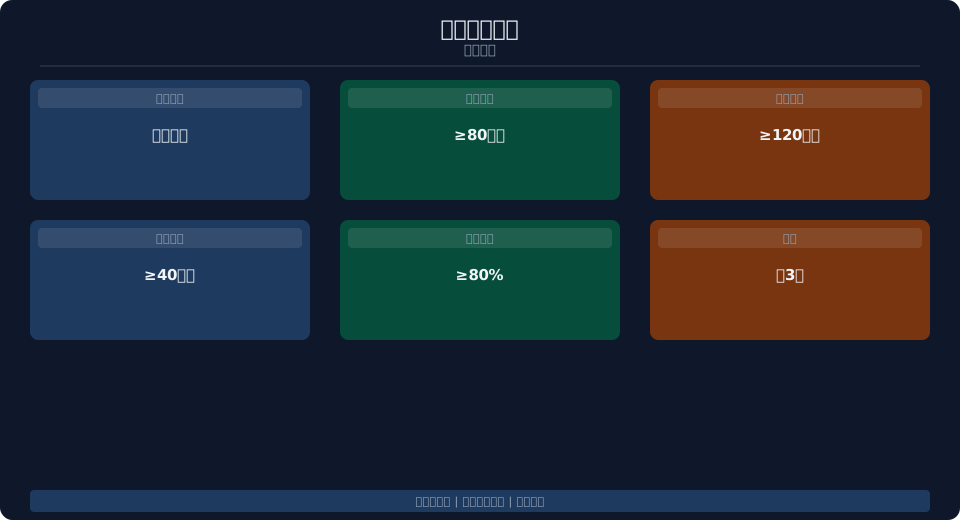
The maintenance training program is organized into three progressive levels. Basic Maintenance Training targets equipment operators and entry-level maintenance workers, covering daily inspection, lubrication maintenance, fastener inspection, and basic fault handling — a minimum of 80 training hours with a 50/50 split between theory and hands-on practice. Specialized Maintenance Training is designed for full-time maintenance staff and repair technicians, covering mechanical and electrical repair, hydraulic maintenance, and safety device calibration — a minimum of 120 hours, of which at least 60 hours are hands-on. Advanced Maintenance Training is intended for senior technicians and maintenance engineers, focusing on fault diagnosis and troubleshooting, system commissioning, condition monitoring and data analysis, and the development of specialized repair plans — a minimum of 160 hours. Safety training is integrated across all levels, with at least 40 hours covering LOTO (lockout/tagout), working at height, and the safe handling of hazardous chemicals.
Assessment & Certification Requirements
Each training level concludes with both a written and a practical examination. The written exam is closed-book, lasts at least 90 minutes, and includes multiple-choice, true/false, and short-answer questions — a passing score of 80% or higher is required. The practical assessment is conducted on actual equipment or simulators, with scoring broken down as follows: daily inspection and operating regulations (30%), fault finding and troubleshooting (40%), and the use of maintenance tools (30%) — again requiring a minimum score of 80%. Graduates of the Basic Maintenance Training must demonstrate proficiency in standard daily inspection procedures, including wire rope lubrication, brake stroke inspection, and grease application points. Graduates of the Specialized Maintenance Training must be able to independently perform drive system overhauls, reducer gear wear inspections, coupling shaft alignment, brake friction lining replacement, and fault diagnosis on electrical control cabinets. Graduates of the Advanced Maintenance Training must possess system commissioning capabilities, including load moment limiter (LML) calibration, parameter configuration, VFD parameter optimization, and condition monitoring system data analysis.
| Level | Training Hours | Content | Assessment |
|---|---|---|---|
| Fundamentals | ≥80 | Inspection/Lubrication/Tightening | Theory≥80Practical Operation≥80 |
| Specialized | ≥120(Practical Operation≥60) | Machinery/Electrical/Hydraulic | Theory≥80Practical Operation≥85 |
| Advanced | ≥160 | Fault Diagnosis/Commissioning/Monitoring | Theory≥85Practical Operation≥85 |
| Safety | ≥40 | LOTO/Aerial Work/Hazardous Materials | Standalone≥80 |
Certificate Management & Refresher Training
Certificates are valid for 3 years. Before expiry, personnel must complete at least 40 hours of refresher training and pass the assessment. Those who fail the assessment three times must retake the full training program for their respective level. Maintenance personnel records include training history, assessment scores, certificate copies, and maintenance work experience logs. Kelude offers maintenance personnel training services in accordance with ISO 24444, featuring a three-tier system—basic, specialized, and advanced—equipped with standard training facilities and certified instructors.
| Item | Requirement |
|---|---|
| certificate validity | 3Year |
| refresher Training Hours | ≥40Training Hours |
| refresher training Assessment | Theory+Practical Operation≥80% |
| record retention | Training Record+Performance Result+Certificate |
FAQ: Maintenance Training & Safety Programs
Q: What does the three-tier maintenance training system cover?
A: The foundation tier requires a minimum of 80 hours covering daily inspection and lubrication. The specialist tier requires at least 120 hours focused on mechanical, electrical, and hydraulic systems. The advanced tier demands 160+ hours in fault diagnosis and system commissioning. Safety training (40+ hours) is integrated across all levels.
Q: What are the assessment requirements for each level?
A: The written exam is closed-book, lasting at least 90 minutes with a passing score of 80%. The practical assessment is scored item-by-item: inspection 30% + fault diagnosis 40% + tool usage 30%, requiring a minimum of 80% to pass. Certificates remain valid for 3 years, after which refresher training of at least 40 hours is required.
Q: What does the safety training cover?
A: The program covers LOTO (Lockout/Tagout) procedures, proper use of safety belts for work at height, and the safe handling and emergency response for hazardous chemicals such as cleaning agents and lubricants. Safety training is assessed separately with a passing score of 80%.
Q: What training services does Kelude Heavy Industry offer?
A: Kelude Heavy Industry provides maintenance personnel training services in accordance with ISO 24444:2020. The program follows the three-tier structure—foundation, specialist, and advanced—and is delivered using standard training equipment by certified instructors.