

Overhead Crane Safety Standards & Inspection: GB/T 28264
Overhead Crane Safety Standards and Periodic Inspection: Key Points of GB/T 28264 and TSG Q7015
Overhead cranes are essential equipment in industrial production, and their safe operation directly affects both personnel safety and production efficiency. To ensure that cranes remain in good working condition, China has established a comprehensive set of safety standards and periodic inspection regulations. This article provides a detailed interpretation of the GB/T 28264 safety monitoring and management system standard and the TSG Q7015 periodic inspection rules, covering inspection cycles, inspection content, common non-conformities, and corrective actions.
GB/T 28264: Safety Monitoring and Management System for Cranes
GB/T 28264 specifies the general technical requirements for safety monitoring and management systems used on cranes. The standard applies to the design, installation, and commissioning of monitoring systems on various types of cranes, including overhead cranes, gantry cranes, and jib cranes. The system is designed to monitor key operational parameters in real time, such as load weight, hook position, and travel limits, and to provide audible and visual alarms when preset thresholds are exceeded.
Under this standard, the safety monitoring system must record and store operational data, enabling traceability and supporting accident analysis. The system should also integrate with the crane's control circuit to automatically stop operations in hazardous conditions. For cranes already in service, retrofitting with a compliant monitoring system is required when the crane undergoes major modification or reaches the end of its designed service life.
TSG Q7015: Periodic Inspection Rules for Cranes
TSG Q7015 is a regulatory document that governs the periodic inspection of cranes in China. It defines the inspection categories, cycles, and procedures that must be followed to verify the continued safe operation of a crane. The regulation applies to all cranes covered by the Special Equipment Safety Law, including overhead traveling cranes, gantry cranes, and other lifting appliances.
Periodic inspections are divided into two main types: regular inspections and full inspections. Regular inspections are typically conducted once every two years, while full inspections are required once every four years. However, cranes used under severe conditions—such as those handling molten metal, corrosive materials, or operating in dusty or hazardous environments—are subject to more frequent inspections, typically once a year for regular checks and once every two years for full checks.
Inspection Items and Key Checkpoints
The periodic inspection covers a wide range of items, including but not limited to:
- Structural integrity: checking for cracks, deformation, and corrosion on the main girders, end carriages, and other load-bearing components.
- Welds and connections: visual and non-destructive testing of critical welds and bolted connections.
- Hoisting mechanism: inspection of the wire rope, drum, sheaves, and hook for wear, deformation, or cracks.
- Braking system: verification of brake performance, lining wear, and adjustment of the braking torque.
- Electrical system: checking of insulation resistance, grounding, and the functionality of limit switches and safety devices.
- Safety devices: testing of overload limiters, anti-collision devices, buffers, and wind speed indicators (where applicable).
- Control system: verification of the functionality of the safety monitoring and management system required by GB/T 28264.
Each inspection item is evaluated against the acceptance criteria defined in the relevant standards. Any non-conformity found during the inspection must be documented, and the crane cannot be returned to service until the issues are rectified and a follow-up inspection confirms compliance.
Common Non-Conformities and Corrective Actions
During periodic inspections, several non-conformities are frequently encountered. The table below summarizes the most common issues and the corresponding corrective actions.
| Non-Conformity | Corrective Action |
|---|---|
| Cracks or deformation in the main girder | Repair by qualified personnel using approved welding procedures, followed by non-destructive testing to verify the integrity of the repair. |
| Wire rope wear exceeding the allowable limit | Replace the wire rope with a new one that meets the original specification and re-test the hoisting mechanism. |
| Brake lining worn beyond the recommended thickness | Replace the brake lining and re-adjust the braking torque to the specified value. |
| Overload limiter not functioning correctly | Calibrate or replace the overload limiter and verify its operation with a test load. |
| Electrical insulation resistance below the minimum requirement | Identify and rectify the cause of low insulation (e.g., moisture, damaged cables) and re-test the insulation resistance. |
| Safety monitoring system not recording data | Troubleshoot the monitoring system, repair or replace faulty components, and confirm that data recording is restored. |
Inspection Cycle and Compliance Requirements
Adhering to the prescribed inspection cycle is a legal obligation for crane owners and users. Failure to conduct periodic inspections on time, or operating a crane with known non-conformities, can result in penalties and, more importantly, poses a serious safety risk. It is recommended that crane users establish an internal maintenance and inspection schedule that aligns with the regulatory requirements, and that they maintain detailed records of all inspections and repairs.
In addition to the statutory periodic inspections, daily and weekly checks by the crane operator and maintenance team are essential for early detection of potential issues. These routine checks should include visual inspections of the wire rope, hook, brakes, and limit switches, as well as functional tests of the safety devices.
Frequently Asked Questions
Q: How often must an overhead crane undergo periodic inspection?
A: Under TSG Q7015, a regular inspection is required every two years, and a full inspection every four years. Cranes operating in severe or hazardous conditions are subject to more frequent inspections—annually for regular checks and every two years for full checks.
Q: What is the difference between a regular inspection and a full inspection?
A: A regular inspection focuses on the key safety components and operational functionality of the crane. A full inspection is more comprehensive, covering all aspects of the crane's structure, mechanisms, electrical systems, and safety devices, and is typically required at longer intervals.
Q: Can a crane be used if a non-conformity is found during inspection?
A: No. If any non-conformity is identified, the crane must be taken out of service until the issue is corrected and a re-inspection confirms that the crane meets all safety requirements.
Q: Is the GB/T 28264 safety monitoring system mandatory for all cranes?
A: The requirement applies to cranes specified in the standard, which includes most overhead and gantry cranes used in industrial settings. For cranes already in service, retrofitting is required under certain conditions, such as major modification or extension of service life.
Q: Who is qualified to perform periodic crane inspections?
A: Periodic inspections must be carried out by inspection agencies approved by the relevant government authority. These agencies employ certified inspectors who have the necessary training and expertise to assess crane safety.
Conclusion
A: Understanding and complying with GB/T 28264 and TSG Q7015 is essential for any facility that operates overhead cranes. These standards and regulations are designed to prevent accidents and ensure that cranes are maintained to a high safety level throughout their service life. By following the prescribed inspection cycles, addressing non-conformities promptly, and maintaining thorough records, crane owners can ensure both regulatory compliance and the safety of their personnel and equipment.
For more information on crane safety standards or to schedule a periodic inspection, contact Kelude Heavy Industry. Our team of experts is ready to assist you with all your crane safety and maintenance needs.
Overhead cranes are classified as special equipment and are subject to strict mandatory safety standards and periodic inspection regulations in many jurisdictions. Facilities that fail to stay current with these requirements often face non-compliance notices and fines from regulatory bodies. This article outlines the key standards governing overhead crane safety and inspection.
GB/T 28264-2012 Safety Monitoring and Management System for Lifting Appliances: Published in 2012, this standard mandates that bridge cranes with a rated lifting capacity above 20 tons must be equipped with a Safety Monitoring and Management System. The system must include load limiters, travel limit switches, and anti-sway/anti-skid monitoring functions, while recording operational data from the most recent 10,000 duty cycles.
TSG Q7015-2016 Rules for Periodic Inspection of Lifting Appliances: In-service overhead cranes must undergo an annual inspection. The inspection covers technical documentation review, metal structure examination, inspection of major components, testing of safety protection devices, and electrical system checks. Cranes that have been out of service for more than one year must also be inspected before being placed back into operation.
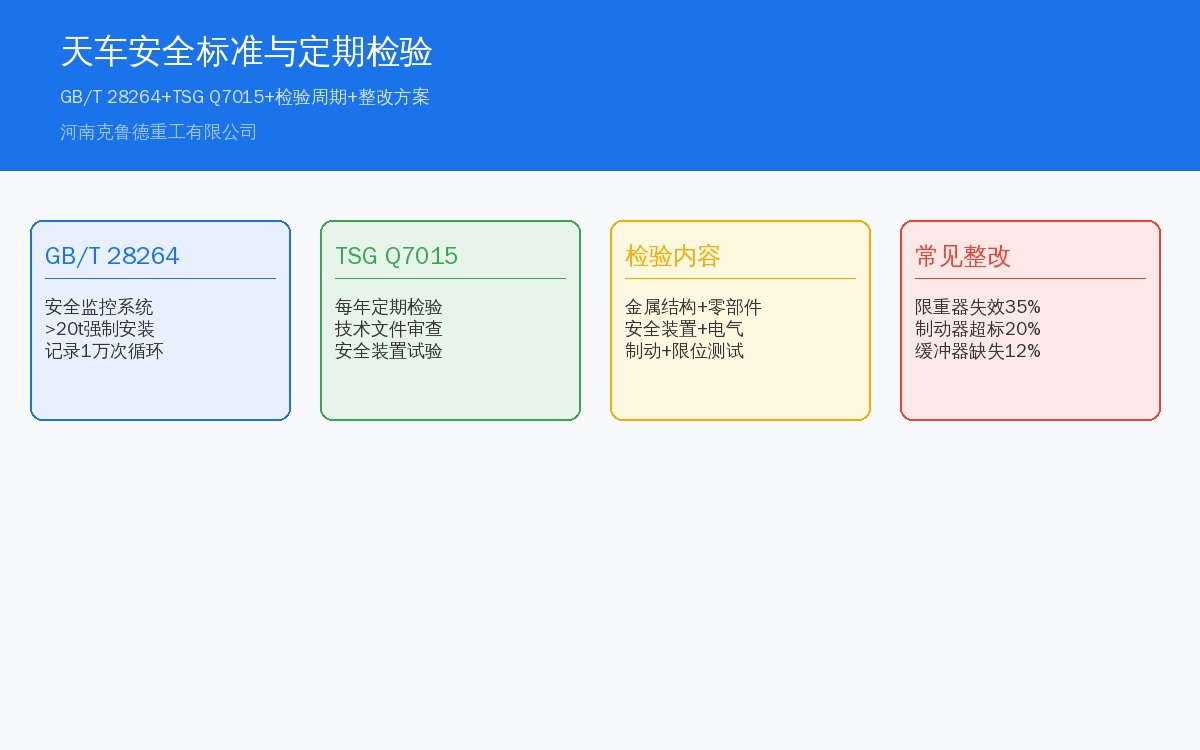
Common non-conformities: 1) Load limiter failure or excessive calibration error (accounting for 35% of rectification orders); 2) brake clearance out of tolerance or severe wear (20%); 3) damaged or missing buffers/end stops (12%); 4) poor electrical protection grounding (10%). Most of these issues can be identified during routine inspections — if they only surface at the annual inspection, it indicates that routine inspection procedures are not being followed properly.
Core Safety Standards for Overhead Cranes
Overhead cranes are a primary focus of special equipment safety supervision, with more than 20 applicable standards and regulations. The four most critical are: GB/T 3811-2023 Crane Design Standard — the fundamental design standard for cranes, specifying calculation methods and safety factors for structural strength, stiffness, and stability of steel structures. GB/T 14405-2011 General Purpose Bridge Cranes — the product standard for general purpose bridge cranes, defining technical requirements for manufacturing and acceptance. GB/T 28264-2012 Safety Monitoring and Management System for Lifting Appliances — mandates that bridge cranes with a rated lifting capacity above 20 tons be equipped with a safety monitoring system that records operational data from the most recent 10,000 duty cycles. TSG Q7015-2016 Rules for Periodic Inspection of Lifting Appliances — specifies the periodic inspection interval, inspection items, and acceptance criteria for in-service cranes.
Annual Inspection Process and Common Non-Conformities
Annual crane inspections are carried out by the local special equipment inspection body. The process involves: submitting documentation (Factory Certificate of Conformity + previous inspection report + self-inspection records) → documentation review → on-site inspection → report issuance. The on-site inspection includes technical documentation review, metal structure examination (main girder deflection measurement, weld seam flaw detection sampling), major component inspection (hook, wire rope, pulleys, brakes), safety protection device testing (load limiter, travel limit switch, height limit switch), and electrical system checks (grounding resistance measurement, insulation resistance measurement, overcurrent protection verification). The entire process typically takes half a day to a full day. Load limiter failure ranks as the most common non-conformity, usually caused by loose sensors or oxidized wiring connections — a simple spot check using calibrated test weights during weekly inspections can catch these issues early.
FAQ
Q: What are the most common reasons for failing an annual crane inspection?
A: Load limiter failure or excessive calibration error accounts for 35% of failures, brake clearance out of tolerance or wear accounts for 20%, damaged or missing buffers/end stops account for 12%, and poor electrical protection grounding accounts for 10%.
Q: What inspections are required before recommissioning a crane that has been out of service for over a year?
A: Per TSG Q7015, cranes out of service for more than one year must undergo a comprehensive inspection before recommissioning, covering metal structure examination, major component inspection, safety protection device testing, and electrical system checks.
A:
