
EN 13001-3-3:2014 Wheel and Rail Tolerance Standard Interpretation
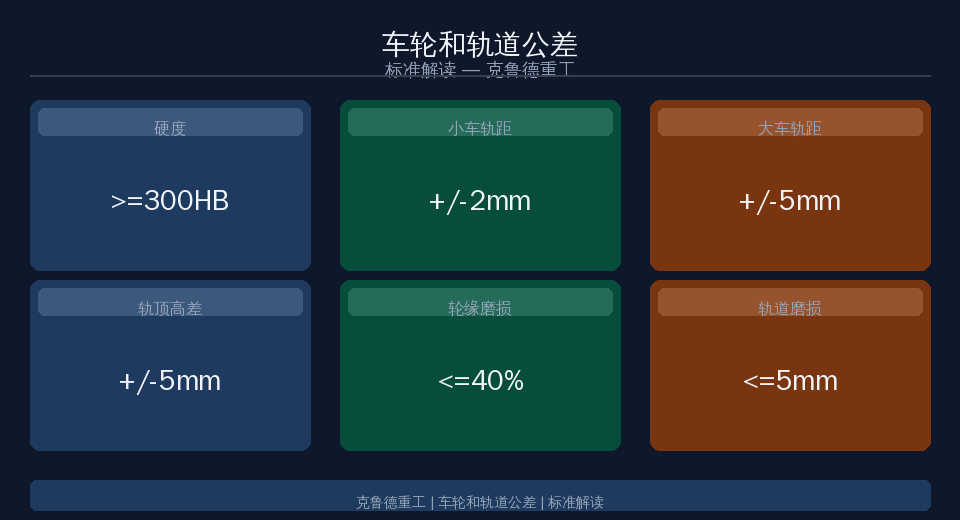
EN 13001-3-3:2014, "Cranes — Wheels and Rail Tolerances," is the European standard within the EN 13001 series dedicated to specifying tolerances for crane wheels and rails. It defines precision requirements including wheel tread and flange hardness (>=300HB), trolley track gauge tolerance (+/-2mm), crane bridge track gauge tolerance (+/-5mm), rail top elevation difference (+/-5mm, with 40% of original thickness), and rail wear threshold (>5mm requires reconditioning). These parameters ensure smooth crane travel on the rails and prevent rail gnawing.

Technical Requirements for Crane Wheels and Rails
The machining and installation accuracy of crane wheels and rails directly determines the smoothness of crane operation and the service life of the wheel track. A wheel hardness of >=300HB ensures adequate wear resistance. The trolley track gauge tolerance is +/-2mm, while the crane bridge track gauge tolerance is +/-5mm. The rail top elevation must be within +/-5mm, with a maximum difference of <=3mm between adjacent points. All four wheels must maintain simultaneous contact with the rail surface. Rail straightness must not exceed 3mm over a 10m length. The positional deviation between corresponding points is limited to <=2mm, and the four-wheel plane tolerance is <=3mm. Kelude strictly controls wheel and rail tolerances in accordance with EN standards to ensure smooth operation of cranes exported to Europe.
Parameters and Inspection
At rail joints, the vertical misalignment must not exceed 0.5mm, and the gap should be maintained between 1~2mm to accommodate thermal expansion. Wheel flanges must be replaced when wear exceeds 40% of the original thickness, and rail tops require reconditioning when wear exceeds 5mm. Kelude strictly controls these tolerance indicators to guarantee reliable, smooth crane operation.
| Parameter | Requirement |
|---|---|
| Hardness | >=300HB |
| Trolley Track Gauge / Rail Gauge | +/-2mm |
| crane span | +/-5mm |
| Rail Top | +/-5mm Adjacent<=3mm |
| Same-Level Difference | <=2mm |
| Four-Wheel Plane | <=3mm |
| Inspection | Content |
|---|---|
| factory | Dimension+Hardness+Appearance |
| after installation | Track Gauge / Rail Gauge+Elevation+Straightness |
| Monthly Inspection | Wheel flange+rail wear |
Rail straightness within 10 m (deviation ≤ 3 mm) is the key to smooth crane travel. A positional difference ≤ 2 mm among the four crane bridge wheels and a plane deviation ≤ 3 mm across the same four wheels ensure even load distribution. Rail joint height differences ≤ 0.5 mm with 1–2 mm joint gaps accommodate thermal expansion. Kelude Heavy Industry controls all tolerance indicators to EN 13001-3-3 for cranes exported to Europe, ensuring stable operation.
Rail straightness — a deviation ≤ 3 mm over any 10 m section — is the critical indicator for smooth, stable crane travel. Rail joint height differences ≤ 0.5 mm and joint gaps of 1–2 mm accommodate thermal expansion and prevent rail distortion. A positional difference ≤ 2 mm among the four crane bridge wheels and a plane deviation ≤ 3 mm across the same wheels ensure the crane runs smoothly along the full rail length without climbing or flange wear. Wheel flange hardness ≥ 300 HB, achieved through quenching or surface hardening, is the wear resistance indicator; insufficient hardness accelerates flange wear and shortens wheel service life. Kelude Heavy Industry strictly controls all tolerance indicators for crane wheels and rails to EN 13001-3-3 for cranes exported to Europe. Every unit undergoes track gauge, elevation, and straightness detection before leaving the factory to ensure full compliance with the standard.
FAQ: Crane Wheel & Rail Tolerances per EN 13001-3-3
Q: What are the wheel hardness and track gauge tolerance requirements under EN 13001-3-3:2014?
A: Wheel flange and tread surface hardness must be ≥ 300 HB, achieved through quenching or surface hardening to ensure wear resistance. Trolley track gauge tolerance is ±2 mm; crane bridge track gauge tolerance is ±5 mm. Rail top elevation difference is ±5 mm, and the height difference between two adjacent rails over a 10 m length must be ≤ 3 mm to ensure all four wheels maintain simultaneous contact with the rail surface.
Q: What are the wheel and rail wear discard criteria under EN 13001-3-3:2014?
A: When wheel flange wear exceeds 40% of the original thickness, the wheel must be replaced immediately to prevent flange fracture or derailment. When rail head wear exceeds 5 mm, the rail must be reconditioned or replaced to restore its cross-section profile. If rail straightness deviation exceeds 3 mm over any 10 m length, the rail position must be adjusted.
Q: What are the crane bridge wheel tolerance requirements under EN 13001-3-3:2014?
A: The positional difference among the four crane bridge wheels must be ≤ 2 mm to ensure the wheels on both sides maintain consistent fore-aft alignment and prevent skewing. The plane deviation across the four wheels must be ≤ 3 mm to ensure each wheel carries its share of the load without lifting off the rail. Rail joint height differences must be ≤ 0.5 mm with 1–2 mm joint gaps to accommodate thermal expansion and contraction.
Q: How does Kelude Heavy Industry control tolerances to EN 13001-3-3:2014?
A: Kelude Heavy Industry strictly controls wheel and rail tolerances to EN 13001-3-3 for cranes exported to Europe. Wheel hardness ≥ 300 HB, trolley track gauge ±2 mm, crane bridge track gauge ±5 mm, wheel positional difference ≤ 2 mm, and four-wheel plane deviation ≤ 3 mm. Every unit undergoes track gauge measurement and dimensional inspection before leaving the factory to ensure all tolerances meet the standard.