

Overhead Crane Lubrication Guide: Oil, Grease & Fault Fixes
Overhead Crane Lubrication Guide: Oil Selection & Greasing Intervals
Lubrication is the single most important maintenance task for an overhead crane. Proper lubrication reduces mechanical failure rates by up to 40%, extends equipment service life, and ensures safe operation. This guide covers lubricant selection for each crane mechanism, recommended greasing intervals and quantities, centralized lubrication system configuration, and common faults caused by inadequate lubrication—along with their remedies.
Why Proper Crane Lubrication Matters
An overhead crane operates under heavy loads, frequent starts and stops, and often in dusty or high-temperature environments. Without proper lubrication, metal-to-metal contact accelerates wear on gears, bearings, wire ropes, and wheels, leading to premature component failure and unplanned downtime. Regular lubrication also helps dissipate heat, prevents corrosion, and flushes out contaminants that would otherwise score bearing surfaces.
Lubricant Selection Standards for Each Mechanism
Different crane mechanisms have different operating conditions and therefore require different lubricants. The table below summarizes the recommended lubricant types for each major crane component.
| Mechanism | Recommended Lubricant | Key Considerations |
|---|---|---|
| Hoist gearbox | Industrial gear oil (EP type), ISO VG 220–460 depending on load and ambient temperature | Use EP (extreme pressure) gear oils for heavily loaded hoists; higher viscosity for tropical climates |
| Trolley & bridge travel gearboxes | Industrial gear oil, ISO VG 150–320 | Lower viscosity than hoist gearbox; follow manufacturer's data sheet |
| Wire rope | Wire rope lubricant (penetrating type) or rope dressing compound | Apply sparingly but regularly; avoid over-lubrication that attracts dust |
| Bearings (all types) | Lithium-based or polyurea-based grease, NLGI 2 or 3 | Match grease type to operating temperature range; do not mix incompatible greases |
| Open gears & racks | Open gear grease or asphaltic-based lubricant | High adhesion required; reapply at shorter intervals in dusty environments |
| Wheels & rail contact surfaces | Light machine oil or dry-film lubricant | Minimal lubrication only; excess oil on rails reduces traction |
| Hydraulic buffer / damper | Hydraulic oil per manufacturer spec (typically ISO VG 32–68) | Check oil level and condition periodically; top up with same grade |
Greasing Intervals and Quantities
Greasing intervals depend on duty classification, operating hours, and environmental conditions. The following table provides baseline recommendations for typical overhead crane applications. For cranes operating in severe conditions—high temperature, heavy dust, or continuous duty—shorten the intervals by 50%.
| Component | Interval | Quantity per Point |
|---|---|---|
| Hoist gearbox oil change | First change after 200 hours; then every 2,500–3,000 hours or 6 months | Fill to oil level plug; typically 5–15 L depending on gearbox size |
| Travel gearboxes (trolley & bridge) | Every 3,000 hours or 12 months | Fill to oil level plug; typically 2–8 L per gearbox |
| Wire rope | Weekly (light application); thorough re-dressing every 500 hours | Thin film over full rope length; approx. 0.1–0.2 L per 10 m of rope |
| Bearings — motor, gearbox, wheel | Every 500 hours or 3 months | 2–5 g per small bearing; 10–20 g per large bearing |
| Open gears & racks | Every 200 hours or 2 weeks | Brush or spray to cover tooth flanks; approx. 50–100 g per application |
| Wheel flanges & rail sides | Every 200 hours | Light oil film; 5–10 m L per wheel |
| Hydraulic buffer | Check level monthly; replace oil every 12 months | Top up as needed; full refill per manufacturer spec |
Always consult the crane manufacturer's manual for the definitive lubrication schedule for your specific model. The values above are general guidelines for typical industrial overhead cranes.
Centralized Lubrication Systems for Overhead Cranes
For cranes with many lubrication points—especially large double-girder cranes with long-travel distances—a centralized lubrication system can significantly reduce maintenance labor and ensure consistent lubrication. These systems deliver metered amounts of grease to multiple points from a single pump station, either manually operated or automatically timed.
Typical configurations include:
- Single-line parallel systems: A single pump feeds each lubrication point through individual feed lines. Simple and reliable, suitable for up to 20–30 points.
- Progressive (series) systems: A divider valve block distributes grease sequentially to each point. Ideal for larger systems with 30–100 points, providing positive displacement and easy monitoring.
- Dual-line systems: Two main lines alternate pressure to deliver grease to injectors at each point. Best for very large cranes with 100+ points or where piping runs are long.
When retrofitting a centralized system, consider the following:
- Grease type must be compatible with the pump and divider valves—avoid greases with large solid particles.
- Feed line lengths and diameters must be sized to deliver the required volume without excessive pressure drop.
- Install pressure gauges and cycle counters to monitor system operation and detect blockages early.
- For outdoor or cold-storage cranes, use a grease with a lower base oil viscosity to maintain pumpability at low temperatures.
Common Faults Caused by Poor Lubrication
Inadequate or incorrect lubrication is a leading cause of crane breakdowns. Recognizing the symptoms early can prevent costly repairs and downtime.
| Symptom | Likely Cause | Remedy |
|---|---|---|
| Excessive noise from gearbox (whining or grinding) | Low oil level, wrong viscosity, or contaminated oil | Check oil level and condition; drain and refill with correct grade if contaminated |
| Bearing overheating (housing too hot to touch) | Over-greasing, under-greasing, or wrong grease type | Purge old grease, relubricate with correct amount and type; check for seal damage |
| Wire rope wear, broken wires, or rust | Insufficient or infrequent lubrication; rope running dry | Clean rope and apply proper rope lubricant; inspect for damage and replace if worn beyond limits |
| Wheel flange wear or rail scoring | Lack of lubrication on wheel flanges; misalignment | Lubricate flanges regularly; check wheel and rail alignment |
| Erratic travel motion or jerky starts | Dry or contaminated gear teeth in travel gearbox | Inspect gearbox oil; replace if contaminated; check for gear tooth damage |
| Oil leaks from gearbox seals | Overfilled gearbox, wrong oil viscosity, or worn seals | Drain to correct level; replace seals if worn; use recommended oil grade |
Best Practices for Crane Lubrication Maintenance
Follow these practical guidelines to keep your overhead crane running reliably:
- Use a lubrication log: Record the date, lubricant type, quantity, and technician for every lubrication task. This helps track consumption and spot abnormal wear patterns.
- Clean fittings before greasing: Wipe off dirt and old grease from grease nipples before attaching the gun to prevent forcing contaminants into the bearing.
- Do not over-grease: Excess grease increases operating temperature and can damage seals. Add grease slowly until a small amount purges from the seal, then stop.
- Match lubricant to season: In regions with wide temperature swings, switch to a lower-viscosity oil in winter and a higher-viscosity oil in summer.
- Store lubricants properly: Keep drums and cartridges sealed and protected from dust and moisture. Never mix different grease types or brands.
- Train maintenance staff: Ensure technicians understand the lubrication schedule, correct lubricant selection, and proper application techniques.
Frequently Asked Questions
Q: How often should I grease the wire rope on my overhead crane?
A: For normal indoor duty, apply a light coat of wire rope lubricant weekly. A more thorough cleaning and re-dressing should be done every 500 operating hours or monthly, whichever comes first. In dusty or corrosive environments, increase frequency.
Q: Can I use the same grease for all bearings on the crane?
A: In most cases, a high-quality lithium or polyurea NLGI 2 grease works for all standard bearings. However, check the manufacturer's recommendations—bearings operating at high temperature or high speed may require a specialized grease.
Q: What happens if I use the wrong viscosity gear oil?
A: Oil that is too thin fails to maintain a protective film, causing accelerated gear wear. Oil that is too thick increases resistance, raises operating temperature, and can lead to inadequate lubrication at startup in cold conditions. Always use the viscosity grade specified by the gearbox manufacturer.
Q: How do I know if a centralized lubrication system is working properly?
A: Monitor the pressure gauge and cycle counter regularly. A steady pressure reading and consistent cycle times indicate normal operation. A pressure drop may signal a blocked line or empty reservoir; a pressure rise may indicate a blocked injector or divider valve.
Q: Is it necessary to warm up the crane before operation in cold weather?
A: Yes. In cold environments, allow the crane to run at low speed for 5–10 minutes before full-load operation. This circulates the lubricant and allows it to reach all components, reducing wear and preventing premature failure.
A: Around 40% of overhead crane mechanical faults are directly linked to poor lubrication—missed lubrication points, the wrong grease or oil grade, or over-greasing that burns out bearings. We see these issues constantly during maintenance and service work.
Lubricant selection by mechanism: Use L-CKD320 heavy-duty industrial gear oil for the hoisting mechanism gearbox; L-CKC220 medium-duty gear oil for the crane bridge and trolley travel gearboxes; dedicated wire rope lubricant (e.g., Great Wall Dewei) for wire ropes; and lithium grease No. 2 or No. 3 for bearings, depending on rotational speed and operating temperature.
Relubrication intervals: Change gearbox oil after the first 500 hours of operation, then every 2,000–3,000 hours or every 6 months. Recoat wire ropes with grease every 15 days. Relubricate bearing housings every 500 hours. Adjust these intervals based on frequency of use and environmental conditions.
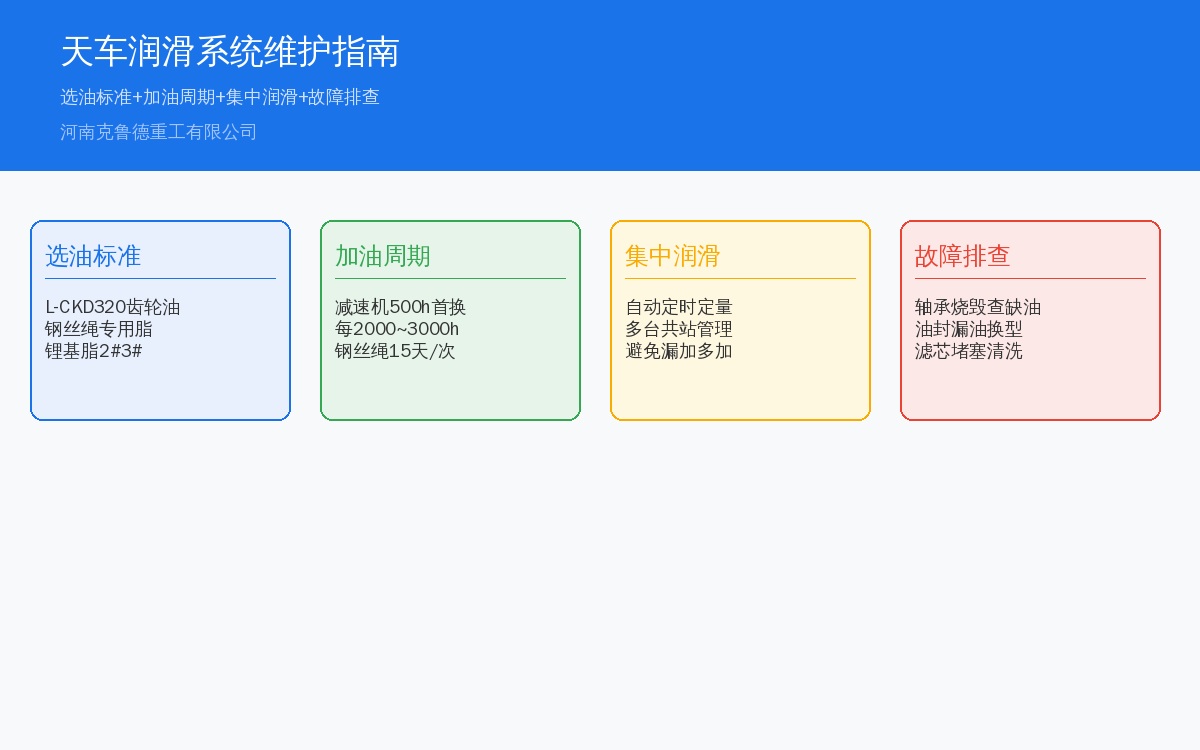
Centralized Lubrication System: For workshops managing multiple overhead cranes, a centralized lubrication system is recommended—one lubrication station supplies oil to several cranes through a pipeline network, delivering precise, automatically timed doses. The initial investment is approximately $30,000–$75,000 per station, but it eliminates both missed and over-lubrication problems.
Lubricant Selection for Each Mechanism
Different crane mechanisms have different lubrication requirements. The hoisting gearbox handles heavy loads and shock loading—use L-CKD320 heavy-duty industrial gear oil (ISO VG320). The bridge and trolley travel gearboxes see comparatively lighter loads, so L-CKC220 medium-duty industrial gear oil is sufficient. Wire ropes require a dedicated wire rope lubricant—standard grease will not work, as it lacks penetrating agents and only forms a surface film while the inner wire strands run dry. For bearings, use lithium grease No. 2 (general purpose) or No. 3 (high-temperature applications). Motor bearings require high-temperature grease with a dropping point of at least 180°C.
Typical Faults Caused by Poor Lubrication
Gear pitting in the gearbox—when oil viscosity is too low or the oil change interval is too long, contact stress exceeds the oil film's load capacity, causing pitting on gear tooth surfaces. Bearing cage fracture—insufficient lubrication raises bearing temperature, leading to fatigue fracture of the cage material (brass or steel). Accelerated wire breakage on wire ropes—inadequate lubrication increases friction between strands, rapidly increasing the number of broken wires. Statistics show that lubrication-related faults account for roughly 40% of all overhead crane mechanical failures, and the vast majority are preventable with proper, scheduled lubrication. Correct lubricant selection, disciplined relubrication intervals, and periodic oil condition monitoring—get these three right and lubrication-related faults drop by over 80%.
FAQ
Q: How often should each crane component be lubricated?
A: Crane wheel bearings—every 3 months; drum bearings—every 6 months; wire ropes—recoat with wire rope grease every 15 days; open gears—weekly. Check the gearbox oil level every 6 months and change the oil annually.
Q: Can different grease types be mixed?
A: Mixing is not recommended. Blending lithium grease with calcium grease alters consistency and degrades performance. When switching grease types, thoroughly flush the old grease from the system before applying the new one.
