

Kelude Crane Structural Optimization with AI
Inside Kelude Heavy Industry's R&D: From Crane Structural Optimization to In-House AI Algorithms. Every crane that ships out is backed by a full-stack engineering ecosystem that spans design, validation, and intelligent control.
Every crane that leaves the drawing board and goes into service is supported by a complete engineering ecosystem. Over the past fifteen years, Kelude Heavy Industry (Kelude Crane) has built a full technology chain that extends from classical structural mechanics optimization to proprietary AI algorithm development. This is not a single linear process, but an interdisciplinary R&D matrix spanning computational mechanics, electrical engineering, IoT communications, and artificial intelligence. This article examines Kelude's R&D capabilities from four perspectives—technology evolution, organizational structure, core equipment, and strategic roadmap—to show how this Chinese equipment manufacturer has moved from following industry trends to leading them in the age of intelligent manufacturing.
From Structural Optimization to Proprietary AI: Four Milestones
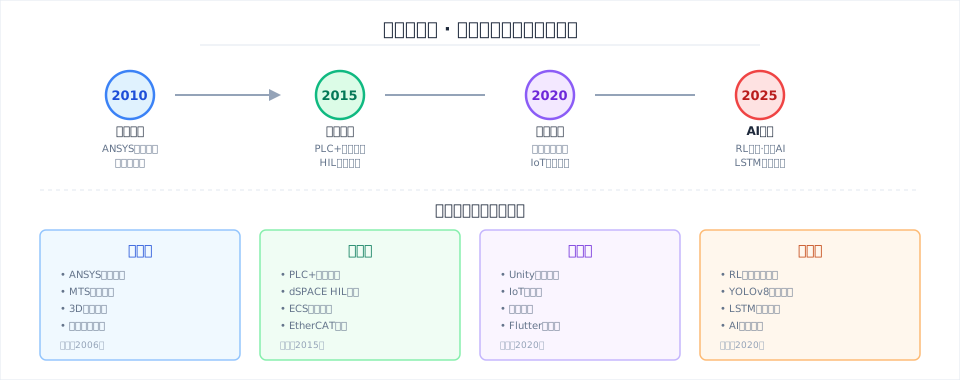
Kelude's technology evolution can be divided into four distinct phases, each marking a leap in core engineering capability and a deeper understanding of what makes a crane perform reliably over decades of service.
2010: Structural optimization foundation. This was the starting point of Kelude's R&D system. The company adopted the ANSYS Workbench platform and built its finite element analysis (FEA) capability. The R&D team applied variable-density topology optimization to the main girders of QD type overhead cranes, aiming to minimize dead weight while preserving load-bearing capacity. The focus in this phase was on computational accuracy—through a three-stage CAE workflow (topology optimization → shape optimization → size optimization), the team achieved a 12%–18% weight reduction on critical structural components while ensuring all designs passed the static test with 1.25 times rated load and the dynamic load factor check of 1.1 as required by the ISO 4301 Crane Design Standard. The introduction of an MTS fatigue testing machine closed the loop between simulation and physical validation. Between 2010 and 2014, the structural engineering department completed more than 200 structural optimization projects and built a comprehensive simulation database covering main girders, end carriages, trolley frames, and hook blocks.
2015: Electrical and automation upgrade. With structural simulation capabilities maturing, Kelude expanded into control systems. The company formed an electrical R&D team, deployed the EtherCAT industrial real-time Ethernet bus, and developed the first-generation Kelude-ECS Electrical Control System. The defining achievement of this phase was the establishment of a standard electrical architecture combining inverter drive, PLC logic, and touch screen HMI, along with the introduction of a dSPACE rapid control prototyping (RCP) platform that cut control algorithm validation time from months to weeks. During the same period, the company deployed FARO 3D laser scanners for reverse engineering of critical crane components and assembly deviation analysis. In 2017, the electrical engineering department completed the first fully in-house designed Electrical Control System installed and verified on a 50-ton bridge crane, marking Kelude's capability to independently develop electrical systems.
2020: Digital and intelligent transformation. From 2020 onward, Kelude shifted its technical focus toward digitalization and intelligence. The company built the Kelude-IoT monitoring platform, enabling real-time acquisition, remote transmission, and cloud storage of crane operational data. Using the growing volume of operational data, the R&D team began training data-driven predictive models—starting with threshold-based alarm logic, evolving to trend prediction based on statistical features, and finally advancing to a health index (HI) assessment system built on LSTM neural networks. In parallel, Kelude launched a Digital Twin project based on the Unity 3D engine, replicating the full dynamic behavior of cranes in a virtual environment to lay the groundwork for unmanned operation and intelligent scheduling. By the end of 2022, the IoT platform had connected more than 800 cranes in active service, with cumulative data exceeding 50 TB.
2025: Breakthrough in proprietary AI algorithms. By 2025, Kelude had developed a complete in-house AI algorithm capability. In anti-sway control, the team developed a deep reinforcement learning anti-sway controller based on the Proximal Policy Optimization (PPO) framework. After 5 million steps of adversarial training in the Digital Twin environment, the controller was deployed on physical cranes, achieving end-point sway angle control accuracy better than 0.3°. In visual recognition, a spreader positioning and obstacle detection model built on the YOLOv8 architecture maintains recognition accuracy above 95% even under low-light and rain-fog conditions. The predictive maintenance engine has expanded from single components to full-machine coverage, encompassing four core components: reducers, brakes, motors, and wire ropes. In the second half of 2025, the first batch of cranes with integrated AI features was delivered to customers, demonstrating significant efficiency gains and reduced failure rates in steel mill and Port Terminal applications. With this, Kelude completed its fourth technology leap—from structural, electrical, and digital capabilities to an AI-native approach.
Four-Pillar R&D Organization: Structural, Electrical, Software, and Algorithm Teams
Technology capabilities only deliver results when supported by the right organizational structure. Kelude's R&D system consists of four core units that form a complete development chain from the physical layer to the algorithm layer, with standardized interface protocols ensuring seamless collaboration across teams.
Structural Engineering Institute forms the foundation of the R&D system and is Kelude's longest-established R&D unit. The team focuses on the mechanical behavior of metal structures, with core capabilities spanning ANSYS FEA simulation, MTS fatigue testing, 3D scanning reverse engineering, and welding procedure simulation. The institute is responsible for the design and optimization of key load-bearing components such as main girders, end carriages, and trolley frames. Every design must pass a four-step closed-loop process: simulation → prototype → testing → design revision. The institute's MTS 322 electro-hydraulic servo fatigue testing machine applies dynamic loads up to 100 kN and covers all fatigue verification items required by the ISO 4301 Crane Design Standard. The institute currently employs 8 senior engineers and 12 mid-level engineers, all with more than ten years of crane structural design experience.
Electrical Engineering Institute handles control system hardware architecture design and electrical system integration, serving as the bridge between the physical and digital worlds. The team has built a standardized control hardware platform around the EtherCAT bus, covering all electrical layer components including inverter drives, PLC Controllers, Safety Relays, and sensor interfaces. The institute also operates a dSPACE SCALEXIO hardware-in-the-loop (HIL) test platform equipped with a high-fidelity full-machine dynamic model (including flexible girders, wire rope sway angles, and wheel-rail contact), enabling complete simulation of various real-world crane operating conditions in the laboratory. The HIL platform has compressed the integration verification cycle for control logic from the traditional 8 weeks to 2 weeks, executing more than 500 automated test cases per software iteration. The institute is also responsible for EMC electromagnetic compatibility testing and CE Certification of all controllers.
Software Engineering Institute focuses on application-layer software and data platforms, serving as the core driver of Kelude's digital transformation. The team independently developed the Kelude-IoT middleware, which supports unified access and data conversion for three industrial protocols: Modbus TCP, OPC UA, and MQTT. The institute also develops the Digital Twin platform, building a 3D visualization model of the complete crane in Unity 3D that synchronizes real-time operational data from physical equipment. This platform is used not only for Remote Monitoring but also as the simulation environment for training and testing reinforcement learning anti-sway algorithms. The software team follows an agile development methodology, releasing an iteration every two weeks to ensure rapid response to customer requirements.
Algorithm Group is the "brain" of Kelude's R&D system. Established as an independent team in 2023, the group comprises researchers in machine learning, computer vision, and control theory, with over 40% holding doctoral degrees. The team's workflow covers the full chain of data acquisition and cleaning, model training and validation, edge device deployment, and continuous iteration. The Algorithm Group operates with established requirement-delivery interfaces to the other three units: the Electrical Engineering Institute provides controller interface specifications, the Software Engineering Institute provides IoT data pipelines, the Structural Engineering Institute provides mechanical boundary conditions, and the Algorithm Group returns validated inference models. This four-pillar collaborative structure ensures a complete technical loop from underlying mechanics to top-level intelligence, allowing breakthroughs in any single area to propagate rapidly across the entire R&D system.
Core R&D Equipment: 3D Scanning, Fatigue Testing, and HIL Validation
The depth and breadth of technical validation depend directly on the quality of R&D equipment. Kelude has invested over 30 million CNY (approximately $4.4 million) in R&D infrastructure, building an equipment matrix that covers three dimensions: geometric measurement, mechanical property verification, and control logic testing.
3D laser scanning system. Kelude is equipped with the FARO Focus S350 3D laser scanner, which delivers measurement accuracy of ±1 mm at 10 m and a scan rate of up to 976,000 points per second. This system is primarily used for reverse modeling of crane structures and assembly deviation detection. During new product development, the Structural Engineering Institute uses scan data to build high-precision CAE models, ensuring simulation boundary conditions match the physical components. In production quality control, welded structures are scanned periodically and compared against CAD design models, with weld seam deviation controlled within ±2 mm. 3D scanning technology is also applied to retrofit projects of aging cranes, where precise measurement of actual structural geometry provides accurate design input for the retrofit solution.
MTS electro-hydraulic servo fatigue testing system. Fatigue testing is the core of crane structural reliability verification. Kelude's Structural Engineering Institute operates an MTS 322 dual-column electro-hydraulic servo fatigue testing machine equipped with a 100 kN Load Sensor and hydraulic fixture system, capable of executing sine wave, triangular wave, and random spectrum load profiles. The system supports continuous fatigue testing of up to 100,000 cycles, automatically recording load-displacement curves and stiffness degradation data. Before a new main girder structural component is finalized, it must undergo at least one full life-cycle fatigue loading on the testing machine, with Residual deformation after testing not exceeding 1/1000 of the span. For example, a QD50-ton bridge crane main girder subjected to 85,000 loading cycles showed a maximum Residual deformation of only 1/1500 of the span—well within design limits. Fatigue test data is also benchmarked against CAE simulation results to continuously refine and improve simulation model accuracy.
dSPACE SCALEXIO Hardware-in-the-Loop (HIL) Test Platform. The HIL platform is the core equipment in Kelude's electrical R&D and a key piece of infrastructure in the company's transition from traditional electrical engineering to intelligent control. The SCALEXIO system features a modular design and is equipped with a DS1007 processor board and DS2202 I/O board. It runs full-machine real-time simulation models in real time, incorporating a finite element model of the flexible girder, a nonlinear pendulum-angle model of the wire rope, and a wheel–rail contact model. The system supports automatic code generation and deployment of Simulink models, enabling a one-click workflow from Matlab/Simulink algorithm development to HIL verification. During the development of the Kelude-ECS 2.0 controller, the HIL platform executed more than 3,000 automated test cases, covering all functional verification items specified in GB/T 33240-2016 Cranes — Control Systems — Performance Requirements. It also supports fault injection testing for 19 failure modes, including sensor wire breaks, communication interruptions, and actuator jamming. The HIL test team has also developed a dedicated extreme-condition scenario library containing more than 30 risk scenarios—such as sudden power loss, emergency stops under full load, and outdoor operation in high winds—ensuring that the control system remains reliable under the most demanding conditions.
4. Closed-Loop Verification: From Virtual Prototype to Physical Validation
In R&D practice, Kelude's technical team operates on a fundamental principle: simulation alone is never conclusive, and physical testing is always required. The company has established a three-tier closed-loop verification system covering virtual prototyping, Hardware-in-the-Loop (HIL) simulation, and physical validation, with clearly defined input/output criteria and acceptance standards at each level.
Tier 1: Virtual Prototype Simulation. The structural engineering team performs finite element analysis (FEA) of complete machines or individual components in ANSYS Workbench, including static analysis, modal analysis, and nonlinear contact analysis. The electrical engineering team builds control system models in Matlab/Simulink, covering motor vector control, anti-sway algorithms, and safety logic. The software team constructs a full-machine digital twin in Unity 3D for pre-validation of human–machine interaction logic and simulation of operator training scenarios. All three teams use a unified parameter management platform to ensure consistency in material properties, load cases, and boundary conditions across simulation models, eliminating simulation deviations caused by data silos.
Tier 2: Hardware-in-the-Loop (HIL) Simulation. This is a distinctive stage in Kelude's R&D system and the critical bridge from the virtual to the real. The HIL platform connects the actual controller hardware into the simulation loop, simulating a crane's complete operating cycle under laboratory conditions. Unlike pure software simulation, HIL testing exposes engineering issues that software simulation cannot detect—such as level-matching problems on controller hardware interfaces, task scheduling delays in the real-time operating system, and communication bus bandwidth bottlenecks. According to statistics, HIL testing of each new controller version uncovers an average of 8–12 defects at the hardware–software interface level, of which approximately 30% are severe logic errors. If these defects were only discovered during on-machine commissioning, the cost of fixing each issue would be 5–10 times higher than at the HIL stage.
Tier 3: Physical Validation and Type Testing. All design solutions that pass HIL simulation must ultimately be validated on a real crane. Structural components must pass the Type Test specified in FEM 1.001 General Purpose Bridge Cranes, including a static test with 1.25 times the rated load, a dynamic load test with 1.1 times the rated load, and deflection measurement under rated load. Control system improvements are verified through on-machine performance comparison tests, recording key indicators such as sway-angle decay curves, positioning accuracy, and response time. Validation data from all three tiers is stored in Kelude's R&D database, serving as the basis for next-generation product design optimization. To date, the database has accumulated more than 1,200 test reports and 30,000 test records, forming a continuously growing enterprise-level knowledge base.
5. Technology Roadmap: From Single-Machine Optimization to Platform Strategy
Looking ahead over the next three years, Kelude Heavy Industry has formulated a three-phase technology roadmap: intelligent single machines, system platformization, and ecosystem openness. This roadmap responds to the industry-wide trend toward intelligence while reflecting the company's strategic commitment to transforming from an equipment manufacturer into a technology platform enterprise.
Near Term (2026–2027): Intelligent Single Machines. The goal is to make basic intelligent functions standard on all newly shipped cranes, building on existing AI algorithms. Specifically, the RL-based anti-sway controller will be upgraded from an option to standard equipment, the C-Vision system will cover more than 95% of operating scenarios, and predictive maintenance will cover all drivetrain components. Technical validation at this stage will be completed on the existing HIL platform and test site, with core technical indicators benchmarked against leading international brands. Thirty percent of the R&D budget will be invested in continuous iteration and optimization of AI algorithms, with a focus on two key technical challenges: multi-crane cooperative anti-sway and visual robustness in complex environments.
Mid Term (2027–2028): System Platformization. Following the completion of single-machine intelligence, Kelude will launch Kelude-OS, a unified operating system platform—a software architecture designed for the entire crane lifecycle that integrates IoT monitoring, digital twin, predictive maintenance, and remote operation into a unified microservice framework. The core objective of the platform strategy is to achieve one software suite compatible with the entire product line, significantly reducing the marginal cost of cross-model development. During this period, the company will establish a System Architecture Department, building on the existing three institutes and one group, to take charge of cross-platform technical architecture design and standardization work. Kelude-OS will adopt a containerized deployment approach, supporting flexible deployment from edge devices to the cloud to accommodate diverse customer IT infrastructure requirements.
Long Term (2029–2030): Ecosystem Openness. Kelude plans to open up selected API interfaces of Kelude-OS around 2029, allowing third-party developers to build industry-specific applications on Kelude's hardware platform. Examples include automatic charging logic for the metallurgical industry, collaborative scheduling algorithms for port terminals, and remote operation applications for explosion-proof environments—all accessible through standard APIs on Kelude cranes. If this strategy is successfully implemented, it will transform Kelude from an equipment manufacturer into a platform-based technology company, fundamentally reshaping the company's competitive moat. In addition, the company plans to establish a developer community and a technical certification system to provide long-term support for the healthy development of the ecosystem.
6. Industry-Academia-Research Collaboration and Standards Participation
Kelude's R&D system is not a closed loop. Through deep collaboration with universities, research institutes, and standardization organizations, the company continuously absorbs cutting-edge technological insights while feeding its engineering experience back into the industry.
In industry-academia-research collaboration, Kelude has established joint laboratories with several leading universities in mechanical engineering and computer science. Research areas include fatigue life prediction of crane steel structures based on graph neural networks, application of multi-agent reinforcement learning to group crane scheduling, and cross-customer equipment collaborative modeling based on federated learning. In these frontier projects, university teams lead fundamental theoretical research and algorithm prototype development, while Kelude provides real operational data, engineering scenarios, and application validation conditions—forming a collaboration model where universities focus on theoretical research and enterprises focus on engineering transformation. The joint laboratories have so far produced 5 SCI papers and 3 invention patents, with the fatigue life prediction model having been preliminarily validated in internal testing.
In standardization, Kelude actively participates in the development and revision of national and industry standards for cranes. Company technical personnel have contributed to the review and validation of multiple standards, including ISO 4301 Crane Design Standard, FEM 1.001 General Purpose Bridge Cranes, GB/T 33240-2016 Cranes — Control Systems — Performance Requirements, and GB/T 33519-2017 Cranes — Brakes — Test Methods. This deep involvement in standards work not only keeps Kelude aligned with industry technology trends but also provides an authoritative reference framework for the company's independently developed AI algorithms and control solutions. In the upcoming round of national standard revisions, Kelude has submitted technical proposals on functional safety and AI algorithm validation for smart cranes, aiming to elevate the company's practical experience in intelligent applications into industry norms.
FAQ
Q: What technical areas does Kelude Heavy Industry's R&D system cover?
A: Kelude Heavy Industry's R&D system covers four core technical areas: crane structural optimization design, intelligent control algorithms, AI visual inspection, and IoT-based remote operation and maintenance. Structural optimization covers lightweight design of main girders and fatigue life prediction; intelligent control covers anti-sway control, unmanned overhead crane scheduling, and multi-crane cooperative operation; AI vision covers personnel intrusion detection, load identification, and weld defect detection; and IoT covers equipment data acquisition, remote operation and maintenance platforms, and digital twin simulation.
Q: What is the organizational structure and headcount of the R&D team?
A: The R&D team operates under a four-in-one organizational structure, with four specialized teams working collaboratively: the Structural Research Institute, the Electrical Control Research Institute, the Software Development Group, and the AI Algorithm Group, totaling more than 120 people. Of these, 45% hold master's or doctoral degrees, spanning disciplines including mechanical design and theory, electrical engineering and automation, computer science, and control theory and control engineering. The enterprise technology center has previously been certified as a provincial-level enterprise technology center and has been approved to establish a post-doctoral research workstation.
Q: What testing and verification capabilities does Kelude have in place?
A: Kelude Heavy Industry has established three major test platforms: a 1000kN electro-hydraulic servo fatigue testing machine for fatigue life verification of main girder welded joints and structural components; a Hardware-in-the-Loop (HIL) simulation platform for hardware-in-the-loop testing of crane controllers and VFD systems; and a complete machine test facility that supports dynamic and static load tests up to 200% of rated load. These platforms cover the full spectrum of testing needs — from material-level and component-level through complete machine verification — ensuring every new product undergoes rigorous reliability validation before design finalization.
Q: What has Kelude achieved in industry-university-research cooperation and technical standard development?
A: Kelude has established long-term industry-university-research partnerships with Zhengzhou University and Henan University of Science and Technology, jointly developing projects such as a crane Digital Twin simulation platform and AI visual inspection algorithms. The company has actively contributed to the drafting and revision of multiple national and industry standards, and employs senior engineers as well as experts serving on the National Technical Committee for Lifting Appliances Standardization. Over the years, Kelude has filed more than 60 patent applications, with over 50 granted invention patents and utility model patents. These technical achievements have been widely applied across the company's product lines, including bridge cranes, gantry cranes, and intelligent overhead cranes.
