

ROBEL 43.02 Rail Handling Device
Rail Handling Device Overview
The rail handling device is a specialized track construction and maintenance tool designed for longitudinal and transverse movement of rails. It is applicable to railway track laying, broken rail replacement, insulated joint installation, and embankment extension projects. The main body is constructed from aluminum alloy for lightweight portability, consisting of two support structures and a cross beam. The unit breaks down into individual components for rapid on-site assembly and immediate put into operation.
Two specification options are available: the German-imported ROBEL rail handling device (ROBEL 43.02/41.04/42.10 series) and the domestically manufactured rail handling device. The imported version uses fully original ROBEL components from Germany, offering higher precision in core mechanisms such as the rack-pinion jack and roller-type rail tongs. The domestic version delivers equivalent functionality at a more economical price. Both models are applicable to standard rails with a lifting capacity of 1.5T, and are widely used in railway maintenance depots, metro maintenance bases, and mining railway lines. For enhanced efficiency, they can be used in conjunction with track transport equipment such as the KPD low-voltage rail electric flat car.
Product Gallery
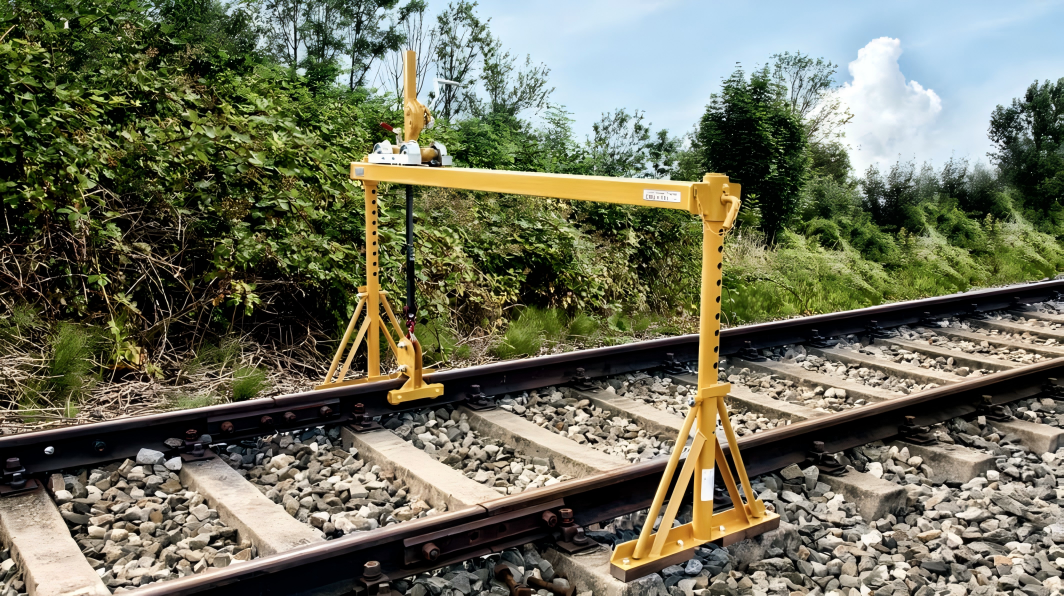
Key Technical Features
1. Precision lifting — the cross beam height is adjustable via bolt holes in the support brackets, with a self-locking mechanism that ensures accurate engagement with the rail base.
2. The support bracket integrates a foldable carrying handle, wooden support feet, and guide rollers in a compact structure, allowing a single operator to relocate the workstation.
3. Fully modular design enables tool-free disassembly and reassembly, facilitating rapid transport between job sites.
4. The ROBEL 41.04 trolley features a gear-and-rack mechanism, safety crank, and load-pressure brake for smooth, secure lifting operations.
5. The ROBEL 42.10 roller-type rail tongs provide self-locking clamping with an integrated longitudinal roller adjustment system, adaptable to various rail profiles.
Working Principle
The rail handling device is used to lift and move rails of any length in both longitudinal and transverse directions. Multiple units are positioned at approximately 10m intervals along the rail. The support height of the transverse components is adjusted using bolts on the cross beam so that the rail base sits flush against the guide rollers. The folding handle and wooden foot pads assist with positioning, while the guide rollers ensure smooth longitudinal movement of the rail. The core power components are the ROBEL 41.04 hand-propelled carriage (with built-in rack-pinion jack and safety crank) and the ROBEL 42.10 roller support tongs (self-locking clamp with roller adjustment). Together, these enable high-precision clamping, lifting, and longitudinal translation of the rail.
Product Structure
- Support bracket assembly — aluminum support structure with height-adjustment bolt holes, folding handle, and wooden support feet.
- Cross beam assembly — connects the two support brackets; length 2240mm; transfers the rail load to the support frames.
- Lifting trolley (ROBEL 41.04) — gear-and-rack jack with safety crank and load-pressure brake for manual lifting operation.
- Roller-type rail tongs (ROBEL 42.10) — self-locking clamp on the rail head with roller adjustment for longitudinal movement.
- Guide roller assembly — rolling support under the rail base that reduces longitudinal movement resistance and protects the rail foot from abrasion.
Technical Parameters
| Parameter | Value |
|---|---|
| Electric double-beam bridge crane | 1.5T |
| stroke | 800mm |
| Trolley Travel Distance | 1900mm |
| Span | 2240mm |
| rail Maximum Headroomwidth | 75mm |
| rail Maximum Headroom Height | 45mm |
| Manual Pushchassis frame Dimensions(Lengthx Widthx Height/Weight) | 1150x360x310mm / 24kg |
| Roller Clamp Size(Lengthx Widthx Height/Weight) | 305x270x165mm / 16kg |
| Cross Beam Dimensions(Lengthx Widthx Height/Weight) | 2450x210x130mm / 45kg |
| Support Bracket Size(Lengthx Widthx Height/Weight) | 1180x700x130mm / 16kg |
Operating Instructions
Setup: Position the two support frames at the required rail gauge spacing, install the cross beam, and adjust the bolts to the desired elevation. Fit the guide rollers into place.
Clamping: Engage the ROBEL 42.10 roller clamp onto the rail head, confirm the self-locking mechanism is fully engaged, and adjust the rollers so the rail moves freely in the longitudinal direction.
Lifting: Crank the ROBEL 41.04 safety handle to raise the rail smoothly via the rack-pinion jack. The load-activated brake automatically locks when cranking stops, preventing any risk of the rail dropping.
Moving: Push the rail along the guide rail direction using the longitudinal rollers on the clamp. For balanced load distribution, we recommend spacing multiple units 10 m apart along the rail.
Disassembly: Lower the rail, release the roller clamps, and break down the components for transport and storage. Keep the wooden support feet in a dry, moisture-proof location.
Manufacturer Support & Services
Henan Kelude Heavy Industry Co., Ltd. supplies both genuine German ROBEL rail handling devices and domestically manufactured units, with options for custom selection, bulk orders, and spare parts supply. The imported version features core components (41.04 rack-pinion jack / 42.10 roller clamp) covered by the original ROBEL factory warranty, while the domestic version includes a one-year free repair warranty. For pricing, delivery lead times, and spare parts lists on specific models, please contact our support team for a detailed proposal.
FAQ: Rail Handling Device
Q: What is the difference between a rail handling device and a standard jack?
A: A rail handling device is an integrated tool specifically designed for rail handling. It includes support frames, a cross beam, a trolley, and roller clamps, enabling lifting, longitudinal shifting, and positioning of rails. A standard jack can only lift vertically and cannot move rails horizontally or transport them over longer distances.
Q: How do I choose between the domestic and German imported versions?
A: The German ROBEL version uses original rack-pinion jacks and roller clamps, offering higher machining accuracy and more reliable self-locking performance. It is ideal for high-frequency use and mainline railway maintenance. The domestic version has the same functional structure but offers better value, making it suitable for low-to-medium frequency applications such as mining railways and private industrial lines. The support frames and cross beams are interchangeable between the two versions.
Q: How long a rail can one set of equipment handle?
A: The device itself does not limit rail length. We recommend spacing multiple units 10 m apart for balanced support — use 2 sets for a 12.5 m standard rail, 3 sets for a 25 m standard rail, and 5–6 sets for a 50 m long rail. Excessive spacing can cause excessive rail deflection, affecting handling accuracy and safety.
Q: Are the wooden support feet prone to damage? Can they be replaced?
A: The wooden support feet provide shock absorption and protect the rail surface from scratches. They are considered normal wear items. For the domestic version, replacements can be ordered individually (approx. $8 per foot); for the imported version, we recommend keeping original spare parts on hand. To extend service life, keep them dry and wipe them down after rain before storage.
Q: How does the self-locking mechanism on the roller clamp work?
A: The ROBEL 42.10 roller clamp operates on an eccentric self-locking principle: once the clamp grips the rail head, the rail's dead weight automatically tightens the clamp arms inward, increasing clamping force as the rail weight increases. The longitudinal rollers are fitted with bearings, allowing the rail to slide easily along the guide direction while clamped. To release, simply operate the manual release handle to disengage the self-lock.
