
GB/T 16563-2019 Harbor Crane Spec Guide

GB/T 16563-2019 "Port Tyre Cranes — Technical Specification" defines the technical requirements for port tyre cranes. It specifies the classification, technical requirements, test methods, and inspection rules for tyre cranes used in cargo handling at port terminals.


Crane Classification & Key Parameters

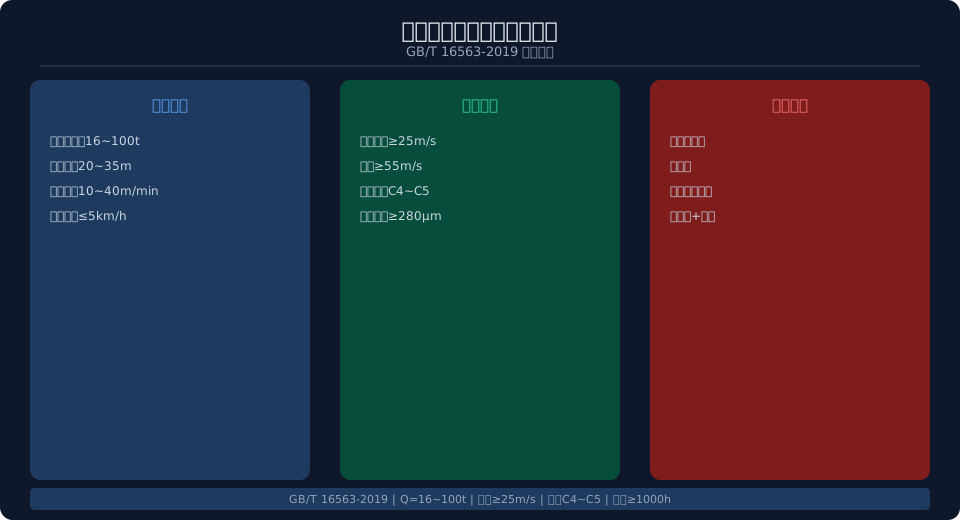
GB/T 16563-2019 applies to tyre cranes operating at port terminals. The rated lifting capacity ranges from 16 to 100 t, with a maximum working radius of 20 to 35 m. Lifting speed varies from 10 to 40 m/min — high speed under no-load conditions and reduced speed under heavy load. Slewing speed is 0 to 2 r/min, and traveling with load is limited to ≤5 km/h. For wind resistance, the crane is designed to operate in winds up to 25 m/s (Beaufort Force 9) and to remain secure when anchored in winds up to 55 m/s (Beaufort Force 12). Standard equipment includes an anemometer, wind anchoring device, and rail clamps. The corrosion protection level is C4 to C5 (ISO 12944, marine atmosphere).


Structural diagram of a port tyre crane


Machine Requirements & Anti-Corrosion Coating

The undercarriage features a dedicated tyre chassis with four-wheel drive and four-wheel steering. The hoisting mechanism uses a hydraulically driven double drum, allowing independent operation of the main and auxiliary hooks. The slewing mechanism incorporates a roller or crossed-roller slewing bearing for full 360° rotation. The luffing mechanism is driven by hydraulic cylinders. For anti-corrosion coating, steel surfaces are prepared to Sa2.5 grade, followed by a system of epoxy zinc-rich primer, epoxy MIO intermediate coat, and polyurethane topcoat, with a total dry film thickness of ≥280 μm. The coating must pass a salt spray test of ≥1000 hours without red rust.

Lifting Capacity
16–100 t
Port Terminal
Working Radius
20–35 m
Maximum Radius
Lifting Speed
10–40 m/min
No-Load High Speed
Wind Resistance
Working ≥25 m/s
Anchored ≥55 m/s
Corrosion Protection
C4–C5
ISO 12944
Coating System
Sa2.5 Grade
DFT ≥280 μm
Parameter 16tLevel 25tLevel 40tLevel 60tLevel
Rated Lifting Capacity(t) 16 25 40 60
Maximum radius(m) 20 25 28 32
Lifting Speed(m/min) 20/10 15/8 12/6 10/5
Total machine weight(t) 28 38 52 72

The standard specifies technical requirements for harbor tire cranes across five major systems: the chassis, hoisting mechanism, slewing mechanism, luffing mechanism, and travel mechanism. The chassis is a dedicated pneumatic-tire design with four-wheel drive and four-wheel steering, enabling agile maneuverability in confined port spaces. The hoisting mechanism uses a double-drum hydraulic drive, allowing the main hook and auxiliary hook to operate independently. The slewing mechanism employs a roller-type or crossed-roller slewing bearing for 360° continuous rotation. The luffing mechanism uses hydraulic cylinders to raise and lower the boom. Each mechanism must start and stop smoothly, with micro-motion control precise enough for delicate lifting operations.

Corrosion protection and coating requirements are stringent in port environments, where the corrosion grade is classified as C4 to C5 (ISO 12944, marine atmosphere). The coating system must meet the following specifications: steel surface preparation to Sa2.5 (sandblasting to near-white metal), followed by an epoxy zinc-rich primer (≥60 μm), an epoxy micaceous iron oxide intermediate coat (≥80 μm), and a polyurethane topcoat (≥80 μm), for a total dry film thickness (DFT) of at least 280 μm. All bolted connections, weld seams, and joints must be sealed and waterproofed. Coating quality must be verified by a salt spray test showing no red rust after 1,000 hours. Effective anti-corrosion coating is critical to maximizing the crane's life cycle in a port environment.

Testing and Inspection Requirements

Routine factory tests include a no-load test, a rated load test (100% SWL) at various working radii with all mechanisms operated for at least three cycles, a 1.25× static load test held at the most unfavorable working radius for 10 minutes, and a stability test verifying that outrigger reactions remain non-negative in all directions. Type testing covers wind anchoring capability and salt spray testing of the anti-corrosion coating. Daily inspections check tire pressure and the outrigger hydraulic system. Monthly inspections cover the anti-corrosion coating. Semi-annual inspections verify the wind anchoring device. Annual inspections include a full anti-corrosion coating assessment and a complete crane safety inspection.

safety device Function Setpoint Cycle
Load moment limiter (LML) Torque%Display 105%Alarm Weekly
Anemometer Wind Speed Monitoring ≥20m/searly warning Daily
Wind Anchor Anchoring ≥55m/s Semi-annually
Anti-corrosion coating guards C4~C5 Annual Assessment

Standard testing requirements include routine factory tests and type tests. Routine tests cover a no-load test (running all mechanisms through their full range to verify smooth operation), a rated load test (lifting the rated load at each major working radius and operating all mechanisms for at least 3 complete cycles), a 1.25× static load test (holding the load at the most unfavorable radius for 10 minutes to confirm no permanent deformation), and a stability test (measuring outrigger reactions in all directions to ensure they remain ≥0). Type tests are conducted every 3 years and include wind resistance verification, a salt spray test on the anti-corrosion coating (1,000 hours), and a durability test (≥5,000 hoisting cycles).

Routine maintenance focuses on daily checks of tire pressure and the outrigger hydraulic system. Weekly inspections verify the condition of the anti-corrosion coating, with prompt touch-up repairs to prevent corrosion from spreading. Monthly inspections check the torque on slewing bearing connection bolts. Semi-annual checks verify the functionality of the wind anchoring device. Annual evaluations cover the anti-corrosion coating condition and a full safety inspection of the machine. Kelude Heavy Industry provides harbor crane maintenance services in accordance with the standard.

Frequently Asked Questions

Q: What are the wind resistance requirements for a harbor tire crane?

A: In working condition, the crane must withstand wind speeds of ≥25 m/s (Beaufort force 9). When anchored in a non-operating state, it must withstand ≥55 m/s (Beaufort force 12). The crane is equipped with an anemometer, wind anchoring device, and rail clamp. Harbor cranes must be able to operate normally in winds up to force 6 and be safely stored in winds up to force 9.

Q: What is the difference between a harbor tire crane and a standard tire crane?

A: Harbor tire cranes are designed for continuous port operations, featuring higher hoisting and slewing speeds (hoisting speed of 10–40 m/min) and stricter wind protection and corrosion resistance requirements (corrosion protection level C4–C5). They are also configured for use with container spreaders. Standard tire cranes operate at lower speeds and typically have a corrosion protection level of C2–C3.

Q: What are the anti-corrosion coating requirements?

A: For port environments with a corrosion grade of C4–C5, the coating system must comply with ISO 12944. Steel surfaces are prepared to Sa2.5, followed by a primer, intermediate coat, and topcoat, with a total dry film thickness (DFT) of ≥280 μm. The coating must pass a salt spray test of ≥1,000 hours with no red rust. Critical connection points require sealing and waterproofing treatment.

Q: What safety devices are required on a harbor tire crane?

A: The crane must be equipped with a load moment limiter (LML), lifting capacity limiter, radius indicator, height limit switch, slewing limit switch, spirit level, and anemometer. Wind protection devices include a rail clamp, wind anchoring device, and rail wedges. All safety devices should be periodically calibrated and verified.

Related News

contact

contact us

phone:
+86 13903802779

mail:3915269@qq.com

Working hours: Monday to Friday

Wechat
Wechat
SHARE
TOP