Crane Rail Buffer Stop Standard ISO 12486:2012 Explained

ISO 12486:2012 — Cranes — Buffer Stops for Crane Rail Ends — is the governing standard for rail-end buffer stops. It specifies buffer stop height (≥ wheel radius + 50 mm), width (≥ rail width + 40 mm), material (Q345B steel plate, welded, wall thickness ≥ 10 mm), fixing method (welded to embedded parts or secured with chemical anchors, minimum 4 × M24 bolts per side), matching buffer (stroke ≥ 200 mm), warning markings (yellow/black stripes), and inspection requirements.


Technical Requirements for Crane Rail Buffer Stops

Buffer stops are installed at both ends of the crane rail. Height must be ≥ wheel radius + 50 mm, and width ≥ rail width + 40 mm. The body is fabricated from Q345B steel plate with welded construction and a minimum wall thickness of 10 mm. Fixing is achieved by welding to embedded parts or using chemical anchor bolts — at least 4 × M24 bolts per side. A buffer with a stroke of ≥ 200 mm must be fitted in front of the buffer stop. The surface is finished with yellow-and-black warning stripes or reflective warning tape. Kelude supplies buffer stops in accordance with ISO 12486.


Buffer stop diagram


Inspection and Compliance Standards

After installation, the centerline of the buffer stop must align with the rail centerline within a deviation of ≤ 5 mm. The contact face between the buffer stop and the buffer must be perpendicular to the longitudinal direction of the rail. Bolts are tightened to the specified design torque, and anti-loosening marks must be clearly visible. A monthly inspection checks the fixing condition, bolt tightness, and buffer wear. Kelude buffer stops are supplied complete with mounting bolts and warning paint.

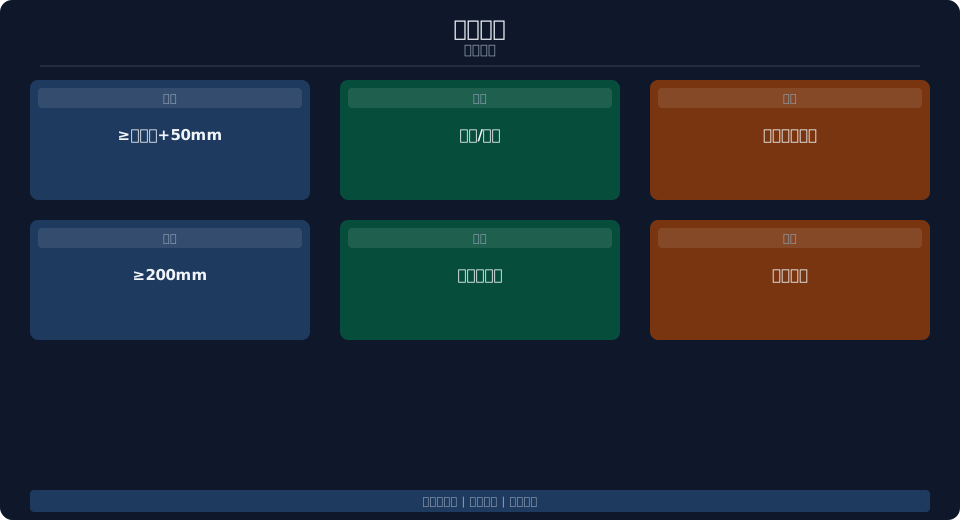
Height
≥ Wheel radius + 50 mm
Material
Q345B
Wall Thickness
≥ 10 mm
Fixing
4 × M24
Buffer Stroke
≥ 200 mm
Warning
Yellow/Black Stripes
Item Requirement
Height ≥Wheel Radius+50mm
Material Q345B (≈S355J2)
wall thickness ≥10mm
Fixing 4×M24
Buffer stroke ≥200mm
Warning Yellow-Black Stripes

Inspection Period
factory unit by unit
Annual Inspection Annually

A crane buffer stop is a critical safety device that prevents the crane from running off the end of the crane rail. Installed at both ends of the track, it works together with the buffer to absorb the crane's impact energy through mechanical blocking, ensuring the crane stops safely at the rail end. The buffer stop height must be no less than the crane wheel radius plus 50 mm to ensure the wheel flange is effectively blocked, and its width must be no less than the rail width plus 40 mm. The body is welded from Q345B steel plate (≈S355J2) with a wall thickness of no less than 10 mm, providing sufficient structural strength to withstand impact. Fixing is achieved by welding to foundation embedment or using chemical anchors, with no fewer than 4 M24 bolts on each side to ensure a secure connection. A buffer with a stroke of no less than 200 mm is fitted in front of the buffer stop. The surface is painted with yellow-and-black warning stripes or fitted with reflective warning tape to alert the operator to the end of the rail. Kelude Heavy Industry supplies buffer stops to ISO 12486 with mounting bolts and warning paint included.

Frequently Asked Questions

Q: What are the height and dimensional requirements for buffer stops per ISO 12486:2012?

A: The buffer stop height must be ≥ the crane wheel radius + 50 mm to ensure effective wheel flange blocking. The width must be ≥ the crane rail width + 40 mm to cover the full rail width. The body is welded from Q345B steel plate with a wall thickness of ≥ 10 mm for adequate impact strength. A polyurethane or spring buffer with a stroke of ≥ 200 mm is fitted in front to provide effective cushioning.

Q: What are the mounting, fixing, and warning requirements for buffer stops?

A: Fixing can be done by welding to the rail foundation embedment or using chemical anchors with ≥ 4 M24 bolts per side, tightened to the design torque with clear anti-loosening marks. After installation, the centerline must align with the rail centerline within a deviation of ≤ 5 mm, and the contact face must be perpendicular to the longitudinal direction of the rail. The surface is finished with yellow-and-black warning stripes or reflective warning tape.

Q: What inspection and inspection interval apply to buffer stops?

A: Post-installation inspection covers weld quality, fixing bolt torque, buffer configuration, and warning signs. A monthly inspection checks the fixing condition of the buffer stop, bolt loosening, and buffer wear. Any deformation of the buffer stop or loosening of the fixing must be repaired immediately. Kelude buffer stops come with mounting bolts and warning paint.

Q: What configuration does Kelude offer for buffer stop assemblies?

A: Kelude Heavy Industry supplies crane buffer stop assemblies to ISO 12486:2012, fabricated from Q345B steel plate with a wall thickness of ≥ 10 mm, including ≥ 4 × M24 bolts and a buffer. The assembly is finished with yellow-and-black warning paint and corrosion-resistant treatment, applicable to the rail ends of both overhead and gantry cranes.

Related News

contact

contact us

phone:
+86 13903802779

mail:3915269@qq.com

Working hours: Monday to Friday

Wechat
Wechat
SHARE
TOP