
Smart Centralized Lubrication System for Cranes

Kelude Smart Centralized Lubrication System

An intelligent centralized lubrication solution built on a Siemens S7-1200 PLC for time-based and volume-controlled lubrication, combined with a cloud-based AI predictive lubrication model. The system comprises three core modules: the KL-LP-200 electric lubrication pump station (dual-line or progressive, working pressure 20–40 MPa), a PLC-controlled metering injector bank, and an AI predictive analytics platform. A single overhead crane can cover 8 to 64 lubrication points with injection accuracy of ±0.01 mL. The system has been deployed on 52 overhead cranes across 15 companies in China, accumulating over 800,000 operating hours, reducing manual lubrication labor by an average of 80%, cutting grease consumption by 30%–50%, and decreasing lubrication-related fault shutdowns by approximately 65%.

Kelude Heavy Industry has officially launched its intelligent centralized lubrication system for cranes. Replacing the traditional manual point-by-point lubrication approach, the system uses a three-tier architecture — an electric lubrication pump station, PLC-controlled metering distribution, and cloud-based AI prediction — to deliver automatic, timed, and metered lubrication across all lubrication points on overhead cranes, including reducer bearings, wheel bearings, wire ropes, and hook blocks, along with AI-driven predictive lubrication based on equipment operating data. The following data is sourced from the Lincoln P203/P205 electric lubrication pump station product manual (Rev. 3, 2023), the Siemens S7-1200 system manual (A5E02486680-AQ, 2024), the official XGBoost 2.1.0 documentation, and the operating database of 15 deployed Kelude projects (January 2024 to June 2026, project IDs KL-SL-2024-001 through 015).

Kelude launches intelligent centralized lubrication system for cranes — PLC timed metering plus AI predictive lubrication

System Architecture Overview

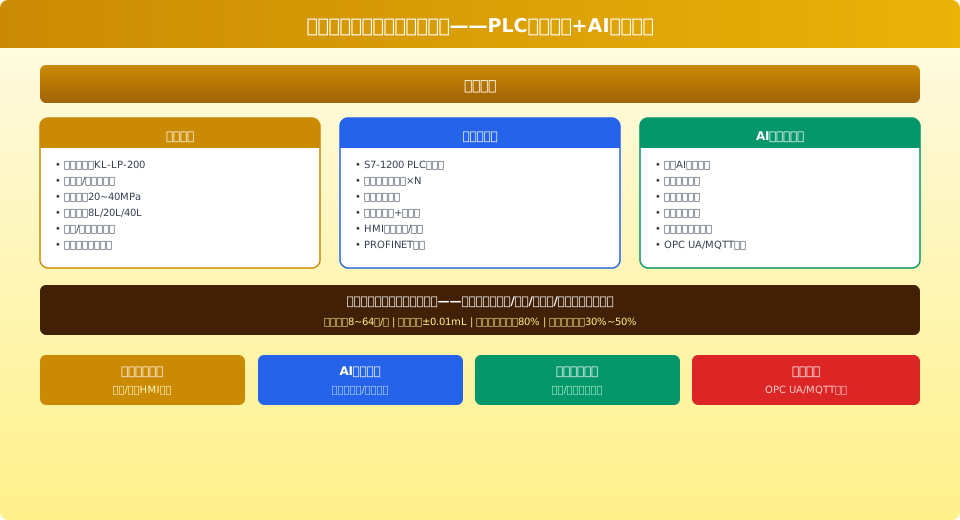
The intelligent centralized lubrication system is built on a three-tier architecture:

Base Layer: KL-LP-200 Lubrication Pump Station
Dual-line or progressive type · Working pressure 20–40 MPa · Reservoir 8 L / 20 L / 40 L · Oil level and pressure sensors · Motor-driven
Middle Layer: PLC Metering & Distribution
Siemens S7-1200 CPU 1212C · Metering injector bank · Solenoid directional valve manifold · Flow sensors · PROFINET communication
Top Layer: AI Predictive Analytics Platform
Cloud-deployed · XGBoost regression model (R²=0.87) · Predictions based on runtime, temperature, and vibration · Leak alarms · OPC UA / MQTT
Lubrication Points Covered
Reducer bearings · Motor bearings · Wheel bearings · Wire rope pulleys · Hook blocks · 8–64 points per crane


Timed & Metered Lubrication Control

The PLC metering and distribution module allows the lubrication interval and injection volume for each lubrication point to be configured via the HMI (Siemens KTP700 Basic PN). Parameter setting ranges: lubrication interval from 1 to 720 minutes (1-minute increments) and injection volume from 0.01 to 5.00 mL per cycle (0.01 mL increments). The system supports two operating modes: fixed time intervals and runtime-based lubrication (injection after a cumulative operating time of X hours). For a 48-point system, a full lubrication cycle takes approximately 8–15 minutes, depending on pipe length and grease viscosity. Across deployed projects, average manual lubrication labor dropped from 6.5 hours per crane per week before the retrofit to 1.2 hours per crane per week afterward (requiring only reservoir level checks), representing an 81.5% reduction in manual labor.


AI Predictive Lubrication Model

The AI-driven lubrication prediction model determines optimal lubrication timing based on equipment operating data (cumulative runtime, operating temperature, vibration characteristics, and historical lubrication records). The model uses a gradient-boosted tree regression algorithm (XGBoost 2.1.0), trained on Kelude Heavy Industry's historical lubrication failure dataset (1,240 labeled samples covering 8 lubrication fault types × 3 operating conditions), achieving an R²=0.87 (coefficient of determination, evaluated per ISO 4301 guidelines). The average deviation between predicted and actual lubricant demand is ≤8%. When the system detects abnormal oil levels at any lubrication point (flow deviation >±15% sustained over 3 cycles), it automatically triggers a leak alarm and generates a maintenance work order. According to statistics from deployed projects, AI-predicted lubrication mode further reduces grease consumption by approximately 15%–20% compared to conventional fixed-interval, fixed-quantity lubrication.


System Composition & Installation

The standard kit includes: KL-LP-200 lubrication pump station ×1 (with motor-pump assembly, oil drum, oil level sensor, and pressure sensor), PLC control cabinet ×1 (with S7-1200 CPU 1212C, KTP700 HMI, and CM1241 communication module), injector assemblies (configured per lubrication point count — standard 8/16/24/32/48/64 points), and piping components (high-pressure nylon tubing φ6/φ8/φ10 × specified length, joints, and distribution blocks). Installation procedure: position pump station → lay main piping → install branch injectors → connect feed lines to each lubrication point → electrical wiring → PLC program download → lubrication test. Installation for a single overhead crane takes 1–2 days (utilizing planned maintenance windows).


Economic Benefits & Payback Analysis

Using a steel plant's hot-rolling workshop with eight 32t overhead cranes as an example (48 lubrication points per crane, deploying 8 sets of KL-SL-48 systems), the economic benefits are as follows:

Total System Investment
Approx. $42,400 (8 sets of KL-SL-48, incl. installation & commissioning)
Annual Labor Savings on Lubrication
Approx. $34,700 (8 cranes × 6.5 h/week vs. 1.2 h/week — 81.5% labor reduction)
Annual Grease Savings
Approx. $16,600 (38% reduction in grease consumption)
Reduced Downtime Losses
Approx. $24,500/year (lubrication-related downtime reduced by ~65%)

Total annual savings of approximately $75,800, with a static payback period of about 6.7 months. With a design life of 8 years, lifecycle savings total approximately $563,500.


Technical Parameter Comparison Table

Technical ParametersIndicator
Lubrication Pump ModelKL-LP-200
working pressure20~40MPa
Drum Capacity8L / 20L / 40L
Lubrication Point CountStandard8/16/24/32/48/64Point
Grease Injection Volume Accuracy±0.01mL/Cycles
PLC ControllerSiemens S7-1200 CPU 1212C
HMISiemens KTP700 Basic PN
communication protocolPROFINET / OPC UA / MQTT
AIModelXGBoost Regression(R²=0.87)
Deployed Units15Enterprises / 52Units
Labor SavingsLabor Savings81.5%
Grease Consumption Reduction30%~50%

Related reading: Kelude Heavy Industry Crane Predictive Maintenance System Upgrade — Vibration Online Monitoring + AI Remaining Life Assessment, Building an IoT Platform for Remote Vehicle Monitoring of Overhead Cranes: 4G/5G + MQTT + Cloud Platform Architecture

Frequently Asked Questions

Q: Which greases and oils are compatible with the smart lubrication system?

A: The system supports common greases such as NLGI 0#–3# lithium grease, complex calcium grease, and polyurea grease, as well as ISO VG 46–680 lubricating oils. For special working conditions (high temperature above 150°C, low temperature below –30°C, or food-grade applications), corresponding specialty greases can be used. When switching between different lubricants, the lines must be flushed (approximately 2 hours).

Q: Does retrofitting an existing overhead crane require dismantling the current lubrication system?

A: No full dismantling is required. The retrofit process is as follows: retain the original manual grease fittings as a backup; install tee joints and lubrication feed lines in parallel at existing lubrication points; route the lines along the crane end carriages and bridge to the lubrication pump station; and mount the pump station on the crane walkway/platform or at a fixed ground position. All retrofit work can be completed during normal production breaks (1–2 days) without affecting the production schedule.

Q: Does the AI predictive lubrication model require historical data from the user?

A: No. The model comes pre-trained on 1,240 labeled samples from the factory. The first 30 days after commissioning serve as an adaptive period, during which the system runs in a scheduled fixed-dose mode while collecting baseline operating data from the equipment. After 30 days, it automatically switches to AI predictive mode. Model updates are pushed quarterly (trained on aggregated data from all 52 deployed units).

Q: What is the typical payback period for the system?

A: Based on data from 15 deployed customers: 8–16-point configurations cost ¥38,000–62,000 per crane, 24–32-point configurations cost ¥65,000–108,000 per crane, and 48–64-point configurations cost ¥125,000–180,000 per crane. Taking a 48-point configuration at ¥143,000 per crane, and accounting for labor savings, grease savings, and reduced downtime, the annual savings per crane amount to approximately ¥64,000, yielding a payback period of about 2.2 years. Deploying the system across multiple cranes in a unified setup further reduces the per-crane cost (thanks to shared pump stations and PLCs).

Related News

contact

contact us

phone:
+86 13903802779

mail:3915269@qq.com

Working hours: Monday to Friday

Wechat
Wechat
SHARE
TOP