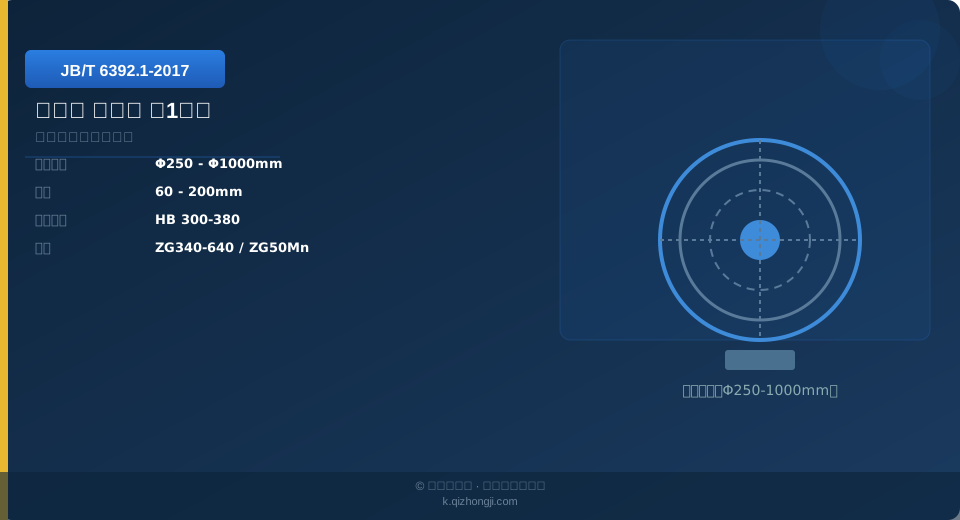

JB/T 6392.1-2017 Crane Wheel Technical Specifications
JB/T 6392.1-2017, "Cranes — Crane Wheels — Part 1: General Technical Specifications," is the industry standard governing the manufacturing and acceptance of crane wheels. It defines terminology, types and dimensions, technical requirements, test methods, and inspection rules for crane wheels, serving as a sector-specific supplement to GB/T 36152-2018. The standard applies to travel wheels used in overhead, gantry, and portal cranes.
JB/T 6392.1-2017 is the industry standard for general technical specifications of crane wheels, covering wheel types, technical requirements, test methods, and inspection rules. It applies to forged, rolled, and cast wheels used in overhead and gantry cranes. As a core component of the crane travel mechanism, wheel quality directly affects the operating stability and service life of the entire machine.
Wheel Types and Manufacturing Processes
JB/T 6392.1-2017 classifies crane wheels by manufacturing process: Forged wheels — produced from ingots forged into blanks and then machined; the metal flow line runs continuously along the circumference, delivering the highest fatigue strength. Rolled wheels — hot-rolled from steel billets, offering well-rounded performance at moderate cost. Cast wheels — the most economical option but with a higher risk of internal defects.
By tread profile, wheels are divided into: cylindrical tread wheels (general-purpose) and conical tread wheels (self-aligning, with a 1:10 or 1:20 taper). The standard diameter range covers ten sizes: Φ250, Φ315, Φ350, Φ400, Φ500, Φ630, Φ700, Φ800, Φ900, and Φ1000 mm. Kelude crane wheels are manufactured exclusively by forging or rolling.
Materials and Heat Treatment
The standard specifies the following wheel materials: forged and rolled wheels use 60 steel or 65Mn steel (carbon content 0.55–0.70%), while cast wheels use ZG340-640 or ZG50Mn2 cast steel. The wheel tread and flange must undergo surface hardening: hardened layer depth on the tread ≥4 mm (for wheel diameters ≤500 mm) or ≥6 mm (for diameters >500 mm).
Tread hardness requirements: HB320–380 for wheel diameters ≤500 mm, and HB300–350 for diameters >500 mm. The hardness variation across a single wheel tread must not exceed HB20. The hardened layer on the flange must be ≥3 mm deep. The hardened layer must transition uniformly from the surface toward the core, with no abrupt hardness changes. Kelude uses medium-frequency induction hardening, which produces a uniform hardened layer with minimal deformation.
Wheel Dimensions and Tolerances
Key dimensional tolerances specified in the standard: wheel diameter tolerance — h9 grade (for a Φ500 mm wheel, the diameter tolerance is 0 to −0.1 mm). Tread radial runout ≤0.05 mm (precision grade) or ≤0.10 mm (standard grade). Face runout of the inner flange face relative to the reference plane ≤0.10 mm. Wheel bore tolerance is H7 grade.
Static balancing requirements: unbalanced torque ≤5 N·cm for wheel diameters ≤500 mm, and ≤10 N·cm for diameters >500 mm. For cranes with travel speeds exceeding 80 m/min, wheels must undergo a dynamic balancing test. Flange thickness — standard wheels have a flange thickness of 20–30 mm, with a wear limit set at 50% of the original thickness.
Inspection and Testing
Factory Acceptance Test (FAT) items: visual inspection (including Magnetic Particle Inspection), dimensional inspection, and hardness testing (three measurement points on both the tread and the flange). A 5% sample from each batch undergoes a static balance test. Type testing is conducted every five years and adds fatigue life and dynamic balancing tests. The standard also specifies marking requirements — each wheel must be marked on the web with the specification, manufacturer, and date.
In-service inspection: check tread and flange wear every three months, inspect bearing clearance and rotational freedom every six months, and perform Magnetic Particle Inspection annually. Replacement criteria: tread diameter wear exceeding 5% of the original diameter, flange thickness wear exceeding 50% of the original thickness, visible cracks, or tread spalling deeper than 3 mm or covering more than 10% of the surface area.
Wheel Diameter
Φ250–Φ1000 mm
Tread Hardness
HB300–HB380
Hardened Layer Depth
Tread ≥4 mm
Flange ≥3 mm
Wheel Load Range
≤150 kN to >350 kN
Manufacturing Process
Forged / Rolled / Cast
Discard Criteria
Diameter wear >5%
Cracks — immediate scrapping
Kelude Heavy Industry: A Trusted Name in Industrial Lifting Solutions
Kelude Heavy Industry has established itself as a reliable manufacturer and supplier of industrial cranes and hoisting equipment. Our product lineup is designed to meet the rigorous demands of workshops, warehouses, and heavy fabrication facilities, offering a balance of performance, durability, and operational safety.
Comprehensive Crane Solutions for Demanding Applications
Our core range includes single-girder and double-girder overhead cranes, as well as gantry cranes, each engineered for specific load capacities and duty cycles. Whether you require a compact solution for light assembly work or a heavy-duty system for continuous steel processing, our equipment is built to deliver precise, reliable lifting day after day.
We understand that every facility has unique material handling challenges. That is why we offer customized configurations, including various span lengths, lifting heights, and control systems—from pendant stations to advanced wireless remote controls. Our team works closely with you to specify the right crane for your operational workflow, ensuring maximum efficiency and safety.
Engineered for Safety and Long-Term Reliability
Safety is a non-negotiable aspect of our crane design. All our equipment complies with international standards such as ISO 4301 for crane classification and IEC 60204-32 for electrical equipment, ensuring that every component—from the hoist mechanism to the control panel—meets stringent quality and safety benchmarks. Features like overload protection, emergency stop functions, and anti-sway technology are integrated as standard or available as options, depending on the model.
We also prioritize ease of maintenance. Our cranes are designed with accessible service points and durable, long-life components, minimizing downtime and reducing total cost of ownership. With Kelude, you invest in equipment that keeps your operations moving.
Technical Specifications and Customization Options
To help you evaluate the right solution, we provide detailed technical specifications for each crane model. Below is a typical configuration example for our double-girder overhead crane series. Please note that exact dimensions and capacities can be tailored to your specific requirements.
| Parameter | Typical Value / Range |
| Lifting Capacity | 5 tons to 50 tons (metric) |
| Span Length | 10.5 m to 31.5 m (custom spans available) |
| Lifting Height | 6 m to 18 m (or as specified) |
| Hoist Type | Wire rope hoist or chain hoist (optional) |
| Control Mode | Pendant station, wireless remote, or cabin (optional) |
| Power Supply | 380V / 50Hz (or as per local grid) |
| Working Duty | A5 – A8 (per ISO 4301) |
For a detailed proposal and a quotation tailored to your project, please contact our engineering team. We are ready to assist with site surveys, load assessments, and installation planning.
Frequently Asked Questions
Q: What is the typical lead time for a standard overhead crane?
A: Our standard lead time is typically 30 to 45 days after receipt of the deposit and final approval of the technical drawings. Customized cranes may require additional time depending on the complexity.
Q: Do you provide installation and commissioning services?
A: Yes, we offer professional installation and commissioning services. Our technicians can supervise the installation or perform the complete setup, ensuring your crane is operational safely and efficiently.
Q: What is your warranty policy?
A: We provide a standard 12-month warranty covering defects in materials and workmanship. Extended warranty options are also available upon request.
Q: Can you customize the crane to fit an existing building structure?
A: Absolutely. We frequently adapt our crane designs to fit existing building constraints, including low headroom situations or unusual column spacing. Our engineers will work with your specifications to provide a tailored solution.
Q: How do you ensure the quality of your cranes?
A: Every crane undergoes rigorous testing during and after production, including load testing and functional checks. We adhere to ISO 9001 quality management systems to ensure consistent reliability.
| Process | Wheel load | Fatigue Strength | Cost | applicable working conditions |
|---|---|---|---|---|
| forged wheel | ≤500kN | Maximum(Above Casting30~50%) | Maximum | Heavy Duty Classification |
| Rolled Crane wheel | 150~350kN | Maximum | Medium | General Purpose |
| cast wheel | ≤150kN | Normal(With Defect Risk) | Low | Light Duty Classification |
FAQ
Q: What are the common failure modes of crane wheel treads?
A: The primary failure modes are: 1) Tread wear — replace when flange thickness wears down to 50% of its original dimension or when tread diameter wear exceeds 5% of the original diameter; 2) Tread spalling — replace immediately when spall depth reaches ≥3 mm; 3) Flange cracking — replace immediately once cracks are detected; 4) Indentations or brinelling on the tread surface.
Q: What is the difference between forged, rolled, and cast wheels?
A: Forged wheels feature continuous metal flow lines and deliver the highest fatigue strength — 30% to 50% higher than cast wheels. Rolled wheels offer performance between forged and cast alternatives, with high production efficiency and moderate cost. Cast wheels are the most economical option but carry a higher risk of internal defects, making them applicable only to light-duty classifications. Selection guideline: for duty classification of A5 or above, or when wheel load exceeds 200 kN, forged or rolled wheels are recommended.
Q: What are the hardness requirements after heat treatment?
A: The hardened layer depth on the tread surface must be ≥4 mm for wheel diameters ≤500 mm, and ≥6 mm for diameters above 500 mm. Tread hardness should be HB320–380 for wheels ≤500 mm in diameter, and HB300–350 for larger wheels. Hardness variation across the tread surface of a single wheel must not exceed HB20. The hardened layer should transition uniformly from the surface toward the core.
Q: What are the discard criteria for crane wheels?
A: A wheel must be scrapped when any of the following conditions is met: 1) Tread diameter wear exceeds 5% of the original diameter; 2) Flange thickness wear exceeds 50% of the original dimension; 3) Any visible crack is found; 4) Tread spalling depth reaches ≥3 mm or the affected area exceeds 10%; 5) The wheel becomes loose in its thermal-fit assembly. Discard assessment should include Magnetic Particle Inspection (MPI) after disassembly and cleaning.