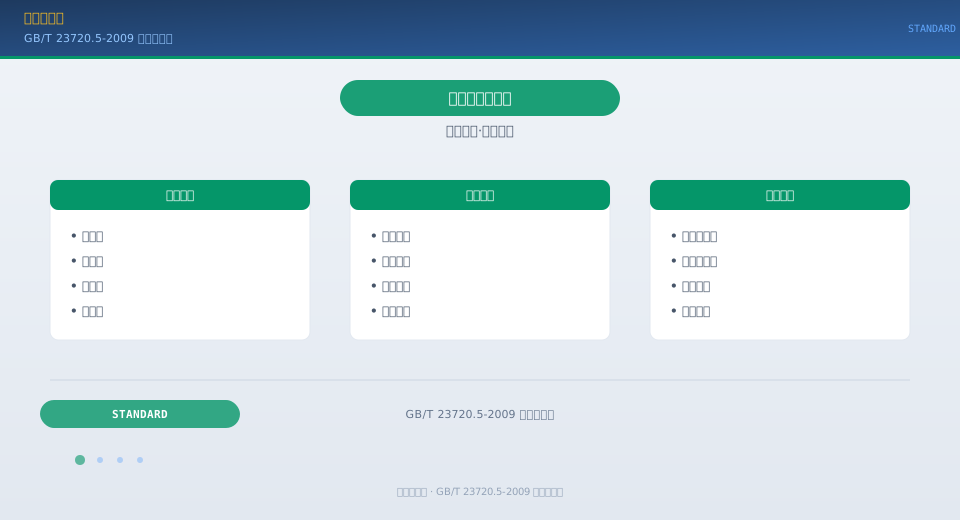

Blind Zone & Precision Lifting Training for Overhead Cranes
GB/T 23720.5-2009, "Cranes — Operator Training — Part 5: Overhead and Gantry Cranes," is the dedicated standard for training operators of overhead and gantry cranes. It defines the theoretical knowledge and practical skills required for operators, covering hoisting and travel operations, safety device handling, and emergency response procedures.
GB/T 23720.5-2009 is Part 5 of the crane operator training series, specifically addressing the training requirements for overhead and gantry crane operators in blind-spot operations and precision lifting. Blind-spot operation of overhead and gantry cranes is a high-risk activity that frequently leads to accidents. This article breaks down the core training requirements of the standard.
Standard Scope and Operating Characteristics of Overhead and Gantry Cranes
GB/T 23720.5-2009 is identical to ISO 9926-5:2004 (IDT) and serves as the dedicated training standard for overhead and gantry crane operators. Operating an overhead or gantry crane differs significantly from operating mobile or tower cranes: the operator's position is fixed (the cab is located on the floor or at the end of the bridge girder), the control mechanisms are relatively simple (three directions of movement: hoisting, crane bridge travel, and trolley travel), and the field of vision is restricted (the hook and load are observed through windows or via cameras). The standard specifies training content and assessment requirements tailored to these characteristics.
Theoretical Training Content
Theoretical training covers: overhead and gantry crane construction — bridge girder types (single-girder/double-girder, box-type/truss-type), trolley structure, hoisting mechanism (drum/electric motor/reducer/brake), crane bridge and trolley travel mechanisms, operator cab, and control console. Electrical fundamentals — power supply methods (conductor rail/cable reel), basic principles of main and control circuits, operation modes for each mechanism (cam controller/master switch/variable-frequency drive), and protective circuits (overload protection/undervoltage protection/limit switch protection). Safety devices — working principles and functional test methods for the load limiter, height limit switch, travel limit switch, door interlock, emergency stop button, and overspeed protection (on VFD-equipped cranes).
Practical Training Content
Practical training for overhead and gantry crane operators is conducted in three stages: Basic operations — inching and continuous operation under no-load conditions: using the operator controller to raise and lower the hook smoothly (eliminating hook sway), moving the crane bridge steadily along the crane rail, and moving the trolley steadily along the main girder. Each mechanism must operate without impact or noticeable oscillation during start-up, acceleration, steady-state, and deceleration. Loaded operations — precision lifting practice at 50%, 75%, and 100% of the rated load. Key focus areas: after lifting the load 200mm off the ground, hold for 2 seconds to confirm reliable braking before continuing the hoist; during combined crane bridge and trolley travel, the load must remain directly below the hook without swinging; slow, precise placement (deviation ≤50mm). Combined operations — simulated complex scenarios: lifting in confined spaces (avoiding obstacles), operations in low-light or nighttime conditions, and correct response to simulated limit switch activation.
Assessment Criteria
Theoretical examination: crane structure principles, safety regulations, and electrical fundamentals. Maximum score is 100 points, with a passing mark of 80. Practical assessment: bucket transport — lifting and placing a bucket filled to 80% capacity along a designated path. Precision positioning — moving a load from Point A to Point B and placing it within a circular target area with a diameter of ≤100mm. Emergency response — correct actions following simulated limit switch activation or load limiter alarm (reverse or forced operation is prohibited). Upon passing the assessment, operators are issued the special equipment operator certificate (Q4 — Overhead and Gantry Crane Operator).
Blind-Spot Operation Training Comparison Table for Overhead and Gantry Cranes
The comparison table below outlines the core parameters for blind-spot operation training of overhead and gantry cranes, for reference by those involved in equipment selection and operation.
Kelude Heavy Industry: Overhead & Gantry Crane Solutions
Kelude Heavy Industry specializes in the design, engineering, and manufacturing of heavy-duty overhead cranes, gantry cranes, and electric hoists. With a strong focus on safety, performance, and longevity, our material handling equipment serves a wide range of industrial sectors, including steel, automotive, shipbuilding, and logistics. We deliver reliable, cost-effective solutions tailored to your specific operational requirements.
Diverse Crane Types for Every Application
Our comprehensive product line covers a broad spectrum of lifting needs. From single-girder and double-girder overhead cranes to versatile gantry and bridge cranes, we offer the right equipment for your facility. Each crane is engineered for durability and precise load control, ensuring smooth and efficient material flow. We also provide specialized solutions, including explosion-proof and low-headroom designs, to meet unique industry standards.
| Crane Type | Typical Applications | Key Features |
|---|---|---|
| Single-Girder Overhead Crane | Light to medium duty workshops, maintenance bays | Cost-effective, compact design, easy installation |
| Double-Girder Overhead Crane | Heavy industrial production, high-capacity lifting | High load capacity, increased hook height, robust construction |
| Gantry Crane | Outdoor yards, storage areas, prefabrication sites | Mobile or fixed options, no runway required, adaptable to terrain |
| Bridge Crane | Large-scale fabrication, power plants, warehouses | Excellent stability, precise positioning, customized spans |
Robust Performance and Safety Features
Safety and reliability are at the core of our crane designs. We integrate advanced safety systems, including overload protection, anti-sway technology, and self-locking mechanisms, to ensure secure operations. Our cranes are built with high-quality components and undergo rigorous testing to meet international safety standards, providing you with dependable performance day after day.
Customized Solutions and Technical Support
We understand that every facility has unique challenges. Our engineering team works closely with you to design and manufacture cranes that fit your exact specifications, from span and lifting height to control systems and special features. Beyond the initial sale, we offer comprehensive technical support, including installation guidance, maintenance programs, and spare parts availability, ensuring your operations run smoothly for years to come.
Frequently Asked Questions
Q: What is the typical lead time for a custom overhead crane?
A: Lead times vary depending on the complexity and specifications of the crane. Generally, standard models can be delivered within 6-8 weeks, while fully customized solutions may take 12-16 weeks from design approval to shipment.
Q: Do you provide installation services?
A: Yes, we offer professional installation services. Our experienced technicians can supervise or fully manage the installation process to ensure your crane is set up correctly and safely, minimizing downtime.
Q: What kind of after-sales support do you offer?
A: We provide comprehensive after-sales support, including a standard warranty, readily available spare parts, and remote or on-site technical assistance. We also offer optional maintenance contracts to keep your equipment in optimal condition.
Q: Can your cranes be adapted for explosion-proof environments?
A: Absolutely. We offer explosion-proof crane configurations designed for hazardous areas, complying with relevant international standards. These cranes feature specialized electrical components and protective measures to ensure safe operation in volatile atmospheres.
Q: What is the maximum lifting capacity available?
A: Our standard overhead cranes range from 1 ton to 50 tons. For heavier applications, we can engineer custom solutions up to 100 tons or more, depending on your specific requirements and site conditions.
Q: How do I determine the right crane for my facility?
A: Choosing the right crane depends on several factors, including the weight and dimensions of your loads, the required lifting height and span, the duty cycle, and your facility's infrastructure. Our sales engineers can conduct a site assessment and provide a tailored recommendation based on your operational needs.
| training module | training content | Skillrequirements | assessment criteria |
|---|---|---|---|
| Blind Spot Identification | Blind Zone Assessment/Line-of-Sight Obstruction Analysis | Accurate Blind Spot Identification | Blind Spot Location Testing |
| Signal Coordination | hand signal/Whistle Signal/Two-Way Radio Communication | Coordinated Hand Signal with Rigger | Hand Signal Identificationassessment |
| Precision Hoisting | Precise Load Placement/Micro-motion Operation/Anti-Sway Control | Precise Load Placement Accuracy±50mm | practical assessment |
| emergency handling | Signal Loss/Emergency Stop/Emergency Response | Rapid Corrective Action | Simulationassessment |