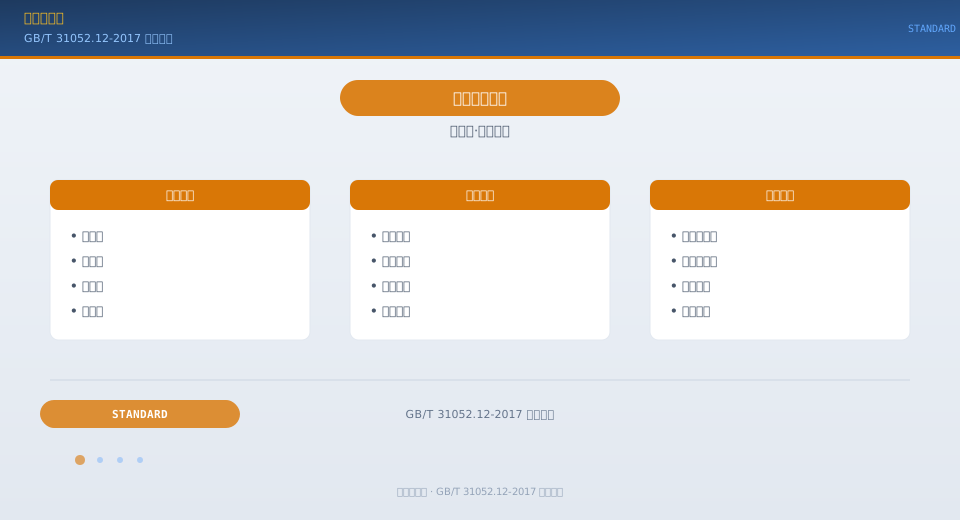

Boom Crane Slewing Bearing Inspection per GB/T 31052.12-2017
GB/T 31052.12-2017, "Cranes — Inspection and Maintenance — Part 12: Jib Cranes," is the dedicated standard governing the inspection and maintenance of jib-type cranes. It specifies the daily inspection, periodic inspection, and maintenance requirements for portal cranes, mast cranes, floating cranes, and deck cranes during service.
GB/T 31052.12-2017 is Part 12 of the crane inspection and maintenance standard series, specifically addressing the inspection and maintenance requirements for the structural components and slewing bearings of jib cranes. The slewing bearing and boom structure are critical load-bearing elements of a jib crane. This article provides an interpretation of the standard's core requirements.
Standard Scope and Inspection Framework
GB/T 31052.12-2017 is the 12th part of the GB/T 31052 series, dedicated to the inspection and maintenance of jib-type cranes, including portal, mast, floating, and deck cranes. Compared to other crane types, jib cranes feature more complex structures, a greater number of mechanisms, and more diverse working environments—ranging from docks and vessels to construction sites. Consequently, inspection and maintenance cycles vary significantly based on operating conditions and usage intensity. The standard establishes a four-tier inspection and maintenance system: daily inspection (each shift), first-level maintenance (monthly), second-level maintenance (quarterly), and annual comprehensive inspection. Each tier specifies detailed inspection items, methods, and acceptance criteria.
Daily Inspection Checklist
Before each shift, the following checks must be performed: Crane rail and foundation (for portal cranes)—verify the rail is free of obstructions, the track gauge is correct, buffer stops are secure, and rail clamps are in the open position. Boom—visually inspect the boom structure for deformation and cracks, ensure the boom connecting pins show no axial movement, and confirm the wire rope is properly seated in the pulley grooves. Hoisting mechanism—verify brake functionality (lift the hook 100 mm off the ground to confirm no load slipping), check that the wire rope is spooled evenly, and ensure at least 3 safety wraps remain on the drum. Slewing mechanism—confirm smooth slewing without binding or hesitation and that the slewing brake operates correctly. Safety devices—perform a self-check of the load moment limiter (LML), functional test all limit switches, and verify the anemometer reading is normal. For floating cranes, additionally check that the vessel's inclination angle does not exceed 5° and that the ballast water system is functioning properly.
Main Structural Component Inspection
The structural components of jib cranes are subjected to alternating loads and are prone to fatigue cracks. Key inspection focus areas include: Boom—use visual inspection and Magnetic Particle Inspection (MPI) to examine the boom root, gusset plate weld seams, luffing pulley support welds, and tie bar connections. Portal base (for portal cranes)—inspect the weld seams connecting the cross beams to the outriggers, with particular attention to the welds on both sides of the portal opening, where stiffness is lower and stress concentration is more pronounced. Slewing platform—inspect the welds and base plates at the hinge point between the slewing platform and the boom. Mast crane—check the straightness of the mast's main chord members (section axis deviation ≤ L/1000) and inspect the guy rope ground anchor connections for wear and corrosion. Floating crane—inspect the vessel structure, particularly the reinforced deck area in the lifting zone, for deformation and weld integrity.
Special Inspections for Floating Cranes
Floating cranes require additional inspections beyond those for land-based units: Hull watertightness—verify that the liquid level alarm devices in all watertight compartments are functioning correctly. Ballast system—confirm that ballast pumps and valves operate smoothly and that piping shows no signs of leakage. Hull corrosion protection—check that the anti-corrosion system for the submerged portion of the hull (sacrificial anodes or impressed current) is operational. Mooring system—inspect the windlass, anchor chain, and bollards for wear. Floating cranes must be dry-docked annually to inspect the underwater hull, including measuring bottom plate corrosion thickness and performing weld repairs as needed.
Jib Crane Structural Component Inspection Reference Table
The following reference table outlines the core parameters for structural component inspection of jib cranes, intended as a guide for selection and operational personnel.
Kelude Heavy Industry: Your Trusted Partner in Industrial Lifting Solutions
Kelude Heavy Industry is a professional manufacturer dedicated to the design, engineering, and production of industrial cranes and hoisting equipment. With years of experience and a strong focus on quality and reliability, we deliver robust, high-performance solutions tailored to the demands of modern industry.
Engineered for Performance and Safety
Our product range is designed to meet the most stringent operational requirements. Every crane we build undergoes rigorous testing and quality control to ensure safe, efficient, and long-lasting service. We prioritize safety and reliability in every component, from the structural steel to the control systems.
| Key Feature | Benefit |
|---|---|
| Robust structural design | Ensures durability and long service life in demanding environments. |
| Advanced safety systems | Provides reliable overload protection and operational safety. |
| Precision engineering | Delivers smooth, accurate load handling and positioning. |
| Customizable configurations | Tailored to fit specific facility layouts and lifting needs. |
Comprehensive Lifting Solutions for Diverse Industries
We offer a wide array of overhead cranes, gantry cranes, and hoists suitable for workshops, warehouses, and heavy industrial plants. Our solutions are engineered to optimize workflow and improve productivity, ensuring your operations run smoothly and safely.
Global Standards, Localized Expertise
Our equipment is designed and manufactured in accordance with internationally recognized standards, including ISO 4301 for crane classification and IEC 60204-32 for electrical equipment. This commitment ensures our products meet global safety and performance benchmarks, providing our customers with peace of mind and compliance assurance.
Dedicated Support and Service
From initial consultation and site assessment to installation, commissioning, and after-sales support, our team of experts is with you every step of the way. We provide comprehensive documentation, training, and maintenance services to ensure your equipment operates at peak performance throughout its lifecycle.
Frequently Asked Questions
Q: What types of cranes do you manufacture?
A: We manufacture a comprehensive range of overhead cranes, including single-girder and double-girder models, as well as gantry cranes and various hoisting solutions. Our portfolio covers capacities from light-duty workshop cranes to heavy-duty industrial systems.
Q: Can your cranes be customized for specific applications?
A: Absolutely. We understand that every facility has unique requirements. We offer extensive customization options, including span, lifting height, control systems, and special features like explosion-proof configurations or anti-sway technology, to ensure the perfect fit for your application.
Q: What safety standards do your products comply with?
A: Our cranes are designed and built to comply with major international safety standards, including ISO 12480 for crane safety and IEC 60204-32 for electrical installations. We also ensure our designs align with ISO 4301 classification guidelines.
Q: Do you provide installation and after-sales support?
A: Yes, we offer complete support services, including professional installation, operator training, and comprehensive after-sales maintenance. Our global service network ensures prompt assistance and spare parts availability to minimize downtime.
Q: What is your typical lead time for a standard crane?
A: Lead times vary depending on the crane type, specifications, and customization level. Generally, standard models can be delivered within a few weeks, while highly customized systems may require a longer lead time. Please contact us with your specific requirements for an accurate timeline.
Q: How do I determine the right crane capacity for my needs?
A: Determining the right capacity involves assessing the maximum load weight, duty cycle, and lifting frequency. Our engineering team can assist you in calculating the appropriate crane class and capacity based on your operational profile to ensure optimal performance and longevity.
Q: What is the price range for your cranes?
A: The cost of a crane depends on various factors, including capacity, span, configuration, and features. For a standard 10-ton overhead crane, the investment typically starts in the range of $45,000 to $60,000. We provide detailed, competitive quotes based on your specific project needs.
Q: Can you provide references or case studies?
A: Yes, we have a portfolio of successful installations across various industries globally. We are happy to share relevant case studies and connect you with existing customers for references upon request.
| inspection item | inspection content | inspection interval | Acceptance Criteria |
|---|---|---|---|
| boom structure | Weld Seam/Deformation/Crack | Monthly | None Crack/Deformation Measure< L/1000 |
| Slewing Bearing | Gear Wear/Bolt Looseness | Quarterly | Tooth Thickness Reduction<10% |
| Connectionpin | Wear/Corrosion/Clearance | Semi-annually | Clearance≤0.5mm |
| Wire Rope | wire break/Wear/Lubrication | Before Each Shift | Per GB/T 5972Standard |
FAQ
• Monthly — Measure radial and axial clearance of the slewing bearing using a dial indicator. Clearance exceeding 0.5 mm warrants attention.
• Semi-annually — Check and re-torque the slewing bearing connection bolts. Sample at least 20% of bolts and verify torque is at or above 90% of the specified value.
• Annually — Perform grease analysis to check for metal particles in the raceway lubricant.