Crane Buffer ISO 24818:2019 Requirements

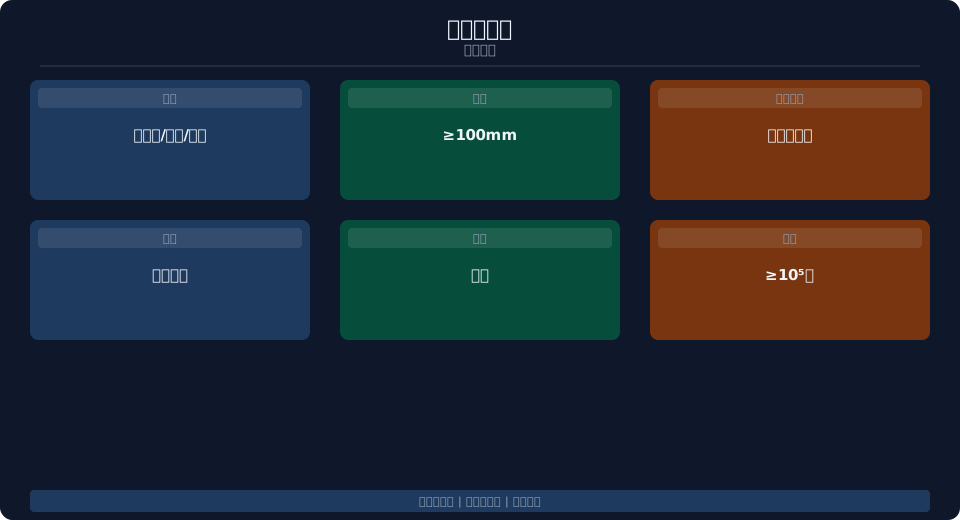
ISO 24818:2019, "Cranes — Technical requirements for buffers," is the product standard governing crane buffers. It defines technical parameters, test methods, and inspection rules for three buffer types: polyurethane buffers (applicable speed ≤50 m/min, excellent elasticity, simple construction), spring buffers (≤80 m/min, long service life, high reliability), and hydraulic buffers (≤120 m/min, bounce-free smooth deceleration). Key requirements include a rated stroke of ≥100 mm, ingress protection of at least IP54, factory compression deviation within ±10%, endurance of ≥10⁵ cycles with deformation ≤5%, and proper performance after 24-hour storage at −20 °C to +60 °C.


Technical Requirements for Crane Buffers

Buffers are classified by working principle into three types: polyurethane (applicable speed ≤50 m/min, good elasticity, simple structure), spring (≤80 m/min, long-lasting and reliable), and hydraulic (≤120 m/min, smooth deceleration without rebound). The rated stroke must be ≥100 mm, mounting bolts on the end carriage exterior must be at least M20, and ingress protection must meet IP54 or higher. Energy absorption is calculated from impact kinetic energy using E = 0.5mv² × K, where K is the impact coefficient ranging from 0.5 to 0.8. Kelude supplies all three buffer types as standard crane components.


Crane buffer diagram


Inspection and Standards Compliance

Routine testing involves a unit-by-unit compression test: each buffer is compressed to its rated stroke while the buffer force curve and energy absorption values are measured, with deviation limited to ±10%. Type testing includes an endurance test of ≥10⁵ cycles, after which deformation must not exceed 5% and the buffer must remain fully functional. Environmental testing requires proper buffer performance after 24 hours of storage at −20 °C to +60 °C. Kelude manufactures crane buffers for all crane types in accordance with ISO 24818.

Polyurethane
≤50 m/min
Spring
≤80 m/min
Hydraulic
≤120 m/min
Stroke
≥100 mm
Mounting
End carriage
Protection
≥IP54
Item Requirement
Polyurethane ≤50m/min
Spring ≤80m/min
Hydraulic ≤120m/min
stroke ≥100mm
Installation End Carriage Outer Side
Protection ≥IP54

Inspection Period
factory unit by unit
Annual Inspection Annually

Crane buffers are critical safety components that absorb impact energy during crane end-carriage or trolley travel, protecting both the structure and equipment from damage. The standard defines three buffer types, each suited to a specific speed range. Polyurethane buffers are applicable to speeds up to 50 m/min, offering good elasticity, a simple structure, and low cost, though their performance is more sensitive to temperature variations. Spring buffers are applicable to speeds up to 80 m/min, providing reliable construction and a long service life, but they produce a rebound effect during deceleration. Hydraulic buffers are applicable to speeds up to 120 m/min, using hydraulic damping to achieve smooth deceleration with no rebound—delivering the best overall performance at a higher cost and with periodic hydraulic oil maintenance required. The rated stroke of the buffer must be no less than 100 mm to ensure an effective deceleration distance. Buffers are installed on the outer side of the end carriage, directly facing the buffer stop at the end of the crane rail. Kelude supplies all three buffer types according to ISO 24818, covering the buffer requirements of cranes across all speed grades.

Frequently Asked Questions

Q: What are the three buffer types defined in ISO 24818:2019 and their applicable speeds?

A: Polyurethane buffers are applicable to speeds up to 50 m/min, offering good elasticity, a simple structure, and low cost, though they are more affected by temperature—suitable for small- and medium-tonnage cranes. Spring buffers are applicable to speeds up to 80 m/min, providing reliable construction and a long service life, but with a rebound effect during deceleration—suitable for medium-tonnage cranes. Hydraulic buffers are applicable to speeds up to 120 m/min, using hydraulic damping for smooth, rebound-free deceleration with the best overall performance—suitable for large-tonnage, high-speed cranes.

Q: What are the installation position and protection requirements for buffers?

A: Buffers are installed on the outer side of the end carriage, directly facing the buffer stop at the end of the crane rail. Bolts must be M20 or larger, and the protection rating must be IP54 or higher. The rated stroke must be at least 100 mm to ensure an effective deceleration distance. Energy absorption is calculated using the impact kinetic energy formula E = 0.5mv² × K, where K is the impact coefficient, ranging from 0.5 to 0.8 depending on the buffer type and installation method.

Q: What are the testing and inspection requirements for buffers?

A: Routine tests are performed unit by unit, compressing each buffer to its rated stroke and measuring the buffer force curve and energy absorption value, with a deviation of no more than ±10%. Type tests include a durability test of 10⁵ cycles or more, after which deformation must not exceed 5% and the buffer must remain fully functional. Environmental tests require storage at temperatures from -20°C to +60°C for 24 hours, after which buffer performance must remain normal. Kelude supplies crane buffers of all types according to the standard.

Q: What is the scope of Kelude's buffer supply?

A: Kelude supplies crane bridge and trolley buffers for overhead cranes, gantry cranes, and electric hoists in accordance with ISO 24818:2019, offering polyurethane, spring, and hydraulic types that cover all specifications for speeds up to 120 m/min, meeting a wide range of operating condition requirements.

Related News

contact

contact us

phone:
+86 13903802779

mail:3915269@qq.com

Working hours: Monday to Friday

Wechat
Wechat
SHARE
TOP