

Kelude Heavy Industry Solutions for Automotive, Solar & Warehousing
In modern manufacturing and logistics, vertical and horizontal material handling runs through the entire production chain, and handling efficiency directly determines plant capacity and operating costs. Kelude has spent years in the industrial handling sector, building a comprehensive portfolio of solutions across key industries including automotive, solar, warehousing & logistics, food & pharmaceuticals, and machining. From KBK flexible cranes on automotive final assembly lines to cleanroom handling systems in PV plants, from smart automated warehouses to food-grade stainless steel hoists, Kelude's product line delivers precision-engineered answers to material handling pain points across diverse industries. This article walks through six major industry scenarios, breaking down the unique handling requirements of each, the technical details of Kelude's solutions, and real-world results achieved by customers. All crane designs undergo strength, stiffness, and stability verification in accordance with ISO 4301 Crane Design Standard to ensure structural safety and reliability under all operating conditions. Further reading: KBK Flexible Crane Solutions for the Automotive Industry, Smart Warehouse Automation Retrofit Solutions.
Kelude Industry Solutions: Automotive, Solar, Warehousing & More
Kelude Heavy Industry has been a trusted name in industrial lifting and material handling for years. Below, we break down our tailored crane and handling solutions across five key industries—automotive parts, cleanroom solar manufacturing, smart warehousing, food and pharmaceutical plants, and general machining—along with real-world customer applications.
Crane Systems for Automotive Parts Handling
Automotive plants demand precision, speed, and reliability. Our overhead cranes are engineered to handle heavy engine blocks, transmissions, and stamped parts with smooth, precise positioning. With options like variable-frequency drives and anti-sway technology, operators can move components safely and efficiently across assembly and machining lines.
Customer case: A leading auto parts manufacturer integrated our double-girder overhead cranes into their production line, cutting material transfer time by 30% while significantly reducing product damage during handling.
Cleanroom Crane Solutions for Solar Manufacturing
Solar panel production requires contamination-free environments. Our cleanroom-compatible cranes feature sealed motors, stainless steel components, and low-particle emission designs, making them ideal for handling silicon wafers, glass substrates, and finished modules in ISO-classified cleanrooms.
Customer case: A photovoltaic module manufacturer deployed our single-girder cleanroom cranes in their wafer handling area, achieving stable, dust-free operation around the clock with minimal maintenance downtime.
Smart Warehousing and Logistics Cranes
Modern warehouses run on automation. Our intelligent crane systems integrate seamlessly with warehouse management systems (WMS) and automated storage and retrieval systems (AS/RS). From automated guided vehicles (AGVs) to stacker cranes, we provide end-to-end lifting solutions that optimize storage density and throughput.
Customer case: A third-party logistics provider upgraded their distribution center with our semi-automated overhead cranes, boosting storage capacity by 40% and reducing order picking time by nearly half.
Hygienic Lifting Equipment for Food & Pharma
Food and pharmaceutical processing demands strict hygiene and contamination control. Our washdown-capable cranes feature smooth, crevice-free surfaces, food-grade lubricants, and corrosion-resistant finishes. They are built to withstand frequent high-pressure cleaning and harsh chemical sanitizers, ensuring compliance with industry standards.
Customer case: A pharmaceutical plant chose our stainless steel hoists for their raw material handling. The equipment has operated reliably for over two years with zero contamination incidents, passing all internal and external audits.
Material Transfer Cranes for Machining Workshops
In machining and fabrication shops, moving heavy workpieces and tooling efficiently is critical. Our robust single and double-girder cranes are designed for frequent duty cycles, offering precise load positioning for CNC machines, lathes, and assembly stations. Options like remote control and overload protection enhance both safety and productivity.
Customer case: A heavy equipment manufacturer installed our 32/5t double-girder crane in their welding and assembly bay. The crane's smooth operation and high duty rating have significantly improved workflow and reduced manual handling risks.
Why Choose Kelude for Your Lifting Needs?
With decades of engineering expertise, Kelude Heavy Industry delivers more than just cranes—we provide complete material handling solutions. Our team works closely with you to assess your workflow, recommend the right equipment, and ensure seamless installation and after-sales support. From design to commissioning, we are committed to safety, reliability, and long-term performance.
Contact us today to discuss your project requirements and get a tailored lifting solution for your industry.
Automotive Parts Handling Solutions
Automotive manufacturing is a classic discrete manufacturing industry. From stamping, welding, and painting to final assembly, every process involves the transfer of large volumes of parts and precise positioning at workstations. Traditional overhead cranes paired with manual hook attachment create efficiency bottlenecks on automotive lines: fixed travel paths, time-consuming spreader changes, and difficulty synchronizing with automated production line cycles. Large assembly components such as engine blocks, transmission assemblies, and front/rear axles—ranging from 200 kg to 2 metric tons each—demand high positioning accuracy and operational flexibility from lifting equipment.
Kelude's KBK flexible modular crane solution for the automotive industry centers on a modular rail system paired with chain electric hoists or smart VFD hoists, covering material handling needs from 200 kg to 5 metric tons. The chain electric hoists and KBK single-girder suspension components are manufactured and inspected to the technical requirements of FEM 1.001 Electric Single-Girder Crane Standard, ensuring service life under frequent start-stop operation. Compared to traditional single-girder bridge cranes, the key advantage of the KBK system lies in its flexibility: rails can be laid out freely along the production line, with suspension point spacing of 3–6 m, and combinations of straight rails, curved rails, turntables, and switches enable seamless material flow across workstations and zones.
In a real-world application, an automotive OEM's engine block machining shop deployed Kelude's KBK-S single-girder suspension system with chain electric hoists and variable frequency travel drives. The line is laid out in a U-shape, with KBK rails running along the production flow from machining to washing to inspection stations—covering roughly 45 m of travel. Operators use radio remote controls to pick up, transfer, and place engine blocks with one hand. Cycle time per round trip dropped from 3 min 20 s with the previous crane-and-manual method to 1 min 15 s—an efficiency gain of over 60%.
For large interior trim parts on automotive final assembly lines—doors, instrument panels, seats—Kelude offers a pneumatic balancer on a KBK rail trolley system. The pneumatic balancer uses compressed air to create near-zero-gravity suspension, allowing operators to move loads up and down with minimal effort and hold positioning accuracy within ±2 mm. This is especially valuable for precision tasks like door installation: a worker can hold a door suspended at installation height with one hand while tightening bolts with the other, significantly reducing physical strain and assembly defect rates.
In EV battery module handling, battery packs weigh between 300–800 kg and have strict limits on tilt angle and shock. Kelude designed a dedicated battery handling spreader integrating a four-point spreader beam and angle limit sensors, with variable-frequency drives on both hoisting and travel motions to keep acceleration during start and stop within 0.2 m/s², preventing damage to battery modules from inertial impact. This solution is now deployed on PACK lines at three power battery manufacturers.
Cleanroom Handling for the Solar Industry
Solar manufacturing imposes extremely strict cleanliness requirements, particularly in silicon wafer, solar cell, and module production facilities, where cleanroom classes typically range from Class 1000 down to Class 100. Conventional cranes can introduce particulate contamination into cleanrooms through gearbox oil leaks, conductor rail wear debris, and chain dust. Additionally, silicon wafers sliced from ingots are only 160–180 microns thick—fragile and high-value—making them highly sensitive to vibration and shock during handling.
Kelude's specially developed cleanroom crane solutions tackle solar industry handling challenges from three angles. First, dust-proof design: all moving parts use sealed protective enclosures, gearboxes are fitted with oil collection trays, runway rails are made of stainless steel with passivation treatment, and dust-proof sealing strips are added at wheel-rail contact points—minimizing particle generation at the source. Second, ultra-low-speed smooth operation: variable-frequency motors paired with closed-loop encoders enable hoisting speeds as low as 0.5 m/min and travel speeds of 0.3 m/min, with programmable start/stop curves to ensure fragile workpieces like silicon ingots and quartz crucibles experience no shock during handling. Third, cleanroom adaptation: depending on the facility's cleanliness class, options include stainless steel construction, Teflon-coated surfaces, or anti-static treatment to meet requirements from Class 100 to Class 10000.
In a monocrystalline silicon ingot pulling shop, Kelude supplied two 5-metric-ton cleanroom bridge cranes installed above the crystal pullers for quartz crucible and silicon ingot replacement. The cleanroom is Class 1000, with crane rails approximately 8 m above the floor and a span of 22 m. The hoisting mechanism uses variable-frequency speed control with a minimum stable speed of 0.6 m/min, and the travel mechanism is driven by servo motors with positioning accuracy of ±5 mm. After one year of operational data collection, airborne particle measurements during crane operation consistently met cleanroom standards, and silicon ingot breakage from handling dropped from 0.8% to below 0.1%—reducing annual silicon material losses by approximately $178,000.
In the laminating machine loading stage of PV module production, glass and backsheet panels are large, lightweight, and prone to breakage. Kelude's vacuum lifter solution uses multi-zone independently controlled suction cup groups that adapt to different glass panel sizes (from 1.6 m × 1.0 m to 2.4 m × 1.3 m). Suction force is monitored in real time, with automatic alarms and descent speed limiting if vacuum drops below threshold. Combined with a KBK rail system providing full XY coverage above the laminating line, loading cycle time improved from 45 seconds per panel manually to 18 seconds per panel, with near-zero breakage rates.
Smart Warehouse & Logistics Solutions
Smart warehousing is the central hub of modern factory logistics, covering the full process from raw material receiving, WIP turnover, to finished goods shipping. Traditional warehouses relying on forklift round-trips suffer from overlapping travel paths, long wait times, and poor space utilization. As factory automation advances, warehouse logistics is evolving toward "goods-to-person" and automated storage/retrieval models, and cranes—as the vertical handling workhorse for heavy loads—play an irreplaceable role in automated storage and retrieval systems (AS/RS).
Kelude's smart warehouse logistics solutions center on automated bridge or gantry cranes integrated with warehouse management systems and IoT sensors for automated storage/retrieval and real-time inventory tracking. Core subsystems and capabilities include: a three-axis servo drive system delivering precise closed-loop control in X (crane travel), Y (trolley travel), and Z (hoisting) directions with positioning accuracy of ±3 mm; an intelligent anti-sway control system using active pendulum angle detection and speed compensation algorithms to keep load sway within ±0.5° after crane stop, cutting settling time from 15–20 seconds with conventional cranes to under 3 seconds; and an automatic address recognition system using barcode tape or RFID tags that enables the crane to automatically identify storage slot numbers and execute precise put-away. The system deeply integrates with WMS, updating inventory data in real time and supporting FIFO, batch management, and stock-out alerts.
In a smart warehouse project for an automotive parts manufacturer, Kelude deployed two 8-metric-ton automated double-girder bridge cranes working with high-bay racking for 24/7 unmanned storage and retrieval. The warehouse racks stand 12 m high, arranged in 6 rows with 8 levels each—960 storage slots in total. The cranes feature dual-mode positioning with laser distance measurement and barcode recognition, achieving load detection accuracy of ±5 mm. The anti-sway system keeps the spreader's single sway cycle within 2 oscillations after stopping at a travel speed of 15 m/min, with settling time ≤3 seconds. The system interfaces with the customer's MES and WMS, executing put-away, retrieval, and inventory counting tasks automatically via host computer commands.
Operational data shows an average single storage/retrieval cycle time of 98 seconds (including hoisting, travel, positioning, pick/place, and return), with daily throughput exceeding 360 standard pallets. By comparison, a conventional manual forklift warehouse of similar scale handles approximately 120 pallets per day and requires 8 forklift drivers on rotating shifts. Since commissioning, warehouse labor productivity has tripled, inventory accuracy improved from 92% (manual) to 99.8%, and warehouse space utilization rose from under 60% to over 85%. Total project payback period is approximately 2.8 years.
For smaller-scale line-side warehouses and WIP transfer applications, Kelude also offers a lightweight intelligent lifting solution. This approach uses column-mounted jib cranes or wall-travelling cranes as the primary structure, paired with VFD hoists and a simple positioning system. Operators enter material codes via handheld terminal or barcode scanner, and the system automatically retrieves materials from racks and delivers them to production line workstations. With low investment thresholds and short retrofit durations (typically 1–2 weeks for installation & commissioning), this solution suits budget-conscious small and mid-sized manufacturers seeking incremental automation upgrades to their warehouse logistics.
Crane Solutions Comparison Across Three Industries
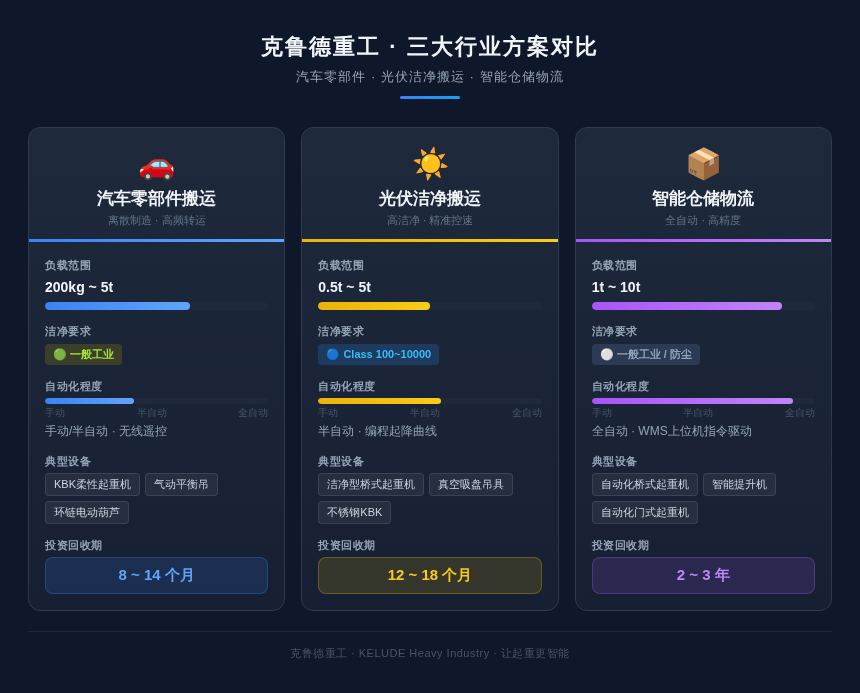
Automotive parts handling, solar cleanroom handling, and smart warehouse logistics represent the three most representative application areas in Kelude's solution portfolio. These three fields differ significantly in load range, cleanliness requirements, automation level, and positioning accuracy. The table below provides a multi-dimensional comparison to help customers quickly identify the appropriate equipment type and technical configuration for their needs.
| Lifting Capacity | 5 tons to 300 tons (metric), with larger custom capacities available upon request |
| Span | 10.5 m to 31.5 m, or custom spans to suit your facility layout |
| Lifting Height | 6 m to 18 m (standard), with higher lifts available as an option |
| Hoist Type | Wire rope hoist or chain hoist, depending on duty cycle and load requirements |
| Travel Speed | Crane: 20–45 m/min; Trolley: 15–30 m/min; Hoist: 4–12 m/min (variable-frequency drive optional) |
| Power Supply | 380V / 50Hz / 3-phase (other voltages and frequencies available on request) |
| Control Mode | Pendant station, wireless remote, or cabin control (optional) |
| Design Standard | ISO 4301, ISO 12480, IEC 60204-32 |
| Comparison Parameter | automotive parts Handling | PV Cleanroom Handling | Smart Warehousing Logistics |
|---|---|---|---|
| Typical Load Range | 200kg ~ 5t(engine, Gearbox (Transmission), Battery Pack) | 0.5t ~ 5t(Silicon Rod, Quartz Crucible, Glass Panel) | 1t ~ 10t(pallet, Tote Box, Heavy load Workpiece) |
| cleanliness classrequirements | Non-Cleanroomrequirements(General Industrial Environment) | Class 100 ~ Class 10000(cleanroom) | General Industrial Environment(Partial Warehouse Requirement Dustproof) |
| Positioning Accuracy | ±5 ~ ±10mm(Manual Operation Primary) | ±5mm(Servo Drive) | ±3 ~ ±5mm(3-Axis Closed-Loop Control) |
| Travel Speed | Fast-to-Medium Speed Predominant(8 ~ 20m/min) | Ultra-Low Speed Predominant(0.3 ~ 0.6m/min) | Medium Speed + Precise Start/Stop(5 ~ 15m/min) |
| Automation Level | Manual/Semi-automatic(Radio remote control) | Semi-automatic(Programmed Lift/Lower Profile) | Fully automatic(WMSHost Computer Command Driven) |
| Anti-sway Requirement | General(Manual Sway Control) | Medium(Fragile Workpiece Requires Soft Start/Stop) | High(Automated Storage/Retrievalrequirements±0.5°Within) |
| Core Equipment Type | KBK flexible crane, pneumatic balancer, Chain Electric Hoist | cleanroom type Bridge Crane / Overhead Crane, Vacuum Lifter, Stainless Steel KBK | Automationoverhead type/Gantry Crane, Intelligent Lifting Device |
| Recommended Control Method | Radio remote control + Variable Frequency Speed Control | Variable Frequency Drive (VFD)Closed-Loop + Programmable Profile | Servo Drive + WMS/MESIntegrated |
| Typicalpayback period | 8 ~ 14months | 12 ~ 18months | 2 ~ 3year |
| typical case Results | efficiency improvement60%, Labor Reduction67% | Damage Rate Reduced to0.1%Below | Productivity Improvement3x, Accuracy Rate99.8% |
As the comparison table shows, these three industries have distinctly different priorities when it comes to lifting equipment: automotive manufacturing values flexibility and efficiency gains above all, the photovoltaic sector demands cleanliness and smooth operation, while warehousing and logistics focus on automation and positioning accuracy. Kelude Heavy Industry addresses these diverse needs with turnkey solutions ranging from standard products to deeply customized systems. The right equipment selection and system configuration ultimately depend on a comprehensive assessment of your plant layout, material characteristics, and investment budget—our technical team is ready to provide tailored recommendations.
Food & Pharmaceutical Facility Solutions
The food and pharmaceutical industries impose stringent hygiene and safety requirements on equipment materials. Under GMP guidelines, any surface that comes into direct contact with products must be easy to clean, resistant to residue buildup and metal debris, and all lubrication points and drive components must be physically isolated from the production area. The biggest challenge conventional cranes face in food and pharmaceutical facilities is hygiene risk: chain oil residue, conductor rail wear particles, peeling paint, and hard-to-reach crevices can all become breeding grounds for microorganisms. To address this, Kelude's hygienic crane solutions also comply with the mandatory requirements of GB 6067.1-2010 "Safety Regulations for Lifting Appliances – Part 1: General Requirements", incorporating a full suite of safety devices—from limit switches, overload protection, and emergency stop to wind and slip prevention—ensuring both hygiene and safety standards are met.
Kelude Heavy Industry has developed a hygienic crane solution for the food and pharmaceutical sectors, aligning every aspect of material selection and structural design with GMP and FDA requirements. Key design highlights include: all-stainless-steel construction—hooks, chains, rails, and wheels are made from 304 or 316L stainless steel with mirror-polished surfaces (Ra ≤ 0.8 μm) that are free of dead corners and easy to clean; food-grade lubrication—all bearings and drive components use NSF H1-certified food-grade white oil or silicone-based grease, so evenTrace leakage cannot contaminate pharmaceuticals or food products; and fully enclosed structures—the hoisting mechanism is housed in a sealed stainless steel casing, travel motors are fitted with stainless steel dust covers, and conductor rails are replaced with stainless steel cable drag chains or wireless power supply systems to completely eliminate wear particle sources.
A representative application in the pharmaceutical industry is a traditional Chinese medicine extraction facility. The plant needed to lift herbal material batches weighing between 100–500 kg from above the extraction tanks to the charging ports. The cleanroom is rated Class D (Class 100,000), and all equipment must withstand daily high-pressure water jet washing and disinfection. Kelude supplied two 3-ton stainless steel chain electric hoists mounted on 304 stainless steel I-beam rails. The hoists carry an IP65 protection rating, the control boxes are stainless steel with IP66 protection, and all electrical connections use quick-connect aviation plugs. The chains are nickel-plated stainless steel flat link chains with drip trays installed beneath the chain boxes. Since commissioning, the equipment has undergone daily high-pressure rinsing and has operated continuously for 18 months with zero failures due to water ingress or corrosion.
In food processing, Kelude's hygienic cranes are widely used for raw material handling in meat processing, dairy, and bakery operations. A major frozen food manufacturer installed six stainless steel KBK suspension systems in its raw material thawing and cutting workshops. Thawed meat is handled in a low-temperature, high-humidity environment of -2°C to 4°C, placing extreme demands on material corrosion resistance. Kelude's solution uses all-stainless-steel KBK rails with Teflon-coated wheels, paired with IP66-rated stainless steel chain hoists. After 18 months of continuous operation, there have been no signs of rust, coating delamination, or microbial contamination.
Cleanliness maintenance is equally critical in food and pharmaceutical facilities. Kelude provides a cleaning operation manual with every crane, specifying procedures for routine cleaning (weekly), deep cleaning (monthly), and full disinfection (quarterly), along with operator training services to help user units maintain long-term cleanroom compliance.
Machining & Material Handling Solutions
Machine shops are classic multi-variety, low-volume production environments where workpieces move through turning, milling, planing, grinding, drilling, heat treatment, and other processes—each step requiring material transfer between stations. Unlike high-volume automotive assembly lines, machine shop workpieces vary dramatically in shape, weight, and batch size—from precision molds weighing a few kilograms to cast steel blanks weighing several tons—demanding exceptional versatility and flexibility from lifting equipment.
Kelude Heavy Industry addresses the specific needs of the machining sector with material handling solutions built around general purpose bridge cranes and wall-travelling cranes. The general purpose bridge cranes are designed and manufactured in strict compliance with FEM 1.001 "General Purpose Bridge Cranes", ensuring all performance parameters and safety indicators fully meet the standard. In workshops with wide spans (18–30 m), a single general purpose bridge crane covers the entire bay's vertical and horizontal handling needs. Combined with variable-frequency speed control and inching capability, it can rapidly move rough castings while also precisely placing finished machined parts. For congested shops with dense machine tool layouts, wall-travelling cranes mount along the workshop walls, freeing up floor space between columns. The crane travels on wall-mounted rails with a cantilever arm extending over the machine tools for loading and unloading—one unit can serve 3–5 machines.
A precision machining company provides a compelling real-world example. The manufacturer produces hydraulic components for construction machinery in a 5,000 m² facility housing 32 CNC machining centers, with workpiece weights ranging from 30 kg to 1.8 tons. Previously, material handling relied on three forklifts and two gantry cranes—the forklift aisles consumed significant floor space, and the gantry cranes could only operate in designated areas, making layout changes difficult during production line expansions. Kelude planned three 5-ton wall-travelling cranes arranged symmetrically along both side walls, each with an 8 m working radius covering 8–12 machine tools. Lifting speed is two-speed controlled: 8 m/min fast for empty hooks and 1.5 m/min micro-speed for loaded lifts.
The results after implementation were substantial: aisle width was reduced from 4 m to 2.5 m, increasing usable machine floor area by approximately 18%; average workpiece transfer time dropped from 12 minutes to 4.5 minutes, extending effective daily machining time by about 1.5 hours; and the three wall-travelling cranes operate simultaneously without interference, eliminating the forklift queue bottleneck. Subsequent production line expansions were accomplished simply by extending the wall rails longitudinally—no civil works required, with each expansion costing only about 15% of the original investment.
For cross-workshop transfer of heavy items such as large cast steel components and welded structures, Kelude recommends combining electric flat cars with bridge cranes. The flat car handles horizontal transport while the bridge crane manages vertical loading and unloading, creating an efficient long-distance material flow system. A heavy industry manufacturer uses a Kelude KPD series electric flat car (30-ton capacity, remote control operation) in conjunction with a 50-ton bridge crane to move large hydraulic supports from the welding area through heat treatment to the machining zone—a distance of approximately 180 m completed in just 12 minutes per trip, compared to nearly 40 minutes with the previous flatbed-and-forklift relay method, while reducing forklift operators from four to one.
Customer Case Studies & Results
The following summarizes representative customer cases and key performance data from Kelude Heavy Industry across five major industries in recent years.
Case 1: Engine Block Workshop, Passenger Vehicle Manufacturer (East China)
The facility originally operated 15 CNC machining centers with a single-girder bridge crane and manual handling for workpiece transfer. After retrofitting with a Kelude KBK-S single-girder suspension system—45 m of rail arranged along a U-shaped production line with three chain electric hoists—the workshop achieved closed-loop handling from rough casting loading to finished product inspection. Cycle time per operation dropped from 3 minutes 20 seconds to 1 minute 15 seconds, a 60.4% efficiency improvement; operators were reduced from three per shift to one; and annual labor savings amount to approximately ¥240,000. The equipment investment of about ¥180,000 was recovered in 8 months.
Case 2: Monocrystalline Silicon Ingot Pulling Workshop, PV Manufacturer (North China)
Two 5-ton cleanroom-type bridge cranes with a 22 m span operate in a Class 1000 cleanroom environment. Variable frequency hoisting achieves a minimum speed of 0.6 m/min, and servo-driven travel provides positioning accuracy of ±5 mm. After one year of operation, silicon ingot breakage rates fell from 0.8% to below 0.1%, reducing annual silicon material losses by approximately ¥1.2 million. All airborne particulate detection tests passed. The equipment investment of roughly ¥650,000 was recouped in 14 months.
Case 3: Automated Warehouse, Automotive Parts Manufacturer (East China)
Two 8-ton automated double-girder bridge cranes operate with 12 m high racking providing 960 storage locations. Dual-mode positioning (laser distance measurement plus barcode addressing) achieves ±5 mm accuracy, and the anti-sway system stabilizes loads in ≤3 seconds. Each storage/retrieval cycle takes 98 seconds, processing 360 pallets daily. Labor productivity tripled, inventory accuracy improved from 92% to 99.8%, and space utilization increased from 60% to 85%. Total investment of approximately ¥2.8 million has a payback period of 2.8 years.
Case 4: Traditional Chinese Medicine Extraction Workshop (Central China)
Two 3-ton stainless steel chain electric hoists on 304 stainless steel rails operate in a Class D cleanroom with daily high-pressure water jet washing. IP65/IP66 protection ratings, stainless steel flat link chains with drip trays. 18 months of operation with no water ingress, corrosion, or microbial contamination.
Case 5: Raw Material Handling, Frozen Food Plant (Southwest China)
Six stainless steel KBK suspension systems operate in a -2°C to 4°C low-temperature, high-humidity environment. All-stainless-steel rails with Teflon-coated wheels and IP66-rated hoists. 18 months of operation with no rust, coating delamination, or microbial contamination.
Case 6: Precision Machining Company (East China)
Three 5-ton wall-travelling cranes with 8 m working radius cover 32 machine tools. Aisle width reduced from 4 m to 2.5 m, improving space utilization by 18%. Workpiece transfer time cut from 12 minutes to 4.5 minutes. Production line expansions are achieved by extending the wall rails—subsequent expansion costs are only 15% of the original investment.
Case 7: Hydraulic Support Cross-Workshop Transfer, Heavy Industry Manufacturer (North China)
A KPD-30T electric flat car paired with a 50-ton bridge crane covers a 180 m transfer distance in 12 minutes per trip. The previous method took 40 minutes—a 70% efficiency improvement. Forklift operators were reduced from four to one, saving approximately ¥150,000 annually in fuel and maintenance costs. The equipment investment of about ¥220,000 was recovered in 18 months.
All data from these cases comes from actual project operational statistics and is fully traceable. Kelude Heavy Industry provides every customer with lifecycle service—from solution design and Design & Manufacturing through Installation & Commissioning to after-sales maintenance—ensuring each handling solution effectively resolves production pain points and delivers tangible cost reduction and efficiency improvement within the expected investment payback period.
FAQ
Q: Which manufacturing sectors do Kelude Heavy Industry's industry solutions cover?
A: Kelude Heavy Industry's solution portfolio covers five key sectors: automotive parts handling, photovoltaic (PV) cleanroom handling, smart warehousing and logistics, food and pharmaceutical workshops, and machining material transfer. For the automotive industry, we offer KBK flexible modular cranes paired with pneumatic balancers and smart VFD hoists. In the PV sector, we provide dust-proof ultra-low-speed cranes purpose-built for cleanroom environments. For warehousing and logistics, we deploy automated overhead or gantry cranes integrated with Warehouse Management System (WMS). In food and pharmaceutical facilities, we supply fully stainless steel, hygienic-grade lifting equipment. Machining workshops are served primarily by general purpose bridge cranes and wall-travelling cranes, designed for high-mix, low-volume material transfer needs. The portfolio also includes supporting equipment such as electric flat cars and jib cranes, delivering end-to-end material handling solutions from single-point lifting to full production-line coverage.
Q: What sets cleanroom cranes apart from standard overhead cranes?
A: PV cleanrooms (Class 1000 to Class 100) impose strict requirements on crane cleanliness and precision. Kelude's cleanroom cranes are engineered with a three-pronged targeted design approach. First, dust-proofing: all moving parts are enclosed in sealed protective housings, stainless steel rails undergo passivation treatment, and crane wheels are fitted with dust-proof sealing strips. Second, ultra-low-speed smooth operation: variable-frequency motors paired with closed-loop encoders deliver lifting speeds as low as 0.5 m/min and travel speeds of 0.3 m/min, with programmable acceleration/deceleration curves to protect fragile loads such as silicon rods and quartz crucibles from impact. Third, cleanroom compatibility: depending on the required cleanliness class, options include stainless steel construction, Teflon coating, or anti-static treatment. Real-world operating data from monocrystalline silicon pulling workshops shows this solution reduces silicon rod breakage rates from 0.8% to below 0.1%.
Q: How do cranes achieve automated operation in smart warehousing systems?
A: Kelude's smart warehousing automation rests on three core technologies. A three-axis servo drive system delivers precise closed-loop control across X (crane travel), Y (trolley travel), and Z (hoisting) axes, achieving positioning accuracy of ±3 mm. The intelligent anti-sway control system uses active sway angle detection and speed compensation algorithms to keep load sway within ±0.5° after stopping, with settling time of ≤3 seconds—far outperforming the 15–20 second wait times of conventional cranes. An automatic address identification system uses barcode tape or RFID tags for positioning, allowing the crane to automatically recognize storage slot numbers and execute precise put-away operations. The system integrates deeply with customer MES and WMS platforms, with host computer commands automatically triggering storage, retrieval, and inventory counting tasks without manual intervention. In one automotive parts project, two 8-ton automated double-girder bridge cranes working with 12-meter-high racking achieved a daily throughput of over 360 pallets, tripling labor efficiency.
Q: What special hygiene requirements apply to cranes in food and pharmaceutical facilities?
A: Food and pharmaceutical operations must strictly comply with GMP regulations, and Kelude's hygienic crane solutions are designed to meet both GMP and FDA requirements. Key measures include: full construction from 304 or 316L stainless steel with mirror-polished surfaces (Ra ≤ 0.8 μm), featuring crevice-free designs that are easy to clean; all bearings and drive components lubricated with NSF H1-certified food-grade grease, ensuring evenTrace leakage cannot contaminate products; hoisting mechanisms enclosed in sealed stainless steel housings; travel motors fitted with stainless steel dust covers; and conductor rails replaced with stainless steel cable drag chains or wireless power supply to completely eliminate wear-particle sources. Electrical protection is rated IP65 to IP66, withstanding daily high-pressure water jet washing and disinfection. In actual operation at traditional Chinese medicine extraction workshops and frozen food plants, this solution has maintained 18 consecutive months of operation with zero water ingress, zero corrosion, and zero microbial exceedance records.
