
GB/T 24815-2009 Crane Pulley Spec: Rope Groove & Hardness

GB/T 24815-2009 "Cranes — Sheaves for Hoisting Mechanisms" is the dedicated standard for the design, manufacturing, and inspection of crane pulleys. The standard specifies materials, rope groove profiles and dimensions, heat-treatment hardness, and inspection requirements for both cast and rolled sheaves. The matching relationship between sheave diameter and wire rope diameter directly affects wire rope service life. This article provides a clause-by-clause interpretation of the standard's core provisions and technical parameters.

GB/T 24815-2009, "Cranes — Sheaves for Hoisting Mechanisms," was issued and implemented in 2009. It specifies the types, dimensions, technical requirements, test methods, and inspection rules for sheaves used in crane hoisting mechanisms. This standard applies to cast sheaves and rolled sheaves for wire rope cranes and serves as the direct basis for sheave design and manufacturing. Kelude crane pulleys are designed and produced in accordance with this standard.


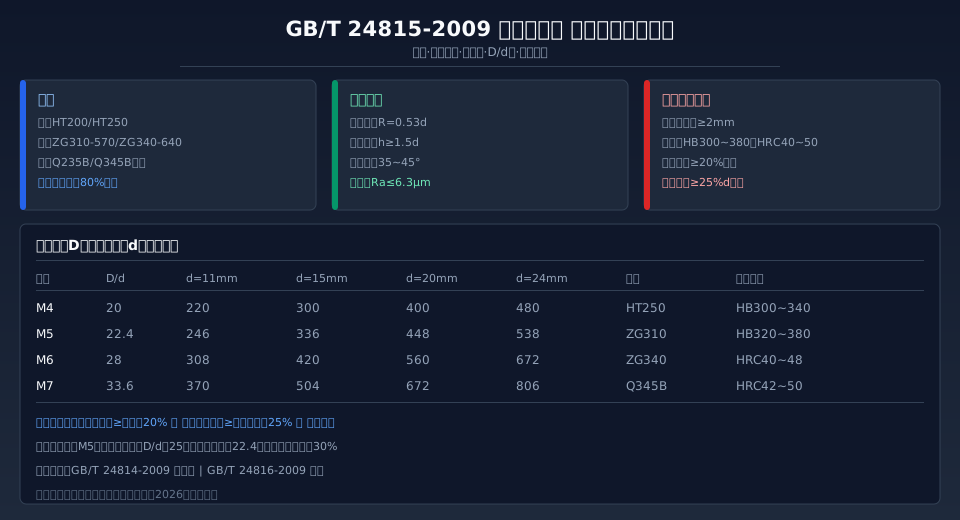
GB/T 24815-2009 crane pulley technical specifications and parameters

Sheave Materials and Heat Treatment

Cast Sheave Materials: Cast iron sheaves are made of HT200 or HT250 grey cast iron, suitable for low-speed, light-load applications. Cast steel sheaves are made of ZG310-570 or ZG340-640, offering superior strength and wear resistance compared to cast iron.

Rolled Sheave Materials: Rolled sheaves are formed by hot rolling Q235B (≈S235JR) or Q345B (≈S355J2) steel plates, offering a dense grain structure, high strength, and low weight. Rolled sheaves are currently the mainstream product in the crane industry, accounting for over 80% of the market.

Heat Treatment Requirements: The rope groove surface of steel sheaves must be quenched, with a hardened layer depth of ≥2 mm and a surface hardness of HB300–380 (flame quenching) or HRC40–50 (induction hardening). The rope groove surface hardness of cast iron sheaves must be ≥HB190.


Rope Groove Dimensions and Wire Rope Matching

The standard imposes strict requirements on rope groove profile and dimensions. The groove bottom radius R must equal 0.53 times the nominal diameter of the wire rope. The groove depth h must be ≥1.5d (where d is the wire rope diameter). The included angle of the rope groove is typically 35°–45°.

The ratio of sheave diameter D to wire rope diameter d is determined according to working class. For M4 class sheaves, D≥20d; for M5 class, D≥22.4d; for M6 class, D≥28d; for M7 class, D≥33.6d; and for M8 class, D≥40d. Equalizer sheaves (non-working sheaves) may have a diameter 20% smaller than that of working sheaves of the same class.


Sheave Discard Criteria

A sheave must be scrapped if any of the following conditions is met: ① wall thickness wear of the rope groove reaches 20% of the original wall thickness; ② wear at the groove bottom diameter reaches 25% of the wire rope diameter; ③ the wheel flange is damaged or cracked; ④ the spoke is fractured or the hub is cracked; ⑤ the sheave does not rotate smoothly or exhibits binding.


Sheave Diameter vs. Wire Rope Diameter Comparison Table

Working Class Minimum Sheave Diameter Ratio (D/d)
M4 ≥20
M5 ≥22.4
M6 ≥28
M7 ≥33.6
M8 ≥40
← Scroll left / right to view full table →
Work Duty / Classification D/d Ratio 11mm Rope Pulley D 15mm Rope Pulley D 20mm Rope Pulley D Pulley Material rope groove hardness
M420220300400HT250/ZG310HB300~340
M522.4246336448ZG310-570HB320~380
M628308420560ZG340-640HRC40~48
M733.6370504672Q345B (≈S355J2)RolledHRC42~50
Kelude StandardM5Grade Electric Hoist Pulley D/d Per25Control, Exceeds National Standard22.4, Wire Rope Extended Service Life30%
Sheave Materials
Cast iron HT200/HT250, cast steel ZG310/ZG340, rolled Q235B/Q345B
Rope Groove Dimensions
Bottom radius R=0.53d, depth h≥1.5d, included angle 35–45°
D/d Ratio Requirements
M4≥20, M5≥22.4, M6≥28, M7≥33.6, M8≥40
Heat Treatment
Steel sheaves: hardened layer ≥2mm, hardness HB300–380 or HRC40–50
Scrapping Criteria 1
Rope groove wall thickness wear ≥20% of original wall thickness
Scrapping Criteria 2
Groove bottom diameter wear ≥25% of wire rope diameter, or cracks present

Frequently Asked Questions

Q: Why must the sheave diameter increase with a higher work duty classification?

A: A larger sheave diameter increases the bending radius of the wire rope, which reduces bending stress and extends the rope's fatigue life. Tests show that increasing the D/d ratio from 20 to 25 can extend the wire rope's bending fatigue life by approximately 50%. For this reason, equipment rated for higher work duty levels uses larger sheave diameters to compensate for the increased bending fatigue from more frequent duty cycles.

Q: Which is better — a cast sheave or a rolled sheave?

A: Rolled sheaves are the preferred choice in modern applications. Compared to cast sheaves, rolled sheaves are 30%–40% lighter, have a dense grain structure free from casting defects, and offer uniform hardness across the rope groove surface. The main drawback is higher die costs, making them best suited for volume production. Cast sheaves remain a practical option for low-volume custom specifications or very large diameters (>1200mm). Kelude Heavy Industry uses rolled sheaves as standard across its product range.

Q: How much rope groove wear is acceptable before a sheave must be replaced?

A: A sheave must be scrapped when groove wall thickness wear reaches 20% of the original wall thickness. Replacement is also required when groove bottom diameter wear reaches 25% of the wire rope diameter. As the groove wears, the contact area between the rope and sheave decreases, increasing contact stress and accelerating rope wear. At the same time, higher sliding resistance makes the sheave harder to rotate.

Q: What are the common causes of a sheave not rotating?

A: Common causes include: ① bearing lubrication starvation or degraded grease; ② bearing failure (rolling element wear or cage deformation); ③ rope groove wear causing the wire rope to jam in the groove; ④ pulley shaft bending or deformation; ⑤ insufficient clearance between the sheave and side plates. Applying grease once a month effectively prevents bearing faults, and a quarterly check of sheave rotation freedom is recommended.

Related News

contact

contact us

phone:
+86 13903802779

mail:3915269@qq.com

Working hours: Monday to Friday

Wechat
Wechat
SHARE
TOP