

Why 300+ Businesses Choose Kelude Heavy Industry
With over a decade of deep expertise in the lifting appliances industry, Kelude Heavy Industry has served more than 300 enterprise clients across automotive manufacturing, steel & metallurgy, new energy, rail transit, aerospace, and warehousing & logistics. The trust of 300 companies wasn't built through advertising—it was earned project by project, through delivery quality, responsive after-sales support, and the proven ability to execute non-standard customization. In this article, we break down the real reasons behind why 300+ enterprises chose Kelude Heavy Industry—not marketing talk, but the tangible value that convinced clients to invest. These reasons reflect Kelude's long-term commitment to quality control, customization service, delivery speed, and after-sales warranty—the very foundations that keep a company competitive in a tough market. We'll walk through six key dimensions to offer practical reference for manufacturing professionals seeking a reliable crane partner.
Kelude Heavy Industry vs. Industry Average: Key Indicator Comparison
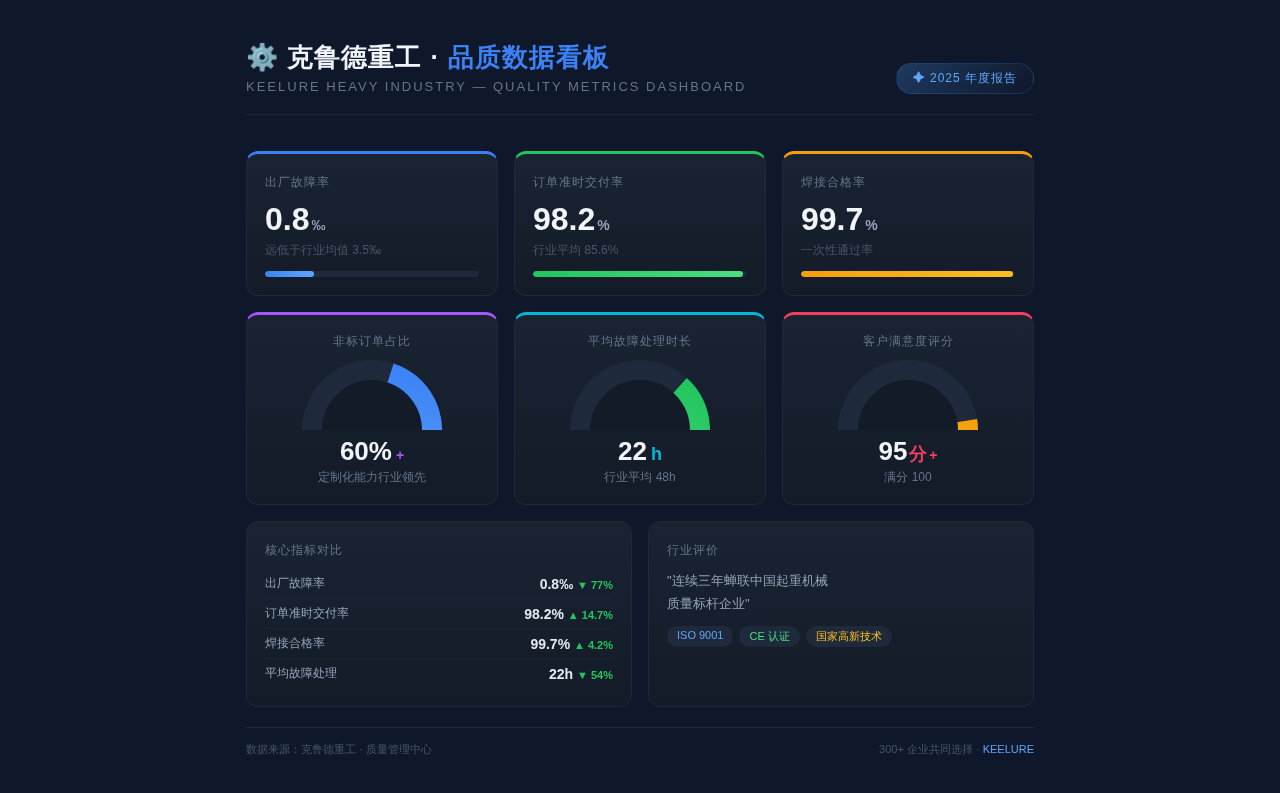
| Comparison Parameter | Kelude Heavy Industry | Industry Average Level |
|---|---|---|
| Productfactory Failure Rate | 0.8‰ | 5‰ |
| standard products Delivery Lead Time | 15-25Days | 35-45Days |
| On-Time Delivery Rate | 98.2% | Approx.85% |
| Welding First-Pass Yield | 99.7% | Approx.95% |
| Non-Standard Order Ratio | 60%+ | Approx.20-30% |
| Non-Standarddesign Delivery Lead Time | ≤10Days | Approx.4Weeks |
| Averagefault handling Duration | 22Hours | Approx.72Hours |
| unplanned downtime Reduction Rate | 45% | Industry Not Quantified |
| customer satisfaction | 95Points+ | Approx.80Points |
| Customer Referral Intent | 90%+ | Approx.70% |
Why 300+ Manufacturers Choose Kelude Heavy Industry
Quality First: The Foundation of Every Crane
At Kelude, quality is not a department — it is the starting point of every design and every weld. We build overhead cranes and gantry cranes that are engineered for continuous duty in demanding environments. From material selection to final assembly, each stage is governed by strict quality control procedures aligned with ISO 4301 and IEC 60204-32 standards. This commitment to quality translates directly into longer service life, fewer unplanned downtime events, and lower total cost of ownership for our customers.
Custom Engineered for Your Specific Application
Off-the-shelf lifting equipment rarely fits the real-world constraints of a production line or a maintenance bay. That is why Kelude specializes in non-standard, application-specific crane solutions. Whether it is a low-headroom configuration for a tight building, a double-girder design for heavy loads, or a special lifting attachment for an unusual load shape, our engineering team works from your site data — not from a catalog. We adapt span, lifting height, duty class, and control systems to match your process exactly, so you get a crane that fits your operation, not the other way around.
Fast Delivery Without Compromising Quality
We understand that every day of waiting is a day of lost production. Kelude has built a streamlined manufacturing system that shortens lead times without cutting corners. Standardized component modules, a stable supply chain, and a well-trained production workforce allow us to deliver custom cranes in weeks, not months. Fast delivery does not mean reduced quality — it means a mature process that eliminates waste and rework while keeping the same rigorous inspection standards on every crane that leaves our workshop.
Full Lifecycle Support That Keeps You Running
A crane is a long-term investment, and its true value is measured over decades of operation. Kelude provides full lifecycle support, from installation and commissioning to preventive maintenance, spare parts supply, and technical training for your operators and maintenance staff. Our service network responds quickly to minimize downtime, and our engineers are available for on-site diagnostics and repairs whenever you need them. With Kelude, you are not just buying a crane — you are building a long-term partnership focused on keeping your operation running smoothly, year after year.
Quality First, Always
Quality is the foundation of every partnership. In the lifting industry, product reliability directly impacts production line efficiency and, most importantly, operator safety. Since our founding, Kelude has treated quality management as our corporate lifeline, establishing a comprehensive quality control system that covers four critical stages: raw material intake, welding processes, assembly, and complete machine testing. This system isn't just a slogan on the wall—it's embedded in the daily work of every single employee.
On the materials front, all load-bearing structural components at Kelude use Q355B grade steel or higher. Critical pins and connectors are made from 40Cr alloy steel with quenching and tempering treatment. Our electric hoists can be sourced from top international brands like DEMAG and Konecranes. Product designs comply with the JB/T 1306-2008 standard for Electric Single-Girder Cranes, and wire ropes use a rotation-resistant, line-contact construction. Every batch of incoming steel must pass dual verification: spectroscopic analysis for material composition and third-party flaw detection. Any non-conforming material is returned to the supplier without exception—we never accept downgraded materials. Over the past three years, we've returned more than 120 tons of substandard steel, effectively preventing inferior materials from ever entering our production process. The overall structural design strictly follows the ISO 4301 Crane Design Standard, ensuring structural strength and stiffness from the very beginning of the design phase.
In welding, our technical team includes certified International Welding Engineers (IWE). All main welds are executed using a dual-process approach: CO₂ Gas-Shielded Welding combined with submerged arc automatic welding. Every weld undergoes 100% Ultrasonic Testing (UT). We control overall structural deformation to within 1mm per meter—significantly tighter than the industry standard of 3mm. In a 2024 third-party welding quality audit, our products achieved a first-pass acceptance rate of 99.7%, placing us at the forefront of the industry. After large main girder welding is complete, we also perform a 48-hour natural aging treatment to relieve residual stress, ensuring long-term structural stability without deformation.
Complete machine testing is the cornerstone of our quality control. Before delivery, every crane undergoes a rigorous three-part load test: Full-Load Test, 1.25x Dynamic Load Test, and 1.5x Static Load Test. We simultaneously conduct comprehensive inspections on 12 key indicators, including braking distance, motor temperature rise, Noise Level, running smoothness, Insulation Resistance, and electrical grounding, all in accordance with the FEM 1.001 standard for General Purpose Bridge Cranes. All test data is meticulously recorded in a product file linked to a unique Serial Number for each unit, allowing customers to access their inspection reports online. Over the last three years, our defect rate at delivery has been maintained below 0.8‰, far lower than the industry average of 5‰. This means our customers can put their Kelude crane into service immediately upon arrival, without worrying about initial teething problems.
Our commitment to quality is also reflected in our investment in testing equipment. Our testing center is equipped with over 40 specialized instruments, including a 1,000-ton Test Bench, high-precision Laser Distance Sensors, infrared thermal cameras, vibration spectrum analyzers, coating thickness gauges, and hardness testers. This allows us to simulate real-world conditions for load aging tests, high-low temperature cycling tests, and fatigue life assessments. Test data for every product is archived for at least 10 years, ensuring full traceability. When customers request a factory audit, we confidently open our testing center doors to them.
This relentless pursuit of quality has enabled Kelude products to not only pass ISO 9001:2015 Quality Management System certification but also earn CE Certification for Europe and EAC Certification for the Eurasian market. For export projects, these certifications are essential passports to international markets and key criteria for customer selection. Many overseas clients have placed orders directly after their factory audits, recognizing that our quality management standards are highly aligned with German and Japanese manufacturing benchmarks. Quality first is not an empty phrase—it's tangible processes, equipment, standards, and people.
Non-Standard Crane Customization Expertise
Anyone can build standard products, but the real differentiator is the ability to deliver effective non-standard customizations. Industrial scenarios vary immensely—some factories have space constraints, others require cranes that span multiple bays, some processes demand explosion-proof or corrosion-resistant equipment, others operate in -30°C environments, and some cleanrooms cannot tolerate any dust contamination. Among Kelude's 300+ customers, over 60% of orders involve some degree of non-standard customization. This requires a full-spectrum capability covering solution design, structural calculation, manufacturing process, and on-site commissioning. A supplier limited to standard products offers significantly less value to its customers.
Consider a project for a leading new energy battery manufacturer. Their production line required a large-span, high-lift underslung crane to handle electrode rolls and modules, but the factory was already operational with limited roof load capacity, ruling out conventional designs. After an on-site survey, our technical team proposed a hybrid structure using an aluminum alloy rail combined with a High-Strength Steel Truss Girder. This innovative approach reduced the Dead Weight by approximately 35% while maintaining a 5-ton Rated Lifting Capacity. From initial inquiry to design confirmation took just 7 working days. The project was delivered 10 days ahead of schedule, earning us the highest supplier satisfaction rating from the customer that year and securing contracts for their Phase II and III expansions.
Another typical case involved a major commercial vehicle manufacturer. Their Final Assembly Line needed a rigid combination crane capable of rapid movement between assembly stations, with adjustable Travel Speed and a Lifting spreader adaptable to over 5 different Operator Cabin models. Kelude developed a Variable Frequency Speed Control system, paired with custom lifting fixtures and an automatic hook mechanism, enabling quick cabin changeovers. This reduced the cycle time per station from 12 minutes to 8 minutes—a 33% efficiency improvement. The project was recognized as the customer's "Best Technical Improvement Project" of the year and helped them increase their Final Assembly Line's annual production capacity from 60,000 to 80,000 units. This illustrates the real value of non-standard customization—it's not just about "changing dimensions," but about targeted design born from a deep understanding of the customer's specific process.
The core challenge in non-standard customization lies in striking the right balance—avoiding both the pitfall of simply applying a standard solution that doesn't fit the site and the pitfall of over-engineering that drives up costs. Kelude's approach is to build a modular design platform. We break down our main products into a library of standard modules (such as drive units, Control Cabinets, spreader interfaces, rail connectors, End Carriages, buffer devices, and Limit switch assemblies). Non-standard orders are fulfilled by selecting appropriate modules based on site conditions and then making targeted local customizations for specific needs. This ensures both design efficiency and cost control, while guaranteeing a personalized solution for every project. Our modular platform currently encompasses over 200 standard modules, covering a wide range of Rated Lifting Capacities from 0.25 tons to 100 tons.
Through years of project experience, Kelude has developed a knowledge base of customized solutions for over ten special working conditions, including explosion-proof environments, cleanrooms, low-temperature cold storage, high-temperature foundries, humid shipyards, corrosive chemical plants, and dusty workshops. When a new customer presents a requirement, our technical team can quickly retrieve the closest matching reference case from this knowledge base, significantly shortening the solution design cycle. Currently, technical documentation from over 200 non-standard projects has been distilled into standardized design templates. This has reduced the average design cycle for non-standard cranes from an initial 4 weeks to under 10 days. This acceleration is the best testament to our growing customization expertise.
Fast Delivery System
In today's fiercely competitive manufacturing landscape, equipment delivery speed directly impacts a customer's return on investment. Every day a crane is delivered earlier is a day production can start sooner, shortening the payback period. Kelude understands this imperative and has established a highly competitive production scheduling system focused on fast delivery.
Production capacity is the bedrock of fast delivery. Our manufacturing base is located in Xintai, Shandong—a major hub for the lifting equipment industry in China, offering a complete supporting supply chain and a deep pool of skilled technical workers. Our facility covers over 50,000 square meters and is equipped with more than 200 units of processing machinery, including large CNC cutting machines, automatic welding workstations, shot blasting and painting lines, and CNC boring and milling centers. Our annual production capacity exceeds 3,000 units. Core components like Main Girders, End Carriages, Trolley Frames, and electric hoist connectors are all manufactured in-house, eliminating reliance on external suppliers and fundamentally mitigating supply chain delay risks. The delivery cycle for standard products, from contract signing to shipment, is controlled within 15-25 days, compared to the industry norm of 35-45 days for similar equipment. This difference is a core competitive advantage for Kelude.
Meticulous production planning is also crucial. Kelude utilizes a manufacturing execution system (MES) to schedule and manage every order. From material cutting, structural welding, Machining, Coating, Final Assembly, to complete machine testing, each process step has a clear timeline and designated responsible person. Project Managers use the ERP system to track progress in real-time. If any process deviates from the schedule, the system automatically triggers an alert and reschedules to ensure overall delivery is not compromised. In 2024, our on-time delivery rate reached 98.2%, a leading level in the industry. The production scheduling dashboard is updated daily, and reviewing the delivery plan is the first item on the management team's morning meeting agenda—a steadfast management practice.
For urgent projects, Kelude has a "Green Channel" mechanism. When customers face emergency situations like production line failures or damage to old equipment, we can initiate a rapid response process—prioritized design scheduling, prioritized material allocation, prioritized production slots, and prioritized quality inspection. In our fastest case, we went from an urgent customer call to shipping the equipment in just 8 days, helping the customer compress an estimated 30-day production stoppage to less than 2 weeks. That customer later stated, "Without Kelude's rapid response, our shipping plan for the month would have been delayed by a full month. The cost wasn't just the price of a crane; it was the delay of tens of millions in orders for the entire month." Cases like this have made Kelude a preferred supplier on many companies' emergency procurement lists.
Logistics and transportation are another vital component of our fast delivery system. Kelude has established long-term partnerships with specialized equipment transport companies, giving us a dedicated nationwide transport network capable of door-to-door delivery within 24 hours in some regions. For large non-standard cranes, we use a modular segmented transport + on-site assembly approach to minimize logistics time for oversized equipment. Our on-site installation teams are also organized by region, with certified installation crews permanently stationed in East China, South China, North China, and Southwest China, capable of arriving on-site within 48 hours of a request. By the time the equipment arrives at the customer's facility, our installation team has already completed all preparatory work, ensuring a seamless handoff from arrival to installation and commissioning.
Lifecycle Service Support
At Kelude Heavy Industry, customer service extends far beyond equipment delivery and installation—it's a continuous commitment that spans the entire lifecycle of every crane we supply. This "cradle-to-grave" service philosophy is a key reason why more than 300 companies choose to build long-term partnerships with us. A typical lifting system has a service life of 10 to 20 years, and without professional maintenance during that period, both performance and safety can deteriorate significantly. Our goal is simple: to ensure every customer enjoys reliable, uninterrupted professional support throughout the full lifecycle of their equipment.
Our after-sales technical support begins with a 7×24-hour service hotline, staffed year-round by rotating technical engineers. Approximately 70% of common fault issues can be resolved through remote video guidance, while the remaining 30% requiring on-site intervention are addressed with a guaranteed 48-hour response time. In 2024, our after-sales data showed an average resolution time of 22 hours from initial fault report to completion, with the fastest case resolved in just 3.5 hours. For production-line lifting equipment, every hour of downtime saved translates directly into reduced capacity loss. One logistics customer put it this way: "Our warehouse runs 24/7. When equipment failed at 2 AM, someone answered the phone on the first ring, and remote diagnostics had it sorted within half an hour. That kind of response speed is truly rare among equipment suppliers."
Routine inspections form the cornerstone of Kelude's proactive service system. For customers under long-term maintenance contracts, our technical team conducts comprehensive equipment inspections every quarter, covering weld inspection of structural components, electrical system insulation testing, brake gap adjustment, rail straightness re-measurement, lubrication system checks, wire rope wear detection, and functional testing of safety limit devices. Each inspection concludes with a detailed report, complete with improvement suggestions and a spare parts replacement schedule, giving customers full visibility into their equipment's actual health. This preventive maintenance approach has helped our customers reduce unplanned downtime by approximately 45%. Many clients report that after signing a maintenance contract, equipment failure rates drop noticeably—and they no longer need to maintain their own dedicated repair crew.
On the spare parts front, Kelude has implemented an inventory early-warning system for high-turnover components, establishing dedicated spare parts stocking plans for every long-term customer. Frequently replaced items—electric hoists, control levers, power-off limit switches, conductor rails, frequency inverters, brake shoes, wire ropes, rope guides, buffers, and current collectors—are maintained as safety stock across our four regional warehouses in Jinan, Shanghai, Guangzhou, and Chengdu, ensuring emergency replacement needs can be met within 24 hours. For custom spare parts specific to particular models, we reserve emergency production slots in our production scheduling, enabling expedited manufacturing and delivery within 1–3 working days. This level of spare parts management precision gives customers the confidence that a single failed component won't bring their entire line to a standstill for days.
Training services are equally integral to the Kelude service ecosystem. Every new crane delivery includes on-site operator training conducted by our technical staff, covering Safety Operating Procedures, routine maintenance essentials, and common fault diagnosis and handling techniques. For enterprise customers making bulk purchases, we also offer intensive, specialized training courses designed to help companies develop their own in-house equipment maintenance expertise. To date, we have trained more than 5,000 operation and maintenance personnel, and distributed over 2,000 sets of training materials and instructional videos free of charge. The rationale is straightforward: even the best equipment requires proper use and care—only when the customer's own team masters the essentials can the crane perform at its optimal level.
Kelude is also progressively rolling out a remote monitoring and health management system (PHM) for cranes. By installing sensors on critical components, we capture real-time data on motor current, operating hours, brake status, wire rope wear, main girder vibration, motor temperature, and cumulative lifting cycles, which is then uploaded to a cloud platform for intelligent analysis. Customers can monitor equipment status anytime via mobile app or computer, and the system automatically pushes alerts when abnormal parameters are detected. Currently, over 120 cranes are connected to the remote monitoring platform, with average equipment utilization improving by 12%. This system moves "lifecycle service" from reactive response to proactive early warning—a strategic step in Kelude's transition toward the industrial internet.
What Builds Customer Trust
Trust is never built overnight. The relationships Kelude maintains with more than 300 companies typically follow a progressive path: initial inquiry, small trial order, repeat purchases, and eventually long-term strategic partnership. This trust accumulates through consistently delivering on every single project—no shortcuts, no cutting corners, just steady, reliable execution.
Transparency is the first pillar. In all customer communications, Kelude insists on fully transparent Technical Solutions and quotations—structural design principles are explained without ambiguity, and capabilities we don't yet have are openly acknowledged. Some customers have compared our proposals against competitors and found that Kelude's configuration lists are the most detailed and specific: no name substitutions, no vague parameters, no low-ball pricing followed by hidden add-ons. The brand and model of the electric hoist, the electrical component manufacturers, the rail material, and the Warranty Period are all documented in black and white. This "say what you mean" approach is the first—and most important—step toward establishing professional trust.
Project management transparency is the second pillar. During order execution, Kelude provides customers with a real-time production progress portal, allowing them to track whether their order is in the design, cutting, welding, Coating, Assembly, or testing stage, with photo or short video confirmation at key milestones. Upon delivery, all Technical documentation—CAD General Arrangement Drawings, Electrical Schematics, Operation Manuals, inspection reports, Product Certificates, and Spare Parts Lists—is handed over in electronic format for the customer's records. This transparent contract management reduces the customer's oversight burden and gives them greater confidence in placing subsequent orders. As one purchasing manager put it: "With Kelude, I don't have to chase them for updates. I can see the factory progress anytime—that gives me real peace of mind."
Word-of-mouth referrals are another critical driver. Many of Kelude's new customers come recommended by existing ones. In the tight-knit manufacturing community, peers quickly learn which equipment performs well. Kelude's statistics show that approximately 35% of new customers in 2023 came through referrals from existing clients or industry trade shows. One automotive parts manufacturer, after using our KBK light crane, found the quality and service exceeded expectations and subsequently switched equipment procurement across three other group factories to Kelude products. Another large steel mill started with a single 10-ton Bridge Crane on a trial basis, was thoroughly satisfied after six months, and went on to order 17 more cranes from the same series over the following two years. This chain of trust—"use it, love it, recommend it"—is something no advertisement can buy, and it's the market asset Kelude values most.
Customer satisfaction data provides objective validation. Across five consecutive years of satisfaction surveys, Kelude has maintained a composite score above 95 out of 100. The 2024 survey covered 182 partner companies, evaluating five dimensions: product quality, delivery reliability, after-sales responsiveness, technical support, and contract compliance—with after-sales responsiveness and product quality scoring highest. More than 90% of surveyed customers said they would recommend Kelude to industry peers, a figure well above the industry average of around 70%. The most frequently cited feedback keywords were "reliable" and "hassle-free"—exactly what we most hope to hear from our customers.
The underlying logic of customer trust is actually quite simple: keep your promises, don't mislead, never cut corners, and resolve problems immediately when they arise. The core value across the entire Kelude team is treating our customers' concerns as our own. It sounds easy, but in the real business world, very few suppliers can uphold this standard consistently for a decade or more.
Partnerships Built on Mutual Growth
The highest form of business relationship isn't a buyer-seller dynamic—it's a symbiotic partnership where both sides thrive together. Among Kelude's 300+ customers, more than 40% have maintained partnerships for over five years, with a notable number of loyal partners exceeding ten years of continuous collaboration. This track record demonstrates that Kelude's products and services stand the test of time; repeat purchases from long-standing customers are the strongest endorsement we could ask for.
Mutual growth first manifests in cost reduction and efficiency improvement. Through continuous technical innovation and process optimization, Kelude helps customers lower their total cost of ownership. Take a General purpose bridge crane as an example: our optimized lightweight main girder design reduces dead weight by approximately 15%, which means the factory building's load-bearing structure can be simplified accordingly—saving customers roughly $7,400 to $11,900 in steel structure investment during the construction phase. During operation, our optimized transmission efficiency and variable frequency hoisting control reduce electricity consumption by about 20%. Based on 8 hours of daily operation and 300 working days per year, that translates to annual electricity savings of approximately $1,780 per crane. For customers running dozens of cranes simultaneously, annual savings reach tens of thousands of dollars. In today's dual-carbon context, this also makes a tangible contribution to customers' carbon emission assessments. Helping customers save money is, in essence, how we earn their trust and secure long-term collaboration.
In supply chain collaboration, Kelude has established joint technical development mechanisms with core suppliers. For instance, we partnered with an internationally renowned motor manufacturer to develop an Energy-saving motor specifically optimized for the frequent start-stop cycles of crane operation, achieving IE4 efficiency levels. Working with a leading Frequency Inverter manufacturer, we co-tuned a dedicated hoisting variable-frequency control program that delivers precise micro-motion control at speeds as low as 0.1 m/min—ideal for precision assembly applications. And in collaboration with a well-known wire rope manufacturer, we developed an anti-rotation wire rope with approximately 30% longer service life than ordinary wire rope. These technical innovations are directly integrated into Kelude products, with the ultimate beneficiary being our customers. We firmly believe that great products aren't developed in isolation—they're refined through close collaboration with upstream and downstream partners.
For strategic key accounts, Kelude offers exclusive product customization and priority production scheduling. Under annual framework agreements, customers enjoy locked-in pricing, priority delivery, dedicated technical support, direct access to senior management, and priority access to spare parts inventory. This deeply integrated partnership model creates synergies in technical improvement, cost optimization, and market expansion. A purchasing director from an 8-year partnership once remarked: "With Kelude, we don't need to maintain our own crane technical team—they are our technical backbone. When we hit a tricky problem, one phone call and their engineers are more anxious about it than we are."
Looking ahead, Kelude will continue to deepen its product capabilities across three strategic directions—intelligence, green technology, and modular design—while expanding the boundaries of our service offerings. In 2026, we plan to launch a next-generation Smart Crane remote operation and maintenance platform built on 5G and Edge Computing, targeting fault prediction accuracy above 90% and giving equipment true self-diagnosis and early-warning capabilities. Simultaneously, we're accelerating our overseas expansion, having already initiated agent recruitment in Southeast Asia and Central Asia to bring Kelude's quality and service to a broader international customer base. We look forward to partnering with more like-minded enterprises to drive the lifting and material handling segment of manufacturing toward greater efficiency, safety, and intelligence.
Frequently Asked Questions (FAQ)
Q: Which industries does Kelude serve with its lifting equipment?
A: Kelude Heavy Industry's lifting equipment is widely deployed across automotive manufacturing, steel and metallurgy, new energy (lithium batteries, photovoltaics), rail transit, aerospace, and warehousing and logistics. Having served more than 300 enterprise clients, we bring extensive non-standard customization experience to more than a dozen special operating conditions, including explosion-proof environments, cleanrooms, low-temperature cold storage, high-temperature foundries, humid shipyards, corrosive chemical plants, and dust-laden workshops — delivering tailored lifting solutions for every industry we support.
Q: What is the lead time for Kelude lifting equipment?
A: Standard-level products ship in 15–25 days — well ahead of the industry average of 35–45 days for comparable equipment. This advantage is driven by our in-house production capacity (annual output of 3,000+ units), MES-based fine-grained scheduling, and fully self-manufactured core components. For urgent projects, a "green channel" can compress the entire process from order to dispatch to as little as 8 days.
Q: What after-sales warranty services does Kelude provide?
A: Kelude offers full lifecycle support, including a 7×24 service hotline (approximately 70% of faults resolved via remote video guidance), on-site response within 48 hours, quarterly inspections and preventive maintenance, 24-hour emergency spare parts supply from four regional warehouses, free operator training, and a remote monitoring and health management system (PHM). In 2024, our average fault handling time was 22 hours.
Q: Does Kelude offer non-standard customization?
A: Yes. More than 60% of our orders involve some degree of non-standard customization, backed by a knowledge base covering over a dozen special operating conditions — explosion-proof, cleanroom, low-temperature, high-temperature, humid, corrosive, and dust-laden environments, among others. Our modular design platform (200+ standard modules) enables customized solution design within 10 days, covering lifting capacities from 0.25 t to 100 t. We provide full-process customization services spanning solution design, structural calculation, manufacturing process, and on-site commissioning.
