
GB/T 5031-2019 Tower Crane Standard Guide

GB/T 5031-2019 "Tower Cranes" is the product standard for tower cranes. It specifies the classification, technical requirements, test methods, inspection rules, and marking, packaging, transportation, and storage requirements for tower cranes, superseding GB/T 5031-2008. As the core product standard for tower cranes, it applies to the design, manufacturing, and inspection of all types of tower cranes.


Classification and Technical Parameters

The standard classifies tower cranes by load moment. Common models range from QTZ63 (630 kN·m) to QTZ125 (1,250 kN·m), with maximum working radii of 50–60 m, maximum lifting capacities of 5–10 t, and free-standing heights of 40–45 m. Structural members are fabricated from Q235B or Q345B steel (≈S235JR and ≈S355J2 respectively), with UT spot inspection of primary load-bearing weld seams at a sampling rate of ≥20%. Mast section connection bolts are Grade 10.9 high-strength bolts, with M24 bolts requiring a pretightening torque of approximately 800 N·m.


Tower crane safety devices


The load moment of a tower crane is the key parameter defining its working capability. Load moment is calculated as lifting capacity × working radius; for example, QTZ63 indicates a maximum load moment of 630 kN·m. The rated lifting capacity is the load that can be lifted at maximum radius, while the maximum lifting capacity is achieved at minimum radius. When selecting a crane, the required moment should be calculated based on the heaviest load to be lifted and the farthest lifting distance.

Mast sections are the fundamental building blocks of the tower mast, typically fabricated as angle-steel trusses or square-tube structures. Sections are stacked and joined using high-strength bolted connections. The pretightening torque for Grade 10.9 high-strength bolts must be applied strictly to design values — approximately 800 N·m for M24 bolts and 1,200 N·m for M30 bolts. Thread-locking compound should be applied to all bolted connections, and periodic inspection and re-tightening are required after service.

Safety Device Requirements

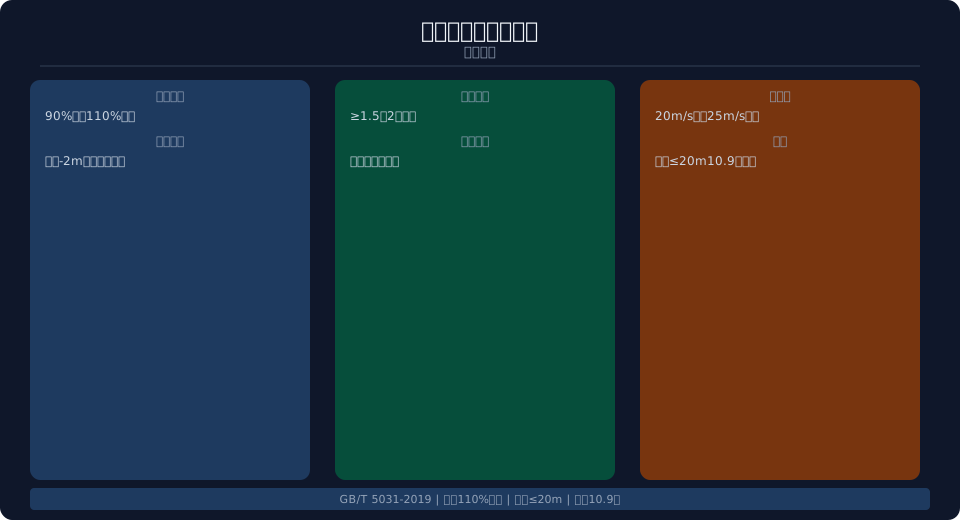
Safety devices include the load moment limiter (LML) (which automatically cuts off hoisting up and luffing out when load moment exceeds 110% of rated value), the load limiter, the luffing limit switch (which initiates deceleration 2 m before the extreme position), the slewing limit switch (limiting slewing to no more than 1.5 turns), the height limit switch, and an anemometer (early warning at ≥20 m/s and automatic shutdown at ≥25 m/s). Safety devices must be verified weekly, and the load moment limiter must be calibrated monthly.

Moment Range
QTZ63~125
630~1,250 kN·m
Max. Radius
50~60 m
Coverage
Lifting Capacity
5~10 t
Model-dependent
Free-standing Height
40~45 m
Tied required above
Bolt Grade
Grade 10.9
M24 ≈800 N·m
Semi-annual Inspection
Full safety check
Annual load test
Model Torque(k N·m) Working radius(m) Lifting Capacity(t)
QTZ63 630 50 5
QTZ80 800 55 6
QTZ100 1000 55 8
QTZ125 1250 60 10

The load moment limiter (LML) is the most critical safety device on a tower crane. When torque reaches 90% of the rated capacity, the early-warning system alerts the operator with a flashing indicator. At 110%, the limiter triggers an automatic shutdown of the hoisting and luffing-up functions, leaving only lowering and luffing-down operations available for safe maneuvering. The LML must be calibrated monthly, with an accuracy tolerance of ≤5%. The connecting cable between the sensor and the indicator should be inspected periodically for any signs of wear or damage.

Anchorage and Inspection Requirements

When the crane exceeds its free-standing height (typically >40 m), an anchorage device must be installed to secure the tower to the building structure. The spacing between anchorage points must not exceed 20 m, and the tie-in struts should be fabricated from seamless steel pipe or structural steel sections, with 10.9-grade connection bolts. After anchoring, the perpendicularity of the tower mast must be maintained within 4/1000. A comprehensive inspection is required after each installation, followed by a full safety inspection every six months during service, and an annual load test.

safety device Alarm Value Cut-off Value verification
torque limiting 90%early warning 110%Cut-off Monthly
luffing limit switch Limit-2m Limit Weekly
slewing limit 1.5Revolution 2Revolution Weekly
height limit Top Position Stop Weekly
Anemometer 20m/searly warning 25m/s Cut-off Annual

Kelude Heavy Industry provides supporting services for tower cranes according to the standard.

FAQ

Q: How does the tower crane load moment limiter work?

A: The LML uses sensors to detect torque (lifting capacity × working radius) and displays the value as a real-time percentage. An early warning flashes at 90%, and at 110% it triggers an automatic shutdown of the hoisting and luffing-up functions (lowering and luffing-down remain available). Monthly calibration keeps accuracy within ±5%.

Q: What are the anchorage device requirements for tower cranes?

A: When the crane height exceeds the free-standing height (approx. >40 m), an anchorage device must be installed to secure the tower mast to the building. The spacing between anchorage points must not exceed 20 m. Anchorage struts are made of seamless steel pipe or structural steel sections. Connection bolts are grade 10.9. After anchoring, tower mast perpendicularity must be ≤4/1000.

Q: What is the purpose of the anemometer on a tower crane?

A: It provides real-time wind speed monitoring: an early warning is triggered at ≥20 m/s (Beaufort force 8), operations stop at ≥25 m/s (force 9), and the crane must be anchored at ≥30 m/s (force 10). Verification is performed once a year.

Q: What are the requirements for tower crane jacking and section insertion?

A: Jacking must be carried out at wind speeds ≤13 m/s with the slewing mechanism locked. Before jacking, confirm that tower mast perpendicularity is ≤4/1000. After adding a section, check the pre-tightening torque of the connection bolts. Slewing or luffing during the jacking process is strictly prohibited.

Related News

contact

contact us

phone:
+86 13903802779

mail:3915269@qq.com

Working hours: Monday to Friday

Wechat
Wechat
SHARE
TOP