

Selecting Crane Brake Models: YWZ Electric-Hydraulic/Disc/Drum Brake Torque and Maintenance Comparison
📌 Key Points Common crane brakes are divided into three categories: ① YWZ electric-hydraulic block brakes (braking torque: 80–5,000 N·m), widely used in traverse and hoisting mechanisms, with a response time of 0.15–0.3 s; ② Disc brakes (200–10,000 N·m), used for precision braking of heavy-duty loads, with a response time of <0.15 s; ③ Drum brakes (20–500 N·m), integrated at the rear end of the electric hoist motor. Brake safety factor: hoisting mechanism ≥ 1.5, travel mechanism ≥ 1.25. Krude Heavy Industry cranes come standard with dual brakes (YWZ + redundant disc brakes), in compliance with GB/T 3811 safety requirements.
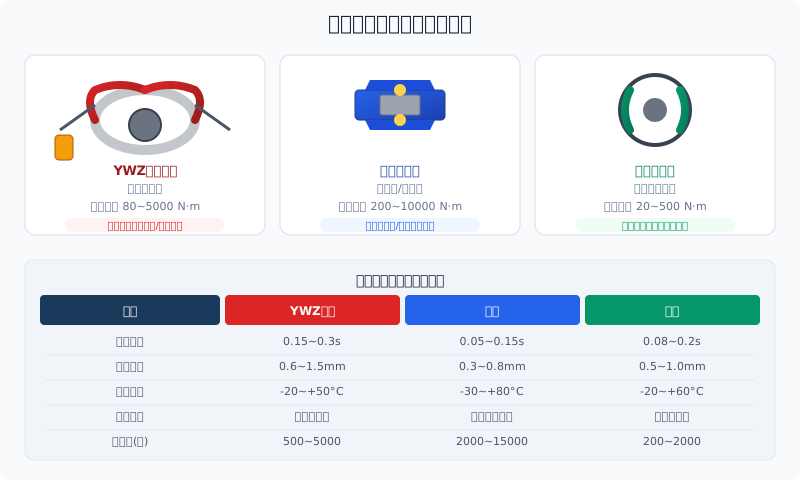
Brake Types and Designs
Hoist brakes are critical components for ensuring safe operation and are classified into three types based on their structure: block-type, disc-type, and drum-type. The YWZ electric-hydraulic block-type brake uses a spring to apply the brake and an electric-hydraulic actuator to release it, providing high braking torque and stable operation; Disc brakes utilize axial force to clamp the brake disc, offering fast response times and adjustable braking torque; drum brakes are integrated into the rear of the electric hoist motor, featuring a compact design.Engineering Calculations for the Hoisting Mechanism of an Electric HoistThe selection of the main brake must be determined based on a comprehensive evaluation of the braking torque and the braking safety factor. All Krude Heavy Industry cranes with a capacity of 20 metric tons or more are equipped with a redundant dual-brake configuration.
| Model | Type | Braking Torque (N·m) | Brake Wheel Diameter (mm) | Used with an applicator | Suggested Price (yuan) |
|---|---|---|---|---|---|
| YWZ-200 | Block-type | 100~200 | 200 | ED-23/5 | 500~800 |
| YWZ-300 | Block-type | 250~630 | 300 | ED-30/5 | 800~1200 |
| YWZ-400 | Block-type | 630~1600 | 400 | ED-50/6 | 1200~2000 |
| YWZ-500 | Block-type | 1600~3150 | 500 | ED-80/6 | 2000~3500 |
| YWZ-600 | Block-type | 3150~5000 | 600 | ED-121/6 | 3500~5000 |
| YP-250 | Disc-type | 200~500 | 250 | Hydraulic Power Unit | 2000~4000 |
| YP-500 | Disc-type | 1500~4000 | 500 | Hydraulic Power Unit | 5000~10000 |
| YP-800 | Disc-type | 5000~10000 | 800 | Hydraulic Power Unit | 8000~15000 |
Reference for Brake Torque Matching
| Crane Capacity (t) | Organization | Recommended Brakes | Braking Torque (N·m) | Safety Factor |
|---|---|---|---|---|
| ≤5 | Lifting | Drum Type/YWZ-200 | 80~200 | 1.5 |
| 5~16 | Lifting | YWZ-300/400 | 250~800 | 1.5 |
| 20~50 | Lifting | YWZ-500+ Disc-Type | 1600~3150 | ≥1.5 |
| 50~100 | Lifting | YWZ-600+ Disc-Type | 3150~5000 | ≥1.5 |
| ≤32 | Large Truck | YWZ-200/300 | 100~400 | 1.25 |
| 32~100 | Large Truck | YWZ-300/400 | 400~1200 | 1.25 |
Note: In accordance with GB/T 3811, the safety factor for the hoisting mechanism is ≥1.5, and for the travel mechanism, it is ≥1.25. Krude Heavy Industry’s hoisting mechanisms for cranes rated at 20 metric tons or more come standard with YWZ + disc-type dual-brake redundancy.
Calculation of Braking Torque
The key to selecting a brake lies in calculating the braking torque. The braking torque required for the hoisting mechanism is Tₚ = K × Tₙ, where K is the braking safety factor (≥1.5) and Tₙ is the rated load torque (converted to the brake wheel shaft). Tₙ = 9550 × P / (n × i × η), where P is the motor power (kW), n is the motor speed (r/min), i is the gear reducer ratio, and η is the transmission efficiency (0.85–0.95).
[Example 1] A 10-metric-ton overhead crane has a hoisting motor power of P = 15 kW, a rotational speed of n = 960 r/min, a gear reducer ratio of i = 40, and a transmission efficiency of η = 0.9. Calculate the required braking torque and select the appropriate model.
Solution: Tₙ = 9550 × 15 / 960 × 40 × 0.9 ≈ 9550 × 0.0156 × 40 × 0.9 ≈ 537 N·m.
The required braking torque Tₚ = K × Tₙ = 1.5 × 537 = 805 N·m.
Refer to the YWZ series specifications table: The YWZ-400 has a braking torque range of 630–1,600 N·m, which covers 805 N·m; therefore, the YWZ-400 is selected.
[Example 2] A 32-metric-ton double-girder bridge crane with a hoisting motor rated at P = 37 kW, n = 740 r/min, i = 50, and η = 0.88.
Tₙ = 9550 × 37 / 740 × 50 × 0.88 ≈ 9550 × 0.05 × 50 × 0.88 ≈ 2101 N·m.
Tₚ = 1.5 × 2101 = 3152 N·m.
Since a single brake is insufficient, Krude Heavy Industry equips its machines with dual brakes as standard: YWZ-500 (1,600–3,150 N·m) + YP-500 disc brake (1,500–4,000 N·m), for a combined braking torque of 3,100–7,150 N·m, which meets the requirement of ≥3,152 N·m and ensures braking capability even if one unit fails.
Actuator Selection and Electrical Control Systems
The electric-hydraulic actuator (ED Series) serves as the release actuator for YWZ brakes. Actuator models are matched to the corresponding brakes as follows: YWZ-200 is paired with ED-23/5, YWZ-300 with ED-30/5, YWZ-400 with ED-50/6, YWZ-500 with ED-80/6, the YWZ-600 is paired with the ED-121/6. The actuator’s duty cycle is S3 60%, with a maximum of 720 power-on cycles per hour; if this frequency is exceeded, a higher-specification model must be selected.
Electrical control of brakes is divided into two types: AC drive and DC drive. In an AC drive, a rectifier converts 380 V AC to 170–220 V DC to power the actuator motor; DC drive (220 V DC) is used in special applications such as metallurgy. A faulty rectifier is a common cause of electrical malfunctions in brakes, manifesting as the brake failing to release or releasing incompletely after power is applied. Krude Heavy Industry’s brake control cabinets come standard with a rectifier status indicator light to facilitate rapid troubleshooting.
The contactor controls the power supply to the brake. When the hoisting contactor opens, the brake contactor is simultaneously de-energized, and the spring applies the brake. If the contactor contacts stick (weld), the brake will remain disengaged after de-energization, causing the hook to slip. Krude Heavy Industry uses a power-off limit switch as the final safeguard against contact sticking.
Complete Comparison Chart for Brake Selection
The following is a quick reference guide for selecting hoisting mechanism brakes (recommended by Krud Heavy Industry):
≤5 t: Drum brake (integrated at the rear of the electric hoist motor) or YWZ-200, braking torque 80–200 N·m
5–16 t: YWZ-300/400, braking torque 250–800 N·m
20–50 t: YWZ-500+YP-500 disc brakes (dual-brake system), total braking torque 3,100–7,150 N·m
50–100 t: YWZ-600 + YP-800 disc brakes (dual-brake system), total braking torque 8,150–15,000 N·m
≥100 t: Large disc brakes (2–4 sets), braking torque ≥20,000 N·m
Considerations for Brake Selection and Maintenance
Frequently Asked Questions
Q: What is the appropriate braking clearance for a YWZ brake? How often should it be adjusted?
Answer: The normal clearance for the YWZ is 0.6–1.5 mm (back clearance), with 0.3–0.8 mm on each side. Krud Heavy Industry recommends checking the brake clearance once a month and adjusting it promptly when wear occurs. Fine-tune the clearance using the adjustment nuts on the brake assembly, and after adjustment, use a feeler gauge to verify that the clearance is uniform on both sides.
Q: What should I do if the electric hoist's brake isn't working properly?
Answer: Reasons why the drum brake on an electric hoist fails to stop: ① Excessive brake clearance (needs readjustment); ② Oil contamination on the friction linings (remove and clean with alcohol, or replace); ③ Spring fatigue (Krude Heavy Industry springs are designed for 100,000 cycles and generally need to be replaced every 2–3 years); ④ Brake wheel wear (turn to restore or replace).
Q: Why are dual brakes installed on the hoisting mechanism?
Answer: GB/T 3811 requires a safety factor of ≥1.5 for hoisting mechanism brakes; however, cranes used to lift molten metal must be equipped with dual brakes. Krud Heavy Industry’s general-purpose cranes rated at 20 metric tons or more also come standard with dual brakes (YWZ + disc brakes), ensuring safe braking even if one fails and doubling the safety factor.
Q: How are disc brakes better than YWZ brakes?
Answer: Disc brakes have a faster response time (<0.15 s vs. 0.15–0.3 s), a wide range of adjustable braking torque, and exert no radial force on the motor shaft. The disadvantages are their higher cost (approximately 3–4 times that of YWZ brakes) and shorter replacement intervals for the friction linings. Krud Heavy Industry typically uses disc brakes in high-capacity or high-speed hoisting mechanisms.
The above is a comprehensive technical guide for selecting among the three types of YWZ electric-hydraulic block, disc, and drum brakes for cranes. Krude Heavy Industry equips all types of cranes with the most suitable brake solutions. For cranes rated at 20 metric tons or more, dual-brake redundancy is standard, and we provide a full range of brake parts and maintenance services. For consultation on brake selection, please contact the Krude Heavy Industry technical team.
