
Crane Wheel Block Specifications: Diameter, Tread & Load Selection
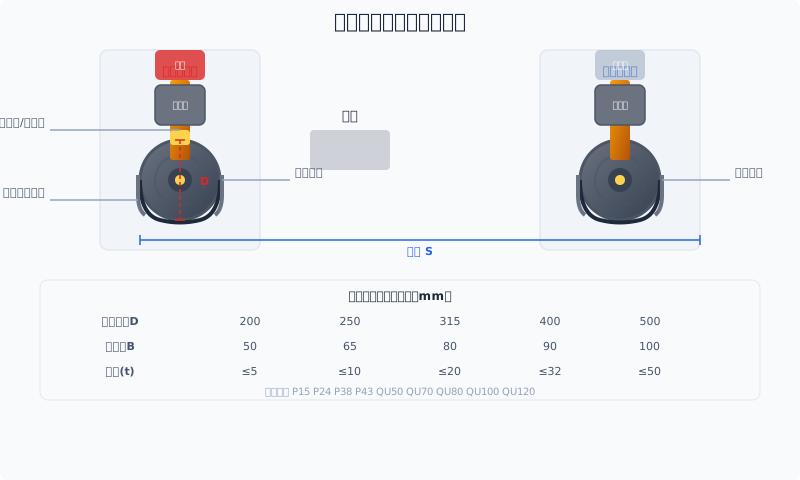
Key Points A crane wheel block consists of a driving wheel and a driven wheel, mounted at both ends of the end carriage. ①Wheel diameter D=200~1000mm, tread width B=50~160mm, commonly made of ZG55 or ZG50MnMo cast steel; ②The driving wheel is driven by a gear motor through a coupling, while the driven wheel rotates freely for support and guidance; ③Wheel tread hardness HB300~380, wheel flange hardness HB250~300; ④Kelude Heavy Industry wheel blocks are made of ZG50MnMo with through hardening to a hardness of HB320~380, extending service life by 30%.
Wheel Block Types and Structural Parameters
A crane wheel block is composed of the wheel, shaft, and bearing housing, and is classified into driving wheels (with drive unit) and driven wheels (without drive). The driving wheel is connected to a gear motor via a coupling to generate traveling force; the driven wheel rotates freely to provide support and guidance. Wheel material directly affects load-bearing capacity and service life. Overhead cranes typically use ZG55 or ZG50MnMo cast steel wheels. Kelude Heavy Industry wheel blocks undergo through hardening, achieving a tread hardness of HB320~380, offering superior wear resistance compared to industry standards.
| Wheel Diameter D(mm) | Tread surface Width B(mm) | Wheel flange Height(mm) | Shaft Diameter(mm) | Maximum Wheel Load(t) | Compatible With Crane Rail | Reference Price(CNY/Set) |
|---|---|---|---|---|---|---|
| 200 | 50 | 15 | 40 | 3 | P15/P18 | 600~900 |
| 250 | 65 | 18 | 50 | 5 | P24/P38 | 800~1200 |
| 315 | 80 | 20 | 60 | 8 | P38/P43 | 1200~1800 |
| 400 | 90 | 22 | 70 | 12 | P43/QU50 | 1800~2800 |
| 500 | 100 | 25 | 80 | 16 | QU50/QU70 | 2800~4000 |
| 630 | 110 | 28 | 90 | 22 | QU70/QU80 | 4000~6000 |
| 800 | 130 | 30 | 100 | 32 | QU80/QU100 | 6000~9000 |
| 1000 | 160 | 32 | 120 | 50 | QU100/QU120 | 9000~14000 |
Note: The reference price covers a complete set of one driving wheel and one driven wheel (including bearing housings), excluding the motor and gearbox. Kelude Heavy Industry wheel blocks are manufactured with ZG50MnMo as the standard material, through-hardened to HB320–380.
Driving-to-Driven Wheel Configuration Ratio
| crane Type | Total Number of Wheels | driving wheel Total Number of Wheels | driven wheel Total Number of Wheels | drive mode |
|---|---|---|---|---|
| ≤5t LD Type | 4 | 2 | 2 | individual drive |
| 10~32t QD Type | 4 | 2 | 2 | individual drive |
| 20~50t LH Type | 8 | 4 | 4 | individual drive |
| 50~100t QD | 8 | 4 | 4 | individual drive |
| ≥100tgantry type | 12~16 | 4~8 | 8~12 | individual drive |
Heat Treatment Process and Hardness Standards for Crane Wheels
The wheel material directly impacts service life. Kelude Heavy Industry uses ZG50MnMo cast steel (C 0.45–0.55%, Mn 1.2–1.6%, Mo 0.2–0.4%) treated with a combined process of through quenching and tempering followed by medium-frequency induction hardening on the tread surface. The quenching and tempering process (quenching at 860°C + tempering at 600°C) produces a tempered sorbite structure with a base hardness of HB 280–320. Medium-frequency induction hardening of the tread (hardened layer depth ≥ 4 mm, hardness HB 320–380) doubles the wear resistance of the tread surface. The wheel flange is left unhardened (hardness HB 250–300) to maintain toughness and prevent brittle fracture.
Heat treatment quality inspection: ① Tread hardness is sampled at 3 points per wheel (evenly spaced at 120°), with an average value ≥ HB 320 and a minimum value ≥ HB 300; ② Hardened layer depth is verified by metallographic examination to be ≥ 4 mm; ③ Hardness variation across the same wheel tread must not exceed HB 40; ④ Ultrasonic Testing (UT) is performed after quenching and tempering, and no cracks or white spots are permitted.
Wheel Load Calculation Method
The wheel load of a crane is a core parameter for wheel selection. The maximum wheel load Pₘₐₓ = (crane dead weight + rated lifting capacity) × eccentric load coefficient ÷ number of wheels. The eccentric load coefficient accounts for the trolley position and is typically taken as 1.1–1.3.
Example 1: A 32t double-girder bridge crane with a dead weight of G = 28t, rated lifting capacity Q = 32t, an eccentric load coefficient of 1.2, and 4 wheels.
Pₘₐₓ = (28 + 32) × 1.2 ÷ 4 = 18t. Checking the wheel parameter table, a D = 500mm wheel with a maximum wheel load of 16t < 18t does not meet the requirement. Solutions: ① Upgrade to an 8-wheel configuration: Pₘₐₓ = (28 + 32) × 1.2 ÷ 8 = 9t per wheel, select D = 400mm wheels (maximum wheel load 12t ≥ 9t); ② Alternatively, select D = 630mm wheels (maximum wheel load 22t ≥ 18t, making the 4-wheel configuration feasible). Kelude Heavy Industry's 32t bridge crane comes standard with an 8-wheel configuration.
Wheel Tread Wear Limits and Diagonal Measurement
Tread wear assessment: ① Replace the wheel when tread diameter wear reaches 3% of the original diameter (e.g., a D = 500mm wheel worn down to 485mm has reached the limit); ② Replace immediately if fatigue spalling, cracks, or indentations appear on the tread; ③ Re-harden or replace the wheel when tread hardness drops below HB 260. Flange wear: ① Replace the wheel when flange thickness wear reaches 50% of the original thickness; ② Replace immediately if the flange shows signs of curling or chipping.
Wheel diagonal measurement method: Position the crane on the middle section of the crane rail. Use a steel tape measure to measure the two diagonal lengths between the centers of the left and right wheels (left-front to right-rear, and right-front to left-rear). The difference between the two measurements is the diagonal deviation. The standard requirement is ≤ 5mm. Note that the tape measure must be pulled taut, and a tension correction must be applied (50N pull for a 50m tape). Kelude Heavy Industry's installation team controls diagonal deviation to ≤ 4mm.
Wheel Block Selection Precautions
FAQ: Crane Wheel Selection & Maintenance
Q: Can driving wheels and driven wheels be mixed on the same crane?
A: No. The diameter and tread width of the driving and driven wheels on the same crane must be identical; otherwise, wheel flange wear (rail gnawing) and uneven loading will occur. Kelude supplies complete wheel blocks with precisely matched dimensions and hardness for both driving and driven wheels.
Q: What causes wheel flange wear (rail gnawing) and how is it resolved?
A: Common causes include: ① misalignment between the wheel and rail centerlines; ② uneven flange wear; ③ excessive rail straightness deviation; ④ lack of synchronization between the two driving wheels. Kelude recommends first measuring rail straightness with a laser distance sensor, then inspecting the wheel block installation position and flange wear condition.
Q: When should a worn wheel tread be replaced?
A: Replacement is required when: ① tread wear reaches 3% of the original diameter (e.g., 12 mm wear on a Φ400 wheel); ② cracks, spalling, or indentations appear on the tread surface; ③ tread hardness drops below HB260. Kelude wheels undergo through hardening, achieving a tread hardness of HB320–380 — 1.3 times the service life of standard wheels.
Q: How much does a wheel block cost? Can I replace only the wheels without changing the bearing housings?
A: Reference pricing for complete wheel blocks (driving + driven) is listed in the table above. Individual wheel replacement (shaft and bearing housing removed) is possible — Kelude supplies single-wheel spare parts at approximately 40–50% of the cost of a full set. However, we recommend replacing the bearing housings as well if they have been in service for more than 5 years or show signs of damage.
This completes our guide to crane wheel block specifications and selection for both driving and driven wheels. Kelude offers a full range of ZG50MnMo quenched crane wheels, supplied as matched driving-and-driven sets, with custom diameters and tread profiles available on request. For wheel block selection assistance or rail-gnawing troubleshooting, contact the Kelude technical team.