EN 17503:2021 Crane Structural Health Monitoring Standard Explained
EN 17503:2021 — Crane Structural Health Monitoring is a key component of the European crane design standard series, developed and published by the European Committee for Standardization (CEN). Released in 2021 as the latest European standard in its field, it is the first to systematically define a sensor-based methodology for assessing the structural health of crane metal structures. The standard covers technical requirements for stress monitoring, fatigue life assessment, crack detection, and structural deformation analysis, and applies to overhead, gantry, and tower cranes rated at A4 to A8 work duty levels.
Implementation of this standard is critical to enhancing the international competitiveness of Chinese lifting equipment and represents a mandatory technical requirement for export to European markets. The technical team at Kelude has conducted in-depth research on this standard framework and fully integrates its requirements into product design to ensure intrinsic safety performance.
Scope and Positioning of the Standard
EN 17503:2021 defines the technical requirements and safety indicators for crane structural health monitoring, covering all types of lifting appliances with a rated lifting capacity of no less than 0.5 t. The standard applies not only to the design and manufacturing of new equipment but also provides clear technical guidance for the inspection, maintenance, and modification of cranes already in service. As an integral part of the EN standard system, it aligns with other parts of the EN 13001 Crane Safety Standard to form a complete framework for crane safety design. The technical parameters and safety factor requirements specified in the standard give design personnel a well-defined design basis, while also providing third-party inspection bodies with quantifiable acceptance criteria for type tests and factory inspections.

Core Technical Parameter Framework
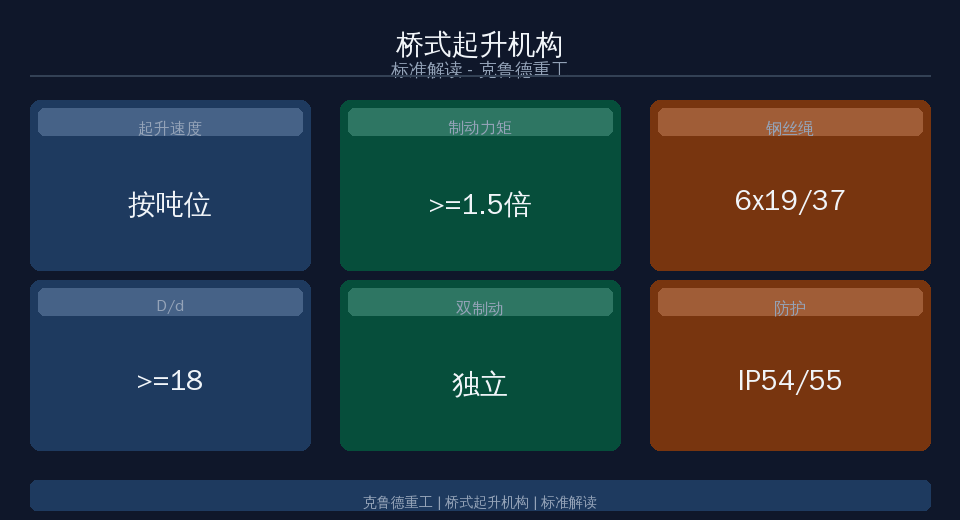
Under the technical provisions of EN 17503:2021, the design and manufacturing of crane structural health monitoring systems must satisfy a stringent set of technical parameters. These parameters are established on the basis of extensive test data and safety engineering theory, covering the entire process from material selection to structural design. The safety factor ranges specified in the standard take full account of fatigue life and limit load conditions under severe operating environments. In practical engineering applications, design personnel must select appropriate parameter combinations based on factors such as the equipment's work duty classification, load spectrum, and operating environment. The parameter cards below present the most critical technical indicators defined in the standard:
Comparative Analysis of Key Technical Parameters
To help design and inspection personnel more intuitively understand the technical requirements of EN 17503:2021, the comparison table below systematically contrasts the core parameters specified in the standard with general engineering practice. All values listed are taken from either mandatory or recommended clauses of the standard and should be strictly implemented during design and selection and factory acceptance testing. For items marked "negotiable," manufacturers and customers may agree on alternative values in the contract, provided they do not fall below the minimum safety requirements set by the standard.
| Technical Parameters | Standardrequirements | recommended value/description |
|---|---|---|
| Stress Monitoring Accuracy | ≤±2%full Measuring Range | strain gauge sensitivity Coefficient2.0±1%, temperature compensation |
| dynamic sampling Frequency | ≥100Hz(dynamic)/≥1Hz(static) | FFTanalysis Frequencyrange0~50Hz |
| fatigue lifeevaluation method | S-Ncurve+Palmgren-Mineraccumulation | averaging considered Stresscorrection(Goodman/Soderberg) |
| Crack Detectionstrain gauge sensitivity | acceptable Detection≥2mmsurface Crack | weekly visual inspection+monthly MT/PT, annual UT |
| data recordingrequirements | coverageequipmentlife cycle | minimumstorage interval1hours, continuous recording of critical events |
| Deformation Monitoring Accuracy | total station±1mm/Laser Distance Measurement±0.5mm | monthly re-measurement of reference points, main girder deflection≤L/1000 |
Inspection Requirements and Intervals
EN 17503:2021 sets out clear requirements for factory acceptance tests, type tests, and periodic inspections of crane structural health monitoring systems. Factory acceptance tests must be carried out on each unit by the quality inspection department at the manufacturer's facility, and each approved unit must be accompanied by a detailed inspection report and a certificate of conformity. Type tests are required when a new product enters initial production, when manufacturing is transferred to a different facility, or when significant structural changes are introduced. For cranes already in service, the periodic inspection interval is determined by the work duty and operating environment, and must not exceed 12 months. The table below summarizes the specific inspection and maintenance requirements for each stage:
| Inspection/maintenance item | inspection method/Standard | period/acceptance criteria |
|---|---|---|
| routinevisual inspection | Main Girder, End Carriage, connection Weld Seamappearance | once per week, continuous recording of critical events Corrosion, Deformation, Crack |
| Non-destructive testing | MTkey point Weld Seam/UTmain Weld Seam/TOFDthick plate | MTmonthly, UTannual, TOFDper2annual |
| Stress Test | critical measurement points for strain gauges Stress Spectrum | semi-annual, and FEmodelcomparative verification |
| Deformation Monitoring | main girder deflection, Side bow / lateral bow, diagonal difference | quarterly, annual re-measurement of reference points |
Safe Operation and Management Requirements
Under EN 17503:2021, safe operation and routine management are just as critical as structural integrity. The standard places strong emphasis on operator qualification and training, requiring that all operators complete specialized training and hold the appropriate certifications before operating equipment. User units must establish a comprehensive equipment file management system that documents the full installation, use, maintenance and inspection history of each crane. Any safety hazards identified must be addressed through the rectification procedure specified in the standard, ensuring the equipment remains safe and controllable at all times. The standard also imposes operational restrictions under extreme weather conditions—for example, lifting operations are prohibited when wind speeds exceed the specified threshold.
Frequently Asked Questions
Q: What new structural health monitoring requirements does EN 17503:2021 introduce?
A: EN 17503:2021 is Europe's latest crane structural health monitoring standard, and its core innovation lies in a systematic methodology for structural safety assessment based on real-time monitoring data. The standard requires dynamic stress monitoring for cranes in Work Duty classifications A4 through A8, with a sampling frequency of no less than 100 Hz to capture the true stress spectrum of critical structural components. Fatigue life assessment follows the S-N curve approach with the Palmgren-Miner linear cumulative damage rule, including mean stress correction. The standard also mandates that monitoring data cover the full life cycle of the equipment, building a complete structural health record. This standard marks a fundamental shift in crane safety management—from traditional periodic inspection toward condition-based predictive maintenance.
Q: What are the technical requirements for crack detection in structural components?
A: The standard requires crack detection sensitivity of at least 2 mm for surface cracks. Daily inspections use visual examination with a magnifying glass on critical weld seams and stress concentration areas, performed weekly. Monthly Magnetic Particle Testing (MT) is applied to key welds for surface crack detection. Annual Ultrasonic Testing (UT) is conducted on primary load-bearing welds of the main girder and end carriages to detect internal defects. For welded joints with plate thickness exceeding 40 mm, TOFD (Time-of-Flight Diffraction) testing is recommended every 2 years. Once a crack is found, its severity must be assessed immediately; if necessary, stop-hole drilling or weld repair is carried out, followed by re-inspection using non-destructive testing to confirm integrity.
Q: What performance indicators apply to stress monitoring systems?
A: The standard sets clear performance requirements for stress monitoring systems: stress measurement accuracy must not exceed ±2% of full scale, strain gauge sensitivity coefficient is 2.0 ± 1%, and temperature compensation is required. Dynamic sampling frequency must be at least 100 Hz to capture stress peaks during hoisting, travel and braking operations. Data analysis should include time-domain statistics (maximum, minimum, stress amplitude) and frequency-domain analysis (FFT power spectrum). The monitoring system must include data recording with a minimum storage interval of 1 hour, while critical events (overload, impact, etc.) require continuous recording. Kelude's structural health monitoring system uses industrial-grade strain acquisition modules with remote data transmission and real-time early warning capabilities.
Q: What methods and indicators are specified for structural deformation monitoring?
A: The standard requires periodic monitoring of main girder deflection, side bow and diagonal difference using a total station or laser distance sensor. Under rated load, the mid-span deflection of the main girder must not exceed 1/1000 of the span. Total station measurement accuracy must reach ±1 mm, while laser distance measurement accuracy must reach ±0.5 mm. Reference points should be located in fixed positions unaffected by crane structural deformation, with monthly re-measurement to ensure reference frame stability. Deformation monitoring is performed quarterly; if abnormal deformation is detected (e.g., continuously increasing deflection), the monitoring interval must be shortened. The manufacturer can provide camber design for main girders to effectively compensate for elastic deformation under load.
Kelude is a professional crane design and manufacturing company whose products fully comply with the EN 17503:2021 standard system, offering full life-cycle services from solution design to after-sales maintenance. To learn how this standard is applied in our products, contact our technical team for detailed technical documentation.