

Interpretation of the EN 13852:2013 Standard “Safety Requirements for Offshore Platform Cranes”
📌EN 13852:2013 "Safety Requirements for Offshore Platform Cranes"It is an important component of the European series of standards for crane design, developed and published by the European Committee for Standardization (CEN). This standard is a mandatory safety specification specifically for cranes used on offshore oil and gas platforms and offshore wind power installation platforms. It covers special requirements related to design loads, corrosion protection, emergency release systems, and personnel safety under marine environmental conditions. The standard applies to cranes on both fixed and mobile offshore platforms.
The implementation of this standard is of great significance for enhancing the international competitiveness of China’s lifting machinery products and constitutes a mandatory technical requirement for exporting to the European market. The technical team at Krude Heavy Industry has conducted in-depth research into this standard system and has fully incorporated its requirements into product design to ensure the intrinsic safety of the equipment.
Scope and Purpose of the Standard
EN 13852:2013, “Safety Requirements for Offshore Platform Cranes,” primarily specifies the technical requirements and safety criteria related to offshore platform cranes and applies to all types of lifting machinery with a rated lifting capacity of 0.5 metric tons or more. This standard not only covers the design and manufacture of new equipment but also provides clear technical guidance for the inspection, maintenance, and retrofitting of in-service equipment. As a key component of the EN standards system, this standard is harmonized with other parts of the EN 13001 series, collectively forming a comprehensive set of safety design specifications for cranes. The technical parameters and safety factor requirements specified in the standard provide designers with a clear basis for design, while also offering quantifiable criteria for type testing and factory acceptance testing by third-party inspection bodies.
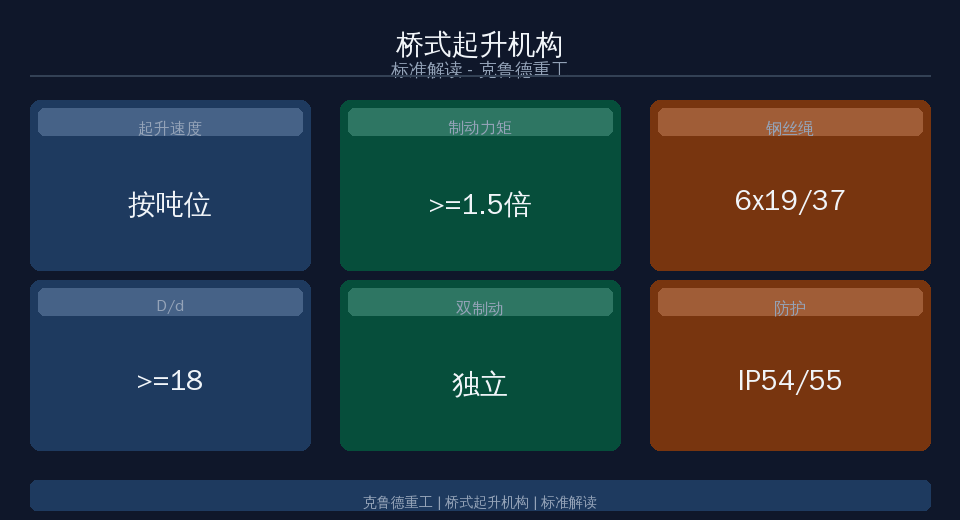
Core Technical Specifications
According to the technical specifications of EN 13852:2013, the design and manufacture of offshore platform cranes must meet a series of stringent technical requirements. These parameters are determined based on extensive experimental data and safety engineering theory, covering the entire process from material selection to structural design. The range of safety factors specified in the standard fully accounts for the fatigue life and ultimate load conditions of lifting machinery under severe operating conditions. In practical engineering applications, designers must select appropriate parameter combinations based on factors such as the equipment’s duty class, load conditions, and operating environment. The parameter cards below present the most critical technical indicators from this standard:
Comparative Analysis of Key Technical Parameters
To help designers and inspectors gain a more intuitive understanding of the technical requirements of EN 13852:2013, the following comparison table systematically contrasts the core parameters specified in the standard with general engineering practice. The data listed in the table are values specified in the mandatory or recommended clauses of the standard; it is recommended that they be strictly adhered to during design, product selection, and factory acceptance testing. For items marked as ”negotiable” in the table, manufacturers and users may make separate agreements in their contracts; however, these agreements must not fall below the minimum safety requirements specified in the standard.
| Technical Specifications | Standard Requirements | Recommended Value/Description |
|---|---|---|
| Design Ambient Temperature | -20°C to +45°C | Steel impact toughness ≥ 27 J at -20°C; CTOD testing of welds |
| Maximum Operating Wind Speed | 20 m/s (standard)/16 m/s (passenger transport) | Triple redundancy for the anemometer; automatic alarm when limit values are reached |
| Anti-corrosion Coating Systems | C5-M High Durability (ISO 12944) | Zinc layer ≥ 85 μm + coating ≥ 320 μm; inspect annually |
| Emergency Release System | Manual + Remote Control Dual Mode | Dual hydraulic and mechanical cutoff, release time ≤ 3 seconds |
| Overload Protection Settings | ≤1331 TP3T Rated Load (Static Test) | Dynamic Test of 110% Rated Load |
| Offset for Ocean Swell | ±3° roll / ±2° pitch / ±1° yaw | Compensation accuracy ≤ ±51 TP3T; response delay ≤ 200 ms |
Inspection Requirements and Frequency
EN 13852:2013 sets forth clear requirements for factory inspections, type testing, and periodic inspections of offshore platform cranes. Factory inspections shall be conducted on a unit-by-unit basis by the quality inspection department at the manufacturer’s facility; equipment that passes inspection shall be accompanied by a detailed inspection report and a certificate of conformity. Type testing is conducted when a new product is first put into production, when production is transferred to a different facility, or when major structural changes occur. The periodic inspection interval for in-service equipment is determined based on the duty class and operating environment, and generally does not exceed 12 months. The table below summarizes the specific requirements for each inspection and maintenance activity:
| Inspection/Maintenance Items | Test Methods/Standards | Cycle/Basis for Determination |
|---|---|---|
| Inspection of Anti-Corrosion Coatings | Visual inspection + thickness gauge; critical joints and welds | Once per quarter, repair any coating damage exceeding 5%. |
| Emergency Release Function Test | Tests for Manual Release and Remote Release, Respected | Once a week, release time ≤ 3 seconds |
| Overload Protection Test | 1.33 times the rated load (static) / 1.1 times the rated load (dynamic) | Once a year + immediately after maintenance |
| Sway Compensation System | Sensor Calibration, Actuator Response, Accuracy Verification | Once a month, classification society-witnessed testing prior to shipment |
Safety Operation and Management Requirements
In the implementation of EN 13852:2013, safe operation and daily management are equally important. The standard places particular emphasis on the importance of operator qualifications and training, requiring that all operators undergo specialized training and obtain the appropriate qualifications before being allowed to work. Equipment-using entities should establish a comprehensive equipment record-keeping system to document in detail the entire process of installation, use, maintenance, and inspection. Any identified safety hazards must be addressed in accordance with the corrective action procedures specified in the standard to ensure that the equipment remains in a safe and controlled condition at all times. In addition, the standard imposes restrictive requirements on equipment use under extreme weather conditions; for example, lifting operations are prohibited when wind speeds exceed specified limits.
Frequently Asked Questions
Q: What are the corrosion protection requirements for offshore platform cranes specified in EN 13852:2013?
Answer: Offshore platform cranes operate in an extreme C5-M corrosion environment characterized by high salt fog and high humidity. Standards require that the anti-corrosion coating system strictly comply with ISO 12944, employing a solution consisting of a thermally sprayed zinc layer (thickness ≥ 85 μm) combined with multiple layers of anti-corrosion paint (total dry film thickness ≥ 320 μm). All connecting bolts are made of 316L stainless steel or alloy steel treated with Dacromet. A comprehensive coating inspection should be conducted annually, and any areas where damage exceeds 5% of the total surface area must be repaired immediately. The hinge points and drainage holes of structural components require special design to prevent localized accelerated corrosion caused by water accumulation. Krud Heavy Industries’ offshore platform cranes employ a modular anti-corrosion design, with a corrosion allowance of 20% incorporated into key structural components.
Q: What specific regulations apply to wind speed and load capacity for cranes in marine environments?
Answer: Standards impose strict limits on operating wind speeds for offshore platform cranes: generally, wind speeds during lifting operations must not exceed 20 m/s (equivalent to a Force 8 wind), and wind speeds during personnel hoisting must not exceed 16 m/s. The crane must be equipped with a triple-redundant anemometer system (operational + backup + independent monitoring), which automatically triggers audible and visual alarms when wind speeds reach the limit. When not in operation, the crane must be capable of withstanding an extreme wind speed of 50 m/s (equivalent to a Category 15 typhoon). In addition to the crane’s dead weight and the load being lifted, the design load must also account for the combined effects of inertial forces caused by platform sway, wave impact forces, and wind loads. The design must account for the effects of ±3° of lateral sway and ±2° of longitudinal sway.
Q: What are the technical requirements for the emergency release system?
Answer: Offshore platform cranes must be equipped with an emergency release system, which is a key safety feature that distinguishes them from onshore cranes. The emergency release system should have two independent operating modes—manual and remote control—with a release time not exceeding 3 seconds. A manual release device should be installed in both the crane operator’s cab and a safe area on the platform, while remote release can be executed from the central control room. The system employs a dual hydraulic and mechanical cut-off mechanism to ensure reliable release even in the event of a single power source failure. Upon release, the hook must automatically disengage from the load or hoist cage to prevent the load from swinging on the deck and causing secondary injuries. The standard also requires a weekly emergency release function test to verify the reliability of both manual and remote control modes.
Q: What is the function and what are the parameters of a sway compensation system for offshore platforms?
Answer: The roll compensation system is a core technology for offshore platform cranes to counteract wave motion. Standards require that the compensation system be capable of handling platform motions of ±3° roll, ±2° pitch, and ±1° yaw, with a compensation accuracy of within ±5% and a system response delay not exceeding 200 ms. Active compensation systems use inertial measurement units to monitor the platform’s motion and attitude in real time, controlling hydraulic or electric actuators to counteract the movement of the lifting gear, thereby keeping the hook relatively stationary in space. Passive compensation systems, on the other hand, rely on springs or pneumatic-hydraulic accumulators to absorb wave energy. The active wave compensation system developed by this company has been successfully applied on multiple types of offshore wind turbine installation platforms, significantly extending the operational window under severe sea conditions.
🔧 This company—a professional crane design and manufacturing firm—strictly adheres to the EN 13852:2013 standard system and provides full-cycle services ranging from conceptual design to after-sales maintenance. If you would like to learn more about how this standard is specifically applied to our products, please contact our technical team to obtain detailed technical documentation.
