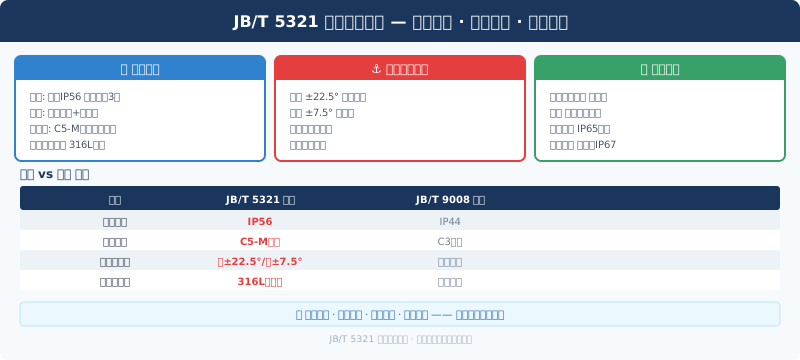

JB/T 5321 Ship Electric Hoist Standard Guide

JB/T 5321-2015, "Ship Electric Hoist," is the machinery industry standard that governs electric hoist products in marine environments. It specifies the types, basic parameters, technical requirements, test methods, and inspection rules for ship electric hoists. The standard applies to wire rope electric hoists used under severe conditions such as salt spray, humidity, rolling, and vibration on ships and offshore installations, making it the core reference for the design, manufacturing, and selection of marine lifting equipment.

Ship electric hoists operate in an environment fundamentally different from their land-based counterparts. Marine atmospheres carry high salt concentrations (typically 5 mg/m³ to 50 mg/m³), relative humidity remains between 75% and 95% year-round, and vessels continuously experience rolling (up to ±22.5°), pitching (±7.5°), and wave-induced accelerations (vertical loads up to ±0.5g). JB/T 5321-2015 addresses these ship-specific conditions by imposing stricter requirements on corrosion protection, sway resistance, and structural strength for electric hoists.

JB/T 5321 Marine Electric Hoist Three-Proof and Sway Resistance Overview

Ship electric hoists are widely used on commercial vessels, workboats, and offshore platforms for engine-room hoisting, spare parts handling, provisions lifting, and deck cargo operations. Based on installation position, they fall into three categories—engine-room hoists, deck hoists, and open-deck hoists—each with distinct corrosion and protection requirements. Kelude Heavy Industry manufactures ship electric hoists in full compliance with JB/T 5321, implementing corrosion-resistant design across material selection, surface treatment, and sealing protection, and offers China Classification Society (CCS) type approval services.


Marine Corrosion Environment and Protective Coating Systems

Salt spray corrosion is the greatest challenge for ship electric hoists. The standard classifies corrosion protection requirements into three levels based on installation position: engine-room interiors (C3, moderate corrosion), sheltered deck areas (C4, high corrosion), and open deck areas (C5-M, very high corrosion). Each level corresponds to distinct surface preparation and coating system requirements. For C5-M environments, the coating system typically comprises: epoxy zinc-rich primer (≥60 μm DFT) + epoxy MIO intermediate coat (≥150 μm DFT) + aliphatic polyurethane topcoat (≥50 μm DFT), with a minimum total dry film thickness of 260 μm.

For material selection, the standard requires that exposed fasteners, hooks, chains, and other critical load-bearing components on ship electric hoists be made of seawater-resistant stainless steel (e.g., 316L) or alloy steel with hot-dip galvanizing plus a sealing topcoat. Electrical control boxes and junction boxes must have enclosures of at least 316L-grade stainless steel or carbon steel with Dacromet treatment. All aluminum components must undergo hard anodizing (film thickness ≥25 μm) to prevent electrochemical corrosion.

Wire rope corrosion protection is especially critical in marine environments. The standard recommends hot-dip galvanized wire rope (Grade A coating) lubricated with salt-spray-resistant grease, or stainless steel wire rope (AISI 316). The rope core should be synthetic fiber (PP or PE) to avoid galvanic corrosion-induced failure of metal cores in humid conditions. Wire rope pulleys should be fitted with MC nylon or polyurethane liners to reduce wear.


Zero Component Standard Land-based nacelle(C3) Deck(C4/C5-M)
Exposed Tightening Part Carbon Steel Black Oxide Finish 304Stainless Steel 316LStainless Steel
Hook Material 20Steel Forging 304Stainless Steel 316LStainless Steel
Wire Rope Bright finish/Galvanized Grade B Galvanized Grade A+Rust Preventive Grease 316Stainless Steel Rope
electrical control box Housing Carbon Steel Spray Painting 304Stainless Steel 316LStainless Steel
Motor Enclosure Cast Iron+Primer Cast Iron+Epoxy Coating Cast Iron+Thermal Sprayed Aluminum+Sealed
Coating / painting System C2(≥120μm) C3(≥160μm) C5-M(≥260μm)

Structural Design for Marine Pitching and Rolling Conditions

Continuous vessel motion at sea places unique structural demands on electric hoists. Rolling and pitching cause load sway, increasing wire rope fleet angles and lateral forces. Standards require ship electric hoists to operate normally under rolling up to ±22.5° and pitching up to ±7.5°, with the hoisting mechanism and travel mechanism free from jamming or derailment. To achieve this, the trolley must be equipped with anti-sway guide devices and limit stops.

Under pitching and rolling conditions, wire rope is prone to jumping out of the drum grooves or becoming tangled. Standards require deeper and wider-spaced drum rope grooves compared to land-based hoists—an increase of 1mm to 2mm in groove depth—along with rope retainers and rope guide devices. The hook block must feature a fully enclosed pulley cover to prevent the wire rope from escaping the pulley groove during vessel motion. Additionally, the hoisting motor and reducer/gearbox bases must be fitted with anti-vibration mounts to absorb hull vibration and impact loads.


Electrical System Requirements for Marine Service

The electrical system of a ship electric hoist must comply with the stringent requirements for marine electrical equipment. The electric motor and control box must have a protection rating of at least IP56 (IP66 for deck areas). All electrical connectors and terminal blocks must be treated with moisture-proof, fungus-proof, and salt-spray-resistant protection. Cable entries must use marine-grade armored cable glands, and the push-button pendant must be watertight (IP67).

Given the wide voltage and frequency fluctuations typical of shipboard power grids (±10% voltage, ±5% frequency), standards require the motor and control circuit to operate reliably within these ranges. The brake electromagnet must pick up at no less than 85% of rated voltage and release at no more than 55% of rated voltage. Furthermore, marine hoists must be equipped with an Emergency Stop Button and overload protection, with phase sequence protection incorporated into the control circuit.


Max Rolling Angle
±22.5°
Max Pitching Angle
±7.5°
Deck Protection Rating
IP66 (Fully Watertight)
Total Coating Thickness
≥260μm (C5-M)
Wire Rope Material
316 Stainless Steel / Galvanized Grade A
Classification Certification
CCS Type Approval

Inspection and Classification Society Certification

Inspection requirements for ship electric hoists are significantly more rigorous than for land-based units. In addition to the standard No-Load Test, Dynamic Load Test, and Static Load Test, marine hoists must undergo inclination tests and salt spray tests. The inclination test requires the hoist to complete full lifting and lowering cycles on a test stand tilted to 15° in the transverse direction and 5° in the longitudinal direction, verifying the reliability of the mechanisms under inclined operating conditions. The salt spray test is conducted in accordance with IEC 60068-2-11 (equivalent to GB/T 2423.17), with durations ranging from 96 hours (C3) to 720 hours (C5-M), followed by inspection for corrosion and verification of electrical insulation performance.

Electric hoists intended for use on classed vessels must obtain type approval certification from a classification society. Inspection by the China Classification Society (CCS) encompasses five stages: drawing review, material testing, welding procedure qualification record (WPQR), product inspection, and routine test. Manufacturers can provide CCS inspection coordination services, assisting customers throughout the entire process from design approval to final certificate issuance.


Inspection Item Land-based Hoist nacelle Land-based(C3) Deck-mounted(C5-M)
Dynamic Load Test 1.1Multiple Rated Load 1.1Multiple Rated Load 1.1Multiple Rated Load+inclination/tilt15°
Static load test 1.25Multiple Rated Load 1.25Multiple Rated Load 1.25Multiple Rated Load
Salt spray test Not Required 96h (Neutral Salt Spray) 720h (Neutral Salt Spray)
Insulation Resistance ≥1MΩ ≥5MΩ(After Damp Heat Test) ≥10MΩ(After Damp Heat Test)
Coating / painting Detection visual inspection Adhesion+Film Thickness Adhesion+Film Thickness+Holiday Detection
Classification Society Requirement Not Applicable CCSProduct Inspection CCSType Approval+Inspection

FAQ

Q: Which types of ships and offshore installations does the JB/T 5321-2015 standard cover for electric hoists?

A: JB/T 5321-2015 applies to wire rope electric hoists used on all types of ocean-going vessels (including cargo ships, tankers, engineering vessels, etc.) and on fixed or floating offshore platforms. The standard defines corrosion protection grade requirements for three installation positions: engine room, deck, and open-air. It should be noted that the standard is primarily intended for wire rope electric hoists. While chain electric hoists may reference its anti-corrosion and environmental requirements for marine applications, certain structural provisions differ.

Q: How do I select the right corrosion protection grade for a ship electric hoist? What are the typical applications for C3, C4, and C5-M?

A: Grade C3 (coating thickness ≥160 μm) is suitable for enclosed engine rooms and steering gear compartments where the corrosive environment is relatively mild. Grade C4 (coating thickness ≥200 μm) is intended for sheltered deck areas, such as those under superstructure overhangs. Grade C5-M (coating thickness ≥260 μm) is required for open decks, forecastle areas, and offshore platforms directly exposed to salt spray and wave splash. The corrosion protection grade should be determined based on the hoist's actual installation position — downgrading to a lower grade is not recommended, as it may lead to premature corrosion failure.

Q: What testing requirements apply to ship electric hoists under rolling and pitching conditions?

A: JB/T 5321 requires that ship electric hoists undergo inclined load testing on a test stand tilted to 15° in the transverse direction and 5° in the longitudinal direction to verify operational reliability of the mechanism. Before shipment, insulation resistance testing is also mandatory — after a damp-heat test (40°C ± 2°C, 93% ± 3% humidity, 48 hours), insulation resistance must not be less than 5 MΩ for engine-room units or 10 MΩ for deck units. During classification surveys, a CCS surveyor witnesses the inclination and load tests on site.

Q: What is the process and typical timeline for obtaining CCS classification certification for a ship electric hoist?

A: The CCS certification process consists of five stages: (1) drawing review — submission of the general arrangement drawing, electrical schematics, and drawings of primary load-bearing components, with a review period of approximately 15 working days; (2) material testing — verification of chemical composition and mechanical properties of critical components; (3) welding procedure qualification — approval of WPS/PQR documents; (4) product inspection — witnessing of prototype testing; and (5) certificate issuance. The entire process typically takes 2 to 3 months. Kelude provides full technical support throughout CCS certification, including document preparation, test coordination, and on-site witnessing assistance, and has successfully passed multiple batches of ship electric hoists through CCS inspection and certification.

Standard basis: JB/T 5321-2015 "Ship Electric Hoists" | Technical Department

Related News

contact

contact us

phone:
+86 13903802779

mail:3915269@qq.com

Working hours: Monday to Friday

Wechat
Wechat
SHARE
TOP