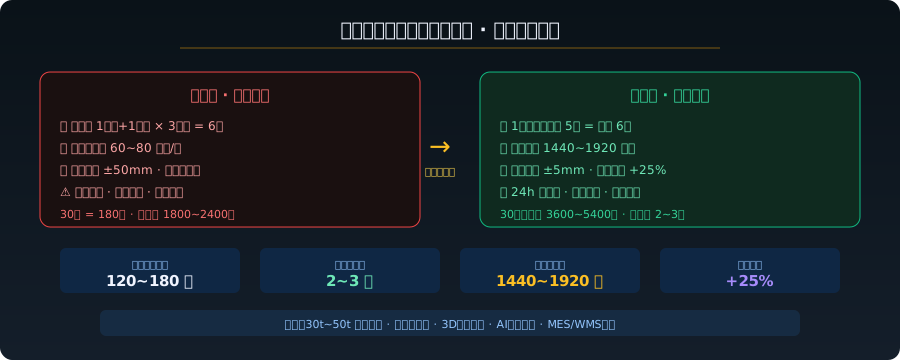

30 Unmanned Overhead Cranes Replace 60 Operators
Project Overview
Industry: Steel (cold-rolled coil warehouse) | Scale: 30 units of 30t–50t Double-Girder Bridge Cranes | Retrofit Scope: Full variable-frequency drive + 3D laser scanning + AI coil identification + ACS unmanned dispatching | Total Investment: Approx. $5.3–8.0 million | Annual Labor Savings: Approx. $2.1–2.8 million | Payback Period: 2–3 years
At a cold-rolled steel coil warehouse of a major Chinese steel producer with an annual output exceeding 10 million tons, all 30 Double-Girder Bridge Cranes previously relied on manual operation—each crane required one driver and one ground coordinator working three shifts, totaling 180 personnel and nearly RMB 20 million in annual labor costs. Between 2024 and 2025, the company completed the unmanned retrofitting of the entire warehouse in phases. Below is the equipment selection rationale, technical solution, and actual ROI data from the project.
Why Retrofit? Four Critical Pain Points in Coil Warehouses
1. Uncontrolled Labor Costs. The 30 overhead cranes in the coil warehouse required 180 operators (including relief shift coverage). Based on the steel industry's average labor cost of RMB 100,000–120,000 per person per year, annual spending reached RMB 18–21.6 million. Recruitment has become increasingly difficult—younger workers are reluctant to enter steel plants, and the average age of existing crane operators exceeds 45.
2. Frequent Safety Incidents. Manual coil lifting operations resulted in 3–5 accidents per year, including pinch injuries, collisions, and coil slippage. The direct loss from a single coil fall (scrapped coil + equipment repair + production downtime) typically exceeds RMB 500,000. Even with the safety factor requirements of the ISO 4301 Crane Design Standard, overload violations and improper angled lifting in manual operations are difficult to eliminate.
3. Significant Storage Capacity Waste. Manual coil stacking achieved positioning accuracy of only ±50 mm, requiring a minimum 100 mm safety margin between stacks. As a result, actual warehouse capacity ran 15%–20% below theoretical capacity for the same floor area.
4. Information Disconnect. Coil inbound, outbound, and re-stacking operations relied entirely on manual records and two-way radio communication. Location data lagged by 2–4 hours, frequently resulting in situations where "the system shows stock, but the coil cannot be found on the floor."
Retrofit Approach: Far More Than Adding Cameras
Unmanned crane retrofitting is not simply equipping a crane with cameras for remote operation. The technical architecture of this project was built on three layers:
Hardware Layer—Each crane was upgraded with full variable-frequency vector speed control (replacing the original wound-rotor motor and resistor bank configuration), absolute encoder feedback (positioning reference), 3D laser scanners (3D coil modeling and volume measurement), AI vision cameras (OCR-based coil number identification and lifting spreader status detection), and millimeter-wave radar (personnel intrusion detection). Hardware retrofit cost per crane: approximately RMB 800,000–1.2 million.
Dispatching Layer—An unmanned crane dispatching system (ACS) was deployed and integrated with the plant's three-tier MES and warehouse management system (WMS). The ACS automatically generates lifting instructions based on production schedules, assigns the optimal crane for each task, and updates the storage location map in real time. Custom development of the dispatching system cost approximately RMB 2–3 million (shared across all 30 cranes in the warehouse).
Safety Layer—In compliance with TSG 51-2023 Crane Safety Technical Supervision Regulation, each crane was equipped with intelligent anti-collision (automatic deceleration/stopping for cranes on the same runway), overload limiting with 30-day data logging, and a dedicated remote Emergency Stop Button in the central control room. Safety system add-on cost: approximately RMB 100,000–150,000 per crane.
Per-Crane Retrofit Cost Breakdown:
| Cost Item | Amount(10,000 CNY/Unit) | Description |
|---|---|---|
| Electrical Upgrade(Variable Frequency Drive (VFD)+Encoder) | 30~50 | Replacementseries resistance speed control, Including VFD cabinet+Cables |
| Sensor Matrix(Laser+Vision+Radar) | 30~40 | SICKLaser Scanning+Hikvision AICamera+mm Wave Radar |
| safety system(TSG (Special Equipment Safety Technical Regulation) 51 Safety Technical Specification for Special Equipment Compliance) | 10~15 | anti-collision+overload Recording+Remote Emergency Stop |
| Installation & Commissioning | 10~15 | Including Shutdown Retrofit Production Continuity Plan |
| Total(Per Unit) | 80~120 | 30Unit Subtotal 2,400~3,600 10,000 + ACS 200~30010,000 |
The Retrofit Payoff: What You Save in a Year
| Benefit Item | Retrofit Before | Retrofit After | Annual Savings |
|---|---|---|---|
| Operators | 180Person | 6Person(Control Room Operator) | 1,440~1,920 10,000 |
| Safety Incident Loss | 3~5Incident/Year ≈150~25010,000 | 0Incident | 150~250 10,000 |
| Storage Capacity | Baseline(±50mm Palletizing) | +25%(±5mm Dense Palletizing) | Expansion Avoidance Warehouse≈Annual Savings50010,000+ |
| steel coil Loss(Scratching) | Approximately 0.3‰ Scratch Rate | Approximately 0.05‰ | 80~120 10,000 |
| Annual Comprehensive Benefit | — | — | 1,670~2,290 10,000 |
Payback period = $5.8–8.0 million ÷ $248,000–340,000/year ≈ 2–3 years. This figure excludes indirect benefits—unmanned overhead cranes operate 24/7 with no fatigue-related performance degradation, real-time coil inventory updates, and overall logistics efficiency gains across the entire cold rolling mill when integrated with the MES system.
Key Pitfalls to Avoid in Crane Automation Retrofits
Pitfall 1: Sensor reliability in steel plant environments is often underestimated. While a cold rolling workshop doesn't generate the extreme heat of a steelmaking shop, oil mist and metal dust concentrations remain high. Laser scanner lenses required weekly cleaning—a maintenance frequency we initially underestimated, leading to frequent false alarms in the first two months. The final solution involved installing compressed air purge systems (approximately $300 per unit), extending the cleaning interval to once a month.
Pitfall 2: MES interface development took twice as long as planned. We originally scheduled three months for ACS-to-MES integration but actually needed six—not due to technical complexity, but because of conflicting priorities between the IT and production departments over dispatching logic. Lesson learned: MES integration must be championed by the production deputy general manager, not driven solely by an IT project manager.
Pitfall 3: Production continuity costs during retrofit were overlooked in the initial budget. With 30 overhead cranes being retrofitted one at a time, each crane was out of service for 7–10 days. Temporary mobile truck cranes were rented to maintain production at approximately $7,400 per day, bringing total continuity costs to roughly $222,000–297,000—an expense absent from the original budget.
Frequently Asked Questions
Q: What type of steel coil warehouse is suitable for unmanned retrofitting?
A: Facilities with five or more overhead cranes, at least 4,000 operating hours per year, and relatively standardized steel coil specifications (to minimize AI identification complexity). Intermittent operations where individual crane utilization falls below 2,000 hours annually are not recommended—labor savings won't justify the retrofit investment.
Q: How long will the steel coil warehouse be out of operation during the retrofit?
A: Cranes are converted one at a time, with each unit offline for 7–10 days (including removal of legacy wiring, installation of new control cabinets, and integrated commissioning). The key is preparing a production continuity plan in advance—renting mobile cranes, activating standby storage areas, or scheduling retrofits during maintenance windows. Converting all 30 cranes typically takes 8–12 months.
Q: Can existing QD-type overhead cranes built to Chinese national standards be converted for unmanned operation?
A: Yes, but at a higher cost. Wound-rotor motors with series resistance speed control cannot meet the requirements of vector closed-loop control; they must first be replaced with variable-frequency motors and VFDs (adding $22,000–37,000 per crane). If the main girder steel structure is also approaching its design life, replacing the crane entirely is more economical than retrofitting. See equipment replacement decision guidelines.
Q: What capabilities should a crane supplier have for unmanned overhead crane projects?
A: Suppliers should demonstrate full variable-frequency drive manufacturing capability plus ACS dispatching system integration experience (or formal partnerships with specialized automation firms). Review their track record of completed unmanned crane installations and customer references. The steel industry demands exceptionally high safety redundancy and rapid fault recovery from overhead crane systems.
Case source: Industry research compilation | Reference standards: ISO 4301 · TSG 51-2023 Crane Safety Technical Supervision Regulation