
How Much Replacement Demand Will Equipment Upgrades Drive?
Key Takeaways
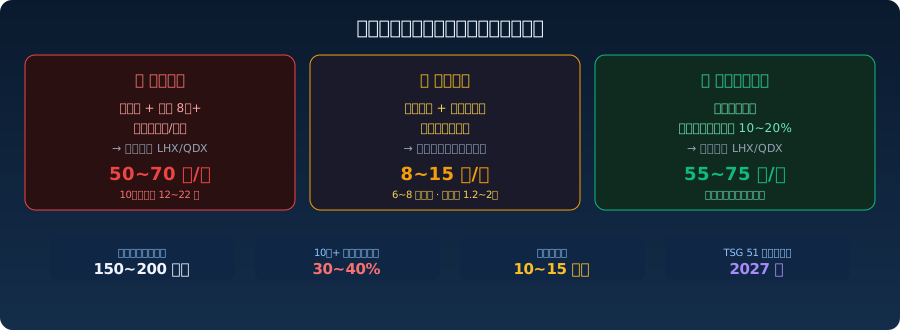
In 2026, the large-scale equipment renewal policy enters its substantive implementation phase. Ultra-long-term special treasury bonds have earmarked funds to support the replacement of green equipment, accelerating the phase-out of high-energy-consumption machinery at China National IV emission standards and below. Based on an estimated national fleet of approximately 1.5–2 million overhead and gantry cranes, outdated models with over 10 years of service—featuring wound-rotor motors and series resistance speed control—account for roughly 30%–40%, or 450,000–800,000 units, facing retirement or retrofit. The equipment renewal policy, combined with TSG 51-2023 Crane Safety Technical Supervision Regulation mandating intelligent safety functions as standard, will directly drive annual demand for 100,000–150,000 new crane replacements and 200,000–300,000 in-service overhead crane retrofits.
Equipment renewal is not just a slogan—it is a structural opportunity unfolding across the industry. This article breaks down the policy rollout timeline, subsidy criteria, and investment decision logic for different application scenarios.
Policy Toolkit: Three Drivers Ignite the Market
| Policy Instrument | Key Points | Impact oncrane Direct Impact |
|---|---|---|
| ultra-long-term special treasury bonds | 2026Annual Special Fund for Equipment Upgrade and Green Low-Carbon Replacement | Reduced Financing Cost for New Equipment Procurement, Interest Rate Advantage of Approximately1.5~2Percentage Points |
| TSG (Special Equipment Safety Technical Regulation) 51 Safety Technical Specification for Special Equipment-2023 Crane Safety Technical Supervision Regulation《lifting appliancessafety technical regulations》 | Mandatory Smart Anti-Collision, overload warning, Remote Shutdown Functions | Retrofit Required for Non-Compliant Existing Equipmentsafety devicesor Full Replacement, Per Unit Retrofit Cost Approximately3~810,000 CNY |
| Dual Carbon Goals+Energy Consumption Limits | Updated Phase-Out List for High-Energy-Consumption Outdated Electromechanical Equipment, wound-rotor motor Classified as Restricted | wound-rotor motor+series resistance speed control Gradual Market Phase-Out, full variable-frequency drive Mandatory or Bonus Criterion |
Legacy Fleet Assessment: Which Cranes Need Replacement First?
Top Priority for Replacement (Three Equipment Categories):
① Cranes with Chinese-standard soft tooth gearboxes (8+ years in service) — The gearbox has already entered its second overhaul cycle (typically every 3–5 years), making continued repairs less economical than replacement. We recommend upgrading directly to European Standard (EN) hardened gear reducers, extending design life from 3–5 years to 10+ years while cutting maintenance cost by over 60%. For a 50t double-girder crane, converting from Chinese standard to European Standard adds an initial investment of CNY 100,000–200,000 (approx. $14,800–$29,700), but saves CNY 120,000–220,000 (approx. $17,800–$32,600) in maintenance over 10 years and CNY 180,000–300,000 (approx. $26,700–$44,500) in energy consumption.
② Cranes with wound-rotor motors and series resistance speed control (10+ years in service) — These systems suffer from extremely poor energy efficiency due to significant heat loss in the resistors, and they cannot meet the intelligent functionality requirements of TSG 51-2023 Crane Safety Technical Supervision Regulation. Retrofit solution: retain the main girder and end carriage, replace the motor with a variable-frequency motor and a full variable-frequency drive control cabinet. Retrofit cost is approximately CNY 80,000–150,000 (approx. $11,900–$22,300) per unit, with annual electricity savings of CNY 12,000–20,000 (approx. $1,800–$3,000), achieving payback in 6–8 years.
③ Aging gantry cranes (15+ years in service, port/yard applications) — The steel structure is approaching the end of its fatigue life, and continued operation poses significant safety risk. These cranes also lack Condition Monitoring (CMS) and remote shutdown capabilities, creating regulatory compliance exposure. Complete crane replacement is recommended.
Replacement vs. Retrofit: A Decision Matrix
| Application Scenario | Recommended Solution | Investment | Rationale |
|---|---|---|---|
| soft tooth flank+Service Life8Years+ | Full Replacement with European Standard (EN) | 50~7010,000/Per Unit | 10Years TCOFar Lower than Continuing Maintenance |
| wound-rotor motor+series resistance speed control | Electrical System Retrofit(Retentionsteel structure) | 8~1510,000/Per Unit | steel structure Optimal Cost-Effectiveness When in Good Condition |
| steel structure Corrosion/Deformation | or Full Replacement | At New Machine Price | Safety Hazards Non-Negotiable |
| TSG (Special Equipment Safety Technical Regulation) 51 Safety Technical Specification for Special Equipment Non-Compliant Units Require Retrofitting | Retrofit Smart Safety Systems Module | 3~810,000/Per Unit | Meet Minimum Regulatory Requirements |
| New Crane+New Installation Factory building | Direct Adoption European Standard (EN)LHX/QDX Type | 55~7510,000/Per Unit | Infrastructure Savingscoverage Procurement Premium |
FAQ: Crane Safety & Retrofit Questions
Q: How do I apply for equipment upgrade subsidies, and what cost coverage can I expect?
A: Applications are submitted through the local Economic and Information Technology Commission (or Bureau of Industry). Subsidy rates typically range from 10% to 20% of the equipment investment, with per-project caps varying by region (generally between CNY 500,000 and CNY 5 million, or roughly $74,000–$742,000). We recommend monitoring your province's 2026 equipment-upgrade application window, as submissions are usually accepted in the first half of the year.
Q: When does TSG 51-2023 Crane Safety Technical Supervision Regulation become mandatory?
A: TSG 51-2023 has been officially released, with a transition period extending through 2027. Newly installed cranes must comply starting in 2025, while existing cranes must be brought into compliance by 2027. We strongly advise against delaying retrofits until the final year — inspection agencies and retrofit contractors are likely to face severe capacity shortages during that window.
Q: Do wound-rotor motors need full replacement, or can they be retrofitted?
A: Retrofitting is a viable option. By mounting an incremental encoder on the motor shaft (approximately CNY 2,000, or about $300) and pairing it with a vector VFD (roughly CNY 15,000–30,000, or $2,200–$4,450), a wound-rotor motor can operate in closed-loop vector mode with performance approaching that of a variable-frequency motor. However, the retrofit cost is often close to replacement cost, so we recommend a thorough cost-benefit analysis before deciding.
Q: What are the best options for disposing of old cranes being replaced?
A: Three main paths exist: ① Sell the complete crane on the second-hand market (demand remains strong in Southeast Asia and Africa); ② Dismantle and refurbish core components such as reducers, motors, and brakes for reuse; ③ Recycle as scrap steel. Selling a complete used crane typically recovers 30%–40% of residual value — far more profitable than selling for scrap metal.
Related Reading & Resources
New Safety Supervision Regulations — TSG 51 compliance requirements
Industry Semi-Annual Report — Impact of equipment upgrade policies
Data sources: State Council equipment upgrade policy | TSG 51-2023 | Provincial Economic & Information Technology Commission application guidelines | Kelude Heavy Industry Technical Department