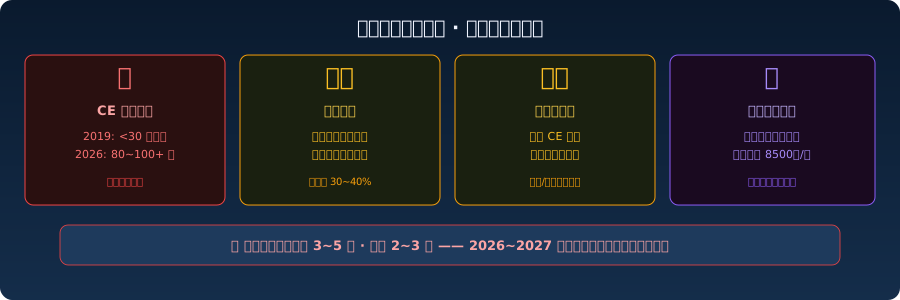

European Standard Crane Export: CE Barriers & Rising Competition

Key Takeaway

European Standard (FEM/DIN) manufacturing capability has been the core export advantage for Chinese crane makers over the past five years—with European-standard models growing from 22% of exports in 2024 to over 30% by the first half of 2026. But this window of opportunity is not permanent: CE Certification barriers are eroding (hundreds of Chinese companies now hold CE credentials), Indian and Turkish manufacturers are rapidly learning and closing the gap on FEM Standard, and industry leaders like Zoomlion, XCMG, and SANY are building plants in Germany and India to compete head-on in global markets. For small and mid-sized Chinese crane manufacturers, the European-standard advantage window is roughly 3–5 years—after which competition will shift from "having certification" to a broader battle across brand strength, service quality, and delivery speed.

How long will the European standard crane export advantage last? CE barriers weakening

At the 2025 bauma Munich trade fair, more than 500 Chinese companies exhibited, drawing the attention of European peers. This is both a point of pride for China's crane industry going global and a signal that the advantage window is narrowing—as more Chinese manufacturers obtain CE Certification, European Standard compliance is no longer a scarce differentiator.

Where the Advantage Came From: The European Standard Window of the Past Five Years

From 2019 to 2024, Chinese crane manufacturers enjoyed a golden window of "European Standard advantage." The core reasons:

① Chinese cost advantages × European Standard quality = an unbeatable combination. A 50t European-standard LHX-type Double-Girder Bridge Crane is priced at approximately RMB 550,000–650,000 ex-works in China, while a comparable European model (DEMAG/Konecranes) costs around €120,000–180,000 (roughly RMB 950,000–1.4 million)—a price gap of 40%–50%. On delivery time, Chinese manufacturers' 3–4 months versus European manufacturers' 8–12 months is a decisive edge.

② Surging infrastructure demand from the Belt and Road Initiative. Mega-projects such as Saudi Arabia's NEOM, Indonesia's new capital, and Egypt's New Administrative Capital have driven bulk procurement of European standard cranes. Chinese companies have rapidly captured market share through their triple advantage of "certification + pricing + delivery speed." Exports grew 29.39% year-over-year from January to February 2026, with European-standard models leading the charge.

③ Localized core components driving down costs. The localization of hardened gear reducers (SEW's China plant/Guomao/Tongli), Variable Frequency Drives (Inovance/INVT), and PLCs (Delta Electronics/Xinje) has steadily reduced the manufacturing cost of European standard cranes in China, narrowing the price gap between European Standard and domestic-standard models from 30%–40% down to 10%–25%.

The Advantage Is Fading: Three Trends Shrinking the Window

Trend Current Status Impact
CE Certification Barrier Reduction Domestic Achievement CE/FEM (Fédération Européenne de la Manutention)Certificationofcrane Enterprises from2019fewer than (year)30increased to2026in (year)80~100companies+ "have Certification"no longer a scarce advantage,"Certification+Quality+Price"Comprehensive Competition
India Indiacrane Manufacturers(Electro Mech, Krishna)massively recruiting FEM (Fédération Européenne de la Manutention)experienced Chinese engineers, rapidly establishing European Standard (EN)production lines India30%~40%, Middle Eastand Africamarket will face direct price competition from Indian competitors
Turkey Turkeycrane Enterprises(Desan, Vinçsan)naturally located in CEsystem, linguistic and cultural alignment with Middle East/North Africa/unimpeded access to European market Turkey is Middle Easta natural competitor in the North African market, Logistics Cost(Mediterranean Sea Freighttransport)far lower than China
Chinese leading enterprises building overseas plants Zoomlion Germany Plant Phase II, XCMG India8500units/year, SANY Indonesia Plant Plan50hundred-million-yuan output value after leading enterprises localize production overseas, cost and service response outperform the export model of domestic SMEs

DEMAG, Konecranes, ABUS vs. Domestic Brands: A Capability Comparison

The "Big Three" of European crane manufacturing—DEMAG (a Tadano Group company), Konecranes (Finland), and ABUS (Germany)—continue to command brand premium and technological advantages in the global high-end market:

Comparison Parameter DEMAG/Konecranes/ABUS Domestic Brands(including Krud etc.)
Brand PremiumHigh(European customers are willing to pay brand premium15%~30%)Barrier Reduction(need to win on cost-effectiveness)
Global Service Networkcoverage80+countries, authorized service providers in every major cityconcentrated domestically+a few overseas agency points
50tDouble Girder Price12~18ten thousand euros(~95~140ten thousand RMB)55~75ten thousand RMB
delivery time8~12months(Standard Machine Model)3~4months
Technological LeadershipHigh-end(Intelligent Anti-sway Algorithms, full life cycle management Software)has caught up in basic performance, gap remains in software and algorithms

Core Competitive Strategy: Chinese-made European Standard (EN) cranes shouldn't try to out-brand DEMAG or Konecranes. Instead, the winning formula is a combination of faster delivery, better value, and flexible service. When Zoomlion acquired Wilbert, it slashed delivery times from one year down to 3–4 months — that's exactly how domestic substitution should be done.

4. How Small & Mid-Sized Players Can Win: Niche Specialization

Strategy 1: Own a regional market — become "the local China expert." Build deep service capabilities in one country or region (resident engineers, a parts warehouse, and strong local dealers) instead of spreading too thin across many markets. Taiyuan Heavy Industry's network of 12 overseas marketing and service centers is a model worth following.

Strategy 2: Focus on underserved product niches. You're not going to out-muscle XCMG or SANY in large-tonnage crawler cranes, but specialized segments like Cleanroom Cranes, Explosion-Proof Cranes, and KBK light rail systems are still wide open — no major player has established deep coverage yet, which leaves a real window for smaller companies.

Strategy 3: Become an OEM/ODM partner for European brands. Supply components or do contract manufacturing for DEMAG, Konecranes, or ABUS on their China projects. It's a way to get your foot in the door, build experience, and earn credentials. Margins are thin at first and the pace is slow, but the risk is low — a solid starting point for export beginners.

FAQ: European Standard Crane Export

Q: How much longer will the European Standard crane export window stay open?

A: Optimistically, 3–5 years. Pessimistically, 2–3 years. The key judgment criteria: once FEM Standard crane production in India and Turkey crosses the tipping point (roughly 5,000 units per year), China's cost advantage will shrink dramatically. We recommend accelerating overseas service capability build-out in 2026–2027.

Q: Is it worth setting up an overseas manufacturing plant?

A: Not for small and mid-sized companies with annual exports under about $740,000 — the investment is too heavy and payback too slow. Prioritize overseas service centers and parts warehouses instead, and build deep partnerships with local dealers. Once annual exports exceed roughly $1.5 million, then consider a local assembly plant in Vietnam, Indonesia, or Mexico.

Q: Will DEMAG and Konecranes cut prices to push Chinese brands out?

A: They already are. DEMAG launched an "economy" product line in the Chinese market in 2024, with prices 15%–20% lower. But their European manufacturing cost structure limits how far they can go. Chinese manufacturers' core advantages — delivery speed and service flexibility — remain intact.

Q: How real is the anti-dumping risk?

A: No large-scale anti-dumping investigations have been launched against cranes yet, but the risk is growing. The EU imposed anti-dumping duties on Chinese electric forklifts in 2025, and cranes could be next. Mitigation strategies: set up overseas plants (like Zoomlion's German factory) or form joint ventures with local companies.

Related Reading

Domestic Substitution Progress — Chinese brands vs. DEMAG & Konecranes market share

Belt and Road Export Guide — In-depth analysis of export markets

Data sources: China Heavy Machinery Industry Association | Puhua Youce | bauma 2025 Munich | Company announcements

Related News

contact

contact us

phone:
+86 13903802779

mail:3915269@qq.com

Working hours: Monday to Friday

Wechat
Wechat
SHARE
TOP