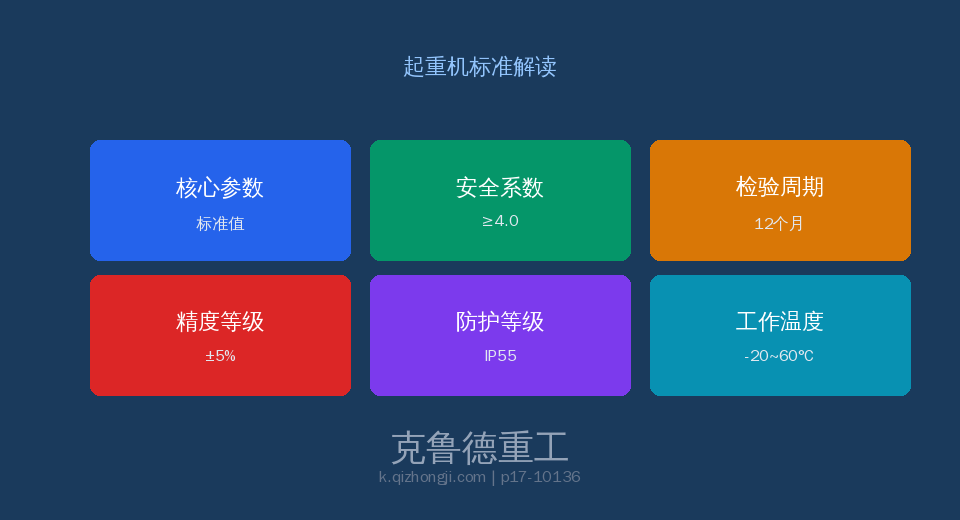

GB 6067.5 Lifting Appliances Safety Regulations Part 5 Explained
GB 6067.5 — Safety Regulations for Lifting Appliances, Part 5 is a key technical specification in the crane industry. Developed by the national standards committee, this document serves as Part 5 of the safety regulations governing lifting appliances.
The standard provides a unified technical basis for design engineers, inspection bodies, and end users. Kelude strictly adheres to its technical requirements throughout product development and manufacturing.
Scope and Application of the Standard
GB 6067.5 defines the safety-related technical requirements for cranes and lifting appliances with a rated lifting capacity above 0.5 t. It covers not only the design and manufacturing of new equipment but also provides clear technical guidance for the inspection, maintenance, and modification of cranes already in service. The standard aligns with the EN 13001 Crane Safety Standard series and ISO 4309 Wire Rope Inspection Standard, forming a comprehensive technical specification framework. The clearly defined core technical parameters and safety factors give design engineers a solid design basis, while also providing quantifiable acceptance criteria for type tests and factory inspections conducted by third-party inspection bodies. As a critical component of the crane standard system, this specification works in concert with EN 13001 and ISO 4309 to establish a complete and coherent regulatory framework.

Core Technical Parameter Framework
Under GB 6067.5, the design and manufacturing of lifting appliances must satisfy a rigorous set of technical parameters. These values are established through extensive test data and safety engineering principles, covering everything from material selection to structural design.
Comparative Analysis of Key Technical Parameters
| Item | technical requirements | Description |
|---|---|---|
| application scope | Bridge and Gantry Crane | Both new and in-service units are subject to inspection |
| Daily Inspection | Operator per shift15Minutes15Items | Limit Switch/Braking/Rope/Hook/Alarm |
| Monthly Inspection | Maintenance Personnelsafety device Full Function | overload/Limit Switch/Buffer/Emergency Stop |
| Annual Inspection | Certified Inspection Full Staffingcoverage | Structure/Mechanism/Electrical/Safety |
| overload limiting | ≥110%Rated Cut-off Hoisting / Lifting | Accuracy±5%Response≤0.5s |
| Brake | Hoisting / Lifting Dual Brake Per Unit≥1.5Times | Monthly Torque Testing |
Inspection Requirements and Intervals
Factory Acceptance Test (FAT) is performed on every unit at the manufacturer's facility by the quality inspection department. Each unit that passes inspection is supplied with a detailed inspection report and a Certificate of Conformity. For equipment in service, the periodic inspection interval generally does not exceed 12 months.
| Item | technical requirements | Description |
|---|---|---|
| Daily Inspection | 15Inspection Checklist | Per Shift+Records |
| Monthly Inspection | safety device Full Test | Monthly+Ledger |
| Annual Inspection | Full Staffingcoverage+Load test | Certified+Report |
| Abnormality | Stop Immediately Upon Discovery+Repair+Re-inspection | Completed Before Re-commissioning |
Safe Operation and Management Requirements
The standard places strong emphasis on operator qualification and training, requiring that all operators complete specialized training and obtain the necessary certification before they are permitted to operate the equipment.
FAQ
Q: What is the application scope of GB 6067.5, the safety regulations for lifting appliances, Part 5?
A: It applies to both overhead and gantry cranes, whether newly manufactured or already in service.
Q: What does the three-tier inspection system (daily, monthly, and annual) under GB 6067.5 entail?
A: Daily inspection — 15 minutes per shift by the operator; monthly inspection — maintenance of safety devices; annual inspection — performed by certified personnel.
Q: What are the set points and accuracy requirements for overload limiters on cranes under GB 6067.5?
A: Tripping at 110% of rated load, with an accuracy of ±5% and a response time of ≤0.5 seconds.
Q: What are the requirements for the configuration and inspection of brakes on hoisting mechanisms under GB 6067.5?
A: A dual brake system is required for hoisting, with a braking torque of at least 1.5 times the rated load per brake, and monthly torque testing.
Kelude — Specialized in crane design and manufacturing.