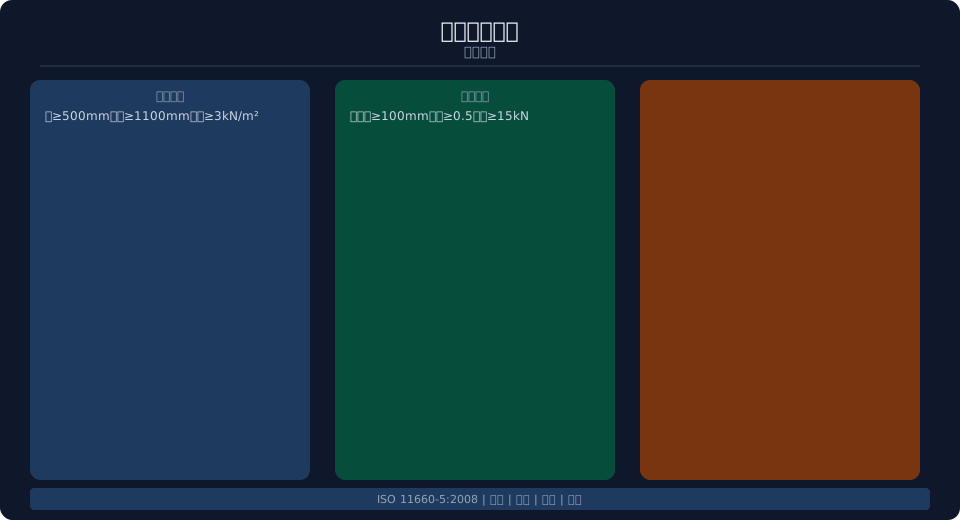

Bridge Crane Walkway Safety per ISO 11660-5:2008
ISO 11660-5:2008 "Cranes — Access, Guards and Restraints — Part 5: Bridge and Gantry Cranes" is the dedicated standard governing access systems and safety guarding for overhead traveling cranes. It sets out specific requirements for main girder walkways, platforms, ladders, guardrails, and conductor rail protection.
Main Girder Walkways and Platforms
Bridge cranes must be equipped with a walkway along the top of the main girder — minimum width 500 mm, with anti-slip grating or checkered steel plate at least 3 mm thick, designed for a load of at least 3 kN/m². Guardrails on both sides must be at least 1100 mm high, with an intermediate rail no more than 550 mm above the walkway surface and a toe board at least 100 mm high. A maintenance platform of at least 0.8 m², rated for 5 kN/m², is required at each end of the main girder. The trolley top must also feature a maintenance platform of at least 0.5 m² with full guardrails, and any gap between the trolley platform and the main girder walkway must be fitted with a self-locking hinged flap. All exposed edges must be marked with yellow warning paint.
Ladders and Guardrails
Vertical ladders must be at least 400 mm wide with rungs spaced 250–300 mm apart; ladders exceeding 6 m in height must be fitted with landing platforms or a fall arrest cage. Inclined ladders must be angled between 45° and 60°, at least 500 mm wide, with handrails on both sides. All ladders must have anti-slip surfaces. Ladders taller than 3 m must be equipped with a safety belt anchorage point rated for at least 15 kN. Guardrails must be at least 1100 mm high with posts spaced no more than 1500 mm apart, capable of withstanding a horizontal load of at least 0.5 kN/m. Guardrails along the conductor rail side must be at least 1800 mm high and fitted with insulated protective plates.
| Facility | Dimensions | guards | Position |
|---|---|---|---|
| main girder walkway | Width≥500mm | ≥3kN/m²+guardrail | Main Girder Overall Length |
| Maintenance platform | ≥0.8m² | ≥5kN/m²+guardrail | End |
| Trolleyplatform | ≥0.5m² | guardrail+Flap | Trolley Top |
| Vertical Ladder | Width≥400mm | >6mlanding platform | From Ground towalkway |
| Inclined Ladder | Width≥500mm | 45~60°+handrail | walkway From Ground to Cabin / Operator Cab |
| Conductor Rail / Busbarguards | ≥1800mm | insulation Flap | Conductor Rail / Busbar Side |
Crane Walkway Maintenance & Inspection
Perform daily inspections of the walkway plates for anti-slip conditions, verify guardrail stability, and check the integrity of toe boards. Conduct monthly inspections of weld seams, guardrail bolts, and the fixing of conductor rail protective plates. Test insulation resistance of protective plates semi-annually, ensuring values ≥5MΩ. Kelude Heavy Industry designs and manufactures bridge crane walkways and guards according to the standard.
| inspection item | Interval | Inspection Item | Standard |
|---|---|---|---|
| walkway plate | Daily | anti-slip/Water Accumulation | Tread Pattern≥50% |
| guardrail | Daily | Stability/Deformation | No Looseness |
| Weld Seam | Monthly | Connection Weld Seam | Hammer Test — No Abnormal noise |
| protective plate | Monthly | Fixing/Aging | No Displacement/Cracking |
| insulation Testing | Semi-annually | protective plate Resistance Value | ≥5MΩ |
The walkway atop the main girder of an overhead crane is the primary access route for maintenance personnel to reach the trolley rail, conductor rail, and various points along the main girder. The standard requires a walkway width of at least 500 mm—wide enough for safe passage without adding excessive dead weight to the crane. Walkway plates are made of anti-slip grating (hot-dip galvanized, with grating spacing ≤40 mm and load-bearing flat bar height ≥30 mm) or checkered steel plate (thickness ≥3 mm, with pattern height ≥1 mm), providing a slip resistance coefficient of ≥0.5. Weld quality on the walkway plates is critical—every connection point between the grating and the supporting beam must be fully welded, with a weld height of ≥4 mm and spacing of ≤300 mm. Intermediate supports (spaced ≤1500 mm) must be installed beneath the walkway plates to prevent excessive elastic deformation.
Guardrails are the core safety feature preventing falls from height. The guardrail height on both sides of the main girder walkway must be ≥1100 mm (measured from the walkway surface)—a dimension validated by extensive engineering practice to effectively prevent personnel from climbing over. The intermediate rail must be positioned at a height of ≤550 mm to prevent personnel from slipping through. Guardrail posts must be spaced at intervals of ≤1500 mm and secured to the walkway plate using bolted connections or welding (bolts ≥M16, or weld height ≥5 mm). Guardrails must withstand a horizontal distributed load of ≥0.5 kN/m (equivalent to the impact force of a 75 kg person striking the guardrail at speed). A toe board of ≥100 mm in height prevents tools and parts from falling off the walkway edge. All guardrail components are finished with yellow warning paint (providing a stark contrast against the surrounding steel structure) to enhance visual warning effectiveness.
FAQ: Walkway & Guardrail Requirements for Bridge Cranes
Q: What are the dimensional requirements for the walkway?
A: Width ≥500 mm (full length), anti-slip grating or checkered steel plate ≥3 mm thick, load capacity ≥3 kN/m². Guardrail height ≥1100 mm, intermediate rail ≤550 mm, toe board ≥100 mm. End maintenance platforms ≥0.8 m². Trolley platform ≥0.5 m².
Q: What safeguarding is required for the conductor rail?
A: Located on the opposite side of the walkway, protected by a protective plate ≥1800 mm of insulating material (FRP/PVC), with mesh openings ≤20 mm. High-voltage warning signs must be posted. Maintenance requires power isolation and lockout/tagout.
Q: What are the requirements for ladders and guardrails?
A: Vertical ladders: ≥400 mm wide, rung spacing 250–300 mm, landing platform required above 6 m. Inclined ladders: 45–60° angle, ≥500 mm wide, handrails on both sides. Guardrails ≥1100 mm high, posts spaced ≤1500 mm. Anchor points rated ≥15 kN required above 3 m.
Q: What are the inspection and maintenance requirements?
A: Daily inspection of walkway, guardrails, and toe boards; monthly inspection of welds and protective plates; semi-annual insulation testing. Kelude bridge cranes come fully equipped with walkway systems and safety facilities according to the standard.