

Which Electric Hoists Require Inspection? An Interpretation of the Definition Standards and Regulations for Special Equipment
📌 Key Points When electric hoists are sold, stored, and used separately, they are not legally classified as special equipment. However, once an electric hoist is installed on a complete lifting unit—such as a bridge crane, gantry crane, or jib crane—and the unit’s lifting capacity is 3 metric tons or more, the entire crane must be subject to special equipment regulation. A simple rule of thumb: 3 metric tons is the cutoff point—equipment weighing less than 3 metric tons falls within the safety threshold and does not require regulatory oversight, while complete units weighing 3 metric tons or more must be submitted for inspection.
Whether electric hoists require inspection and whether they are classified as special equipment are among the most frequently asked questions from users. Many users, after purchasing an electric hoist, are unsure whether annual inspections are required, whether they need to obtain an operator’s license, and what the consequences of failing to undergo inspection might be. In fact, the answer is not complicated; the key lies in distinguishing between two scenarios: ”electric hoists used independently” and ”electric hoists used as part of a crane.” This article is based on the *Law of the People’s Republic of China on the Safety of Special Equipment* (2014 edition), TSG Q7016-2016 “Rules for Supervision and Inspection of the Installation, Modification, and Major Repairs of Lifting Machinery,” TSG Q7015-2016 “Rules for Periodic Inspection of Lifting Machinery,” and Announcement No. 57 of 2020 issued by the State Administration for Market Regulation, systematically outlines the criteria for defining electric hoists as special equipment.
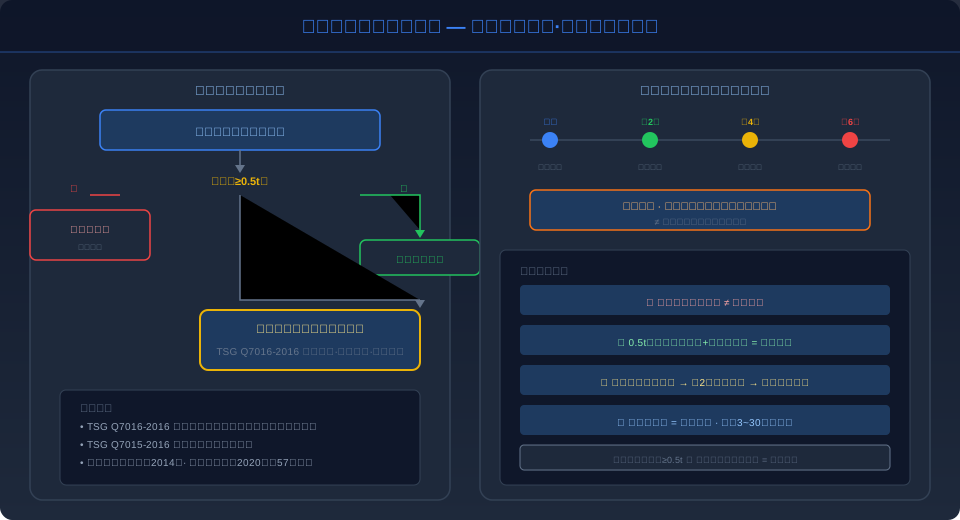
1. The Legal Definition of Special Equipment
Article 2 of the ”Law of the People’s Republic of China on the Safety of Special Equipment” defines special equipment as boilers, pressure vessels, pressure pipelines, elevators, lifting machinery, passenger ropeways, large amusement facilities, and special-purpose motor vehicles used within sites or factories that pose a significant risk to personal safety and property. An electric hoist is not, in and of itself, a separate category of special equipment; however, when it is installed on a crane as a hoisting mechanism, the entire crane is classified as ”crane machinery” for the purposes of special equipment management. Announcement No. 57 of 2020 by the State Administration for Market Regulation, titled “Catalog of Special Equipment,” clearly states: “Lifting machinery refers to electromechanical equipment used for the vertical lifting or vertical lifting and horizontal movement of loads. Its scope is defined as hoists with a rated lifting capacity greater than or equal to 0.5 metric tons; cranes with a rated lifting capacity greater than or equal to 3 metric tons (or tower cranes with a rated lifting moment greater than or equal to 40 metric ton-meters, or ship-to-shore cranes with a throughput greater than or equal to 300 metric metric tons per hour), and a lifting height greater than or equal to 2 meters.”
Key Point: When electric hoists are sold, stored, and used separately, they are not legally classified as special equipment. However, once an electric hoist is installed on a complete crane—such as a bridge crane, gantry crane, or jib crane—and the crane’s total lifting capacity is ≥3 metric tons, the entire crane must be subject to special equipment regulation. Easy to remember:3 metric tons is the cutoff point—No inspection is required for units weighing 3 metric tons or less; units weighing 3 metric tons or more must be submitted for inspection.
2. In what situations is inspection required?
According to TSG Q7016-2016 and TSG Q7015-2016, an application for inspection must be submitted to a special equipment inspection agency in the following three situations:
Scenario 1: Supervision and inspection of new installations.After an electric hoist with a lifting capacity of 3 metric tons or more has been installed on a crane, an application for installation supervision and inspection must be submitted to the local special equipment inspection agency. The inspection covers: inspection of the equipment itself (metal structure, hoisting mechanism, travel mechanism); inspection of safety devices (limit switches, brakes, overload limiters); inspection of the electrical system; and load testing (125% static load + 110% dynamic load). Upon passing the inspection, a “Hoisting Machinery Installation Supervision and Inspection Report” will be issued, after which the equipment may be put into service.
Scenario 2: Periodic inspection (every 2 years).Cranes in service must undergo a periodic inspection every two years, conducted on-site by an inspection agency. Inspection items include: visual inspection, functional testing of safety devices, inspection of wear on major components, insulation resistance testing, and load testing (100% rated load), among others. Cranes that pass the periodic inspection are issued a “Periodic Inspection Report for Lifting Equipment”; those that fail are ordered to cease operation and must undergo rectification within a specified timeframe before undergoing a re-inspection.
Scenario 3: Annual Inspection (every year).The annual inspection organized by the user entity does not constitute a periodic inspection. The annual inspection is conducted by the user entity’s safety management personnel or by a qualified maintenance and inspection service provider commissioned by the user entity, with the inspection scope and standards based on Appendix A of TSG Q7015-2016. Records of the annual inspection must be archived for future reference, and market regulation authorities will verify compliance with the annual inspection requirements during their routine inspections.
3. In what situations is inspection not required?
① Lifting Capacity<3-metric-ton electric hoist(Including micro electric hoists with capacities of 0.25 metric tons or less and 0.5 metric tons or less).
② Electric hoists sold or stored as standalone components, not yet installed on the crane.
③ Lifting capacity ≥ 3 metric tons but classified as manual lifting equipment(Hand-operated chain hoists/hand-operated block hoists) Manual lifting equipment is not subject to regulation under the *Catalog of Special Equipment*.
④ Household-use micro electric hoists for non-commercial settings(Rated Lifting Capacity<3 metric tons and a lifting height of less than 2 meters). Note: Electric hoists with a lifting capacity of 3 metric tons or more are not classified as special equipment when used alone and are therefore not subject to special equipment regulation; however, in the event of a safety accident, the using entity remains responsible for ensuring workplace safety.
4. Testing Standards and Implementing Agencies
Inspections of special equipment are conducted by special equipment inspection agencies approved by the provincial market supervision administration. Each prefecture-level city typically has one or two qualified inspection agencies (such as the Provincial Special Equipment Inspection Research Institute or the Municipal Special Equipment Inspection Institute). Inspection fees are set by provincial price authorities and typically range from 500 to 3,000 yuan per unit (varying depending on the type and tonnage of the equipment).
Handling of Non-Conforming Inspections:For lifting equipment that fails a periodic inspection, the operating entity must complete corrective actions within the timeframe specified by the inspection agency (typically 30 days). After making the necessary corrections, the user must apply for a re-inspection; if the equipment still fails the re-inspection, it must be taken out of service and deregistered. The cost of corrective actions typically ranges from several thousand to tens of thousands of yuan (depending on the number of non-conformities), which is far higher than the inspection fee itself. Krude Heavy Industry recommends that users conduct annual inspections and maintenance during routine operation to resolve issues before the scheduled inspection takes place.
5. Comparison Table of Criteria for Defining Special Equipment
| Equipment Type | Lifting Capacity | Is it a piece of special equipment? | Inspection Requirements | Based on |
|---|---|---|---|---|
| Electric Hoist (Standalone) | Any | 否 | No inspection required | General Administration Notice No. 57 of 2020 |
| Complete crane (including electric hoist) | ≥3 t | 是 | Supervisory Inspection + Periodic Inspection Every 2 Years + Annual Inspection | TSG Q7016-2016/7015 |
| Complete Crane Unit | <3t | 否 | No inspection required | "Catalog of Special Equipment" |
| Manual Hoist (Hand-Pull/Hand-Crank) | Any | 否 | No inspection required | "Catalog of Special Equipment" |
| Explosion-proof electric hoist | ≥3 t | 是 | Same as for standard cranes + special explosion-proof inspection | TSG Q7016-2016 + GB/T 3836.1-2021 |
6. Data Card for the Definition of Special Equipment
|
3t
Definition of Special Equipment
Cranes with a rated lifting capacity of ≥3 metric tons must be subject to special equipment regulation; the following are exempt.
|
2 years
Periodic Inspection Interval
Cranes in use must undergo a periodic inspection every two years, which is conducted on-site by a certified inspection agency.
|
30,000–300,000
Amount of Fines for Uninspected Items
A fine of 30,000 to 300,000 yuan may be imposed for putting equipment into use without having undergone supervisory inspection or periodic inspection.
|
|
500–3,000 yuan
Cost per test
Pricing is set at the provincial level and varies depending on the type and tonnage of the equipment; it does not include the cost of rectification and re-inspection.
|
3 items
Inspection Type
Inspection of new installations + periodic inspections every two years + annual inspections—all are mandatory.
|
30 days
Deadline for Rectification
If an inspection fails, the deadline for corrective action is typically 30 days; if the product still fails the re-inspection, it must be taken out of service and deregistered.
|
The above provides a comprehensive interpretation of the regulations defining electric hoists as special equipment. Every crane sold by Krude Heavy Industry that includes an electric hoist comes with a complete factory inspection report and technical documentation to assist users in completing the application process for supervisory inspection of newly installed equipment. For more information on inspection and reporting requirements, please refer toWiring Guide for Electric Hoist Limit SwitchesKey Points for Daily Inspections of Safety Protection Devices.
💬 Technical Commentary on the Definition of Special Equipment
“The question of whether electric hoists need to be inspected comes up at least a few hundred times a year. The bottom line is this: when sold separately, an electric hoist is not classified as special equipment; however, once mounted on a crane with a lifting capacity of 3 metric tons or more, it becomes special equipment. Many small manufacturers purchase electric hoists, weld a frame around them, and use them as cranes without undergoing either initial inspection or annual inspection. If caught, the fine starts at 30,000 yuan. Upon delivery of the equipment, Krude Heavy Industry signs a ”Special Equipment Notification and Confirmation Form” with the customer, clearly outlining the inspection obligations to prevent customers from inadvertently using the equipment in violation of the law.”
Frequently Asked Questions (FAQ)
Q: Is a 0.5-metric-ton electric hoist considered special equipment?
Answer: When sold or stored separately, electric hoists—regardless of their lifting capacity—are not considered special equipment and do not require inspection. However, once a 0.5-metric-ton electric hoist is installed on a complete crane with a lifting capacity of 3 metric tons or more, the entire crane is classified as special equipment. It must undergo installation supervision inspection in accordance with the requirements of TSG Q7016-2016 and may only be used after obtaining an inspection report. Easy to remember: Look at the whole, not the parts—the parts are not special equipment, but the whole is.
Q: Do you need an operator's license to operate a 2-metric-ton electric hoist?
Answer: A 2-metric-ton electric hoist does not require an operator’s license on its own; however, when a 2-metric-ton electric hoist is mounted on a crane with a lifting capacity of 3 metric tons or more, the person operating the crane must hold a Special Equipment Operator’s Certificate (category code Q2, crane operator). According to the ”Measures for the Supervision and Administration of Special Equipment Operators,” anyone who engages in special equipment operations without authorization shall be ordered to rectify the violation and shall be fined between 1,000 and 10,000 yuan. Therefore, the question is not ”Does a 2-metric-ton electric hoist require a license?” but rather “Does operating a crane equipped with an electric hoist require a license?”—and the answer is yes.
Q: What happens if an electric hoist is found to have not been submitted for inspection?
Answer: The penalties increase progressively. Step 1: If market regulation authorities discover a crane that has not been inspected during an on-site inspection, they will issue a “Special Equipment Safety Inspection Order” on the spot, ordering the immediate cessation of use and requiring the owner to submit the crane for inspection within a specified time limit. Step 2: If the issue is not rectified by the deadline, a fine of between 30,000 and 300,000 yuan will be imposed in accordance with Article 84 of the “Special Equipment Safety Law.” Step 3: If a safety accident occurs, the person in charge of the using entity may face criminal liability (for the crime of causing a major liability accident, punishable by up to 7 years’ imprisonment). Additionally, cranes that have not been inspected cannot be insured, meaning the using entity will bear full financial responsibility in the event of an accident. We recommend that using entities contact an inspection agency before installing the equipment and incorporate the inspection into their project plan.
Q: Are the annual inspection and periodic inspection of electric hoists the same thing?
Answer: They are not the same thing; there is a fundamental difference between the two. An annual inspection is an annual inspection organized independently by the using entity (TSG Q7015-2016, Appendix A). It may be conducted by the entity’s safety management personnel or delegated to a maintenance and repair provider, and the inspection records need only be archived for future reference. Periodic inspections, on the other hand, are statutory inspections conducted on-site every two years by an approved special equipment inspection agency. They carry legal weight, and a formal inspection report is issued upon successful completion. Annual inspections cannot substitute for periodic inspections, nor can periodic inspections exempt an entity from the obligation to conduct annual inspections. One represents a routine management responsibility, while the other is a statutory technical supervision procedure; they are not interchangeable.
For more information on the management of special equipment, please refer to our upcoming articles.Electric Hoist Power Wiring and Electrical Control SystemRequirements regarding electrical safety.
