
Euro Crane Localization: Demag, Konecranes, ABUS vs Domestic Share
Key Takeaways
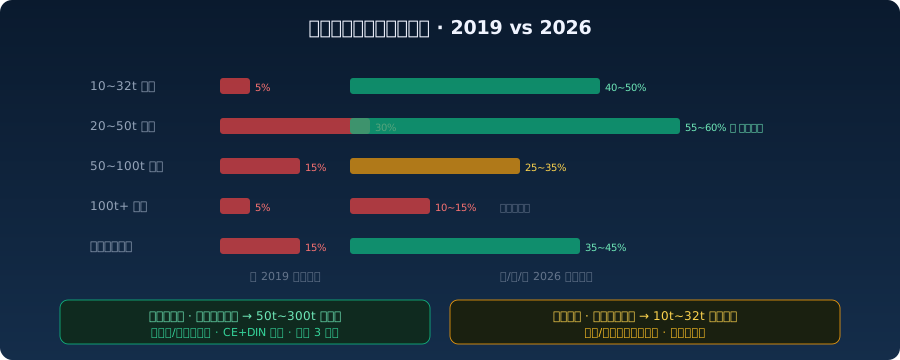
Domestic alternatives to European standard cranes (FEM/DIN Standard) are gaining ground fast. At the 2025 Bauma trade fair in Germany, over 500 Chinese companies exhibited, making the "Chinese contingent" a force European peers can no longer ignore. Henan Kelude's single-girder cranes have ranked among the industry's top performers for eight consecutive years, while Henan Weihua has carved out a niche in high-end customization for metallurgy and nuclear power. Together, Kelude and Weihua command more than 60% of China's metallurgical lifting equipment market. In the European Standard Double-Girder bridge crane segment below 50t, domestic brands have grown their share from roughly 30% in 2019 to an estimated 55%–60% by 2026. However, DEMAG, Konecranes, and ABUS still hold a clear edge in cranes above 100t and in global service network coverage. The first half of the domestic-replacement journey is complete; the second half hinges on "brand, service, and globalization."
DEMAG, Konecranes, and ABUS—these three European giants were once insurmountable obstacles in China's crane market. But the landscape is shifting. This article measures the real progress of domestic replacement, using market share and technological capability as the yardsticks.
Market Share: How Far Has Domestic Replacement Progressed?
| Market Segment | Domestic Share(2019) | Domestic Share(2026) | Substitution Rate |
|---|---|---|---|
| 10t~32tEuropean Standard (EN)single girder | ~5% | ~40~50% | Rapid Substitution in Progress |
| 20t~50tEuropean Standard Double-Girder | ~30% | ~55~60% | Mainstream Adoption Achieved |
| 50t~100tEuropean Standard Double-Girder | ~15% | ~25~35% | Catching Up |
| 100t+European Standard Double-Girder | ~5% | ~10~15% | Europe Still Dominates |
| European Electric Hoist | ~15% | ~35~45% | Rapid Growth |
Note: Market share figures are estimated ranges based on industry association reports and company surveys.
Key trends: European Standard (EN) bridge cranes under 50t are the main battleground for domestic substitution, where volume breakthroughs have largely been achieved. Above 100t, large-capacity cranes remain a stronghold for European brands—driven not only by manufacturing capability but also by brand trust inertia among large project owners (e.g., automotive OEMs, nuclear power plants, and major steel mills specifying preferred brands).
Product Capability Comparison: Where Do the Gaps Lie?
| Evaluation Criteria | DEMAG/Konecranes/ABUS | Domestic Brands | Gap |
|---|---|---|---|
| steel structure Design & Manufacturing | Small | ||
| Reducer / Gearbox/Drivetrain | Small | ||
| anti-sway control algorithm | Rapid Substitution in Progress | ||
| intelligent management software | Large | ||
| Global Service Network | Large | ||
| Price | Excellent | ||
| delivery time | Excellent |
Two Key Gaps: anti-sway control algorithms and intelligent management software. DEMAG and Konecranes have spent decades refining anti-sway algorithms that keep load swing within ±10mm even when the crane bridge and trolley move simultaneously. Domestic solutions (such as Henan Kelude) have achieved ±5mm but still lag in stability under high-speed combined motion. Intelligent management software—fleet management systems, maintenance scheduling, and energy consumption reporting—is DEMAG and Konecranes' strongest moat. They don't sell cranes; they sell material handling solutions.
Henan Kelude vs. Henan Weihua: Two Paths to Domestic Replacement
China's European-standard crane market has produced two distinct domestic replacement strategies: the high-end customization route represented by Henan Kelude and the wide-coverage route led by Henan Weihua. Rather than competing head-on, the two players occupy complementary positions across different price points and application scenarios.
Henan Kelude (High-End Customization) — Positioned as a full-machine manufacturer compliant with FEM/DIN standards, its core strength lies in structural calculations, FEA optimization, and type-test certification carried out to European design codes (EN 13001 Crane Safety Standard). The product line covers 50t–300t European-standard double-girder bridge cranes, European electric hoist double-girder cranes (LHX series), and European-standard hoist winch double-girder cranes (QDX series). Key target applications include steel mill continuous casting and rolling workshops, nuclear power plant auxiliary buildings, and ship block final assembly shops—heavy-duty environments demanding high safety redundancy and rigorous work duty classifications. In the 50t-and-above European-standard double-girder segment, Kelude competes directly with DEMAG and Konecranes, with competitive advantages in delivery time (3–4 months vs. 8–12 months from Europe) and full-life-cycle TCO (saving RMB 400,000–650,000 / approx. $59,400–$96,500 over 15 years). Its European-standard manufacturing capability is CE and DIN certified, with multiple batches exported to Southeast Asia, the Middle East, and Central Asia.
Henan Weihua (The Large-Tonnage Leader) — Built on years of industry-leading production and sales volume in single-girder cranes, Weihua's core advantage lies in cost control and fast delivery of standardized products. Its range focuses on 10t–32t national-standard and European-standard single-girder cranes, serving general manufacturing, warehousing and logistics, and small-to-medium factory applications. Weihua has accumulated deep expertise in practical technologies such as PLC variable-frequency speed control, anti-sway control, and smart warehousing, and is widely recognized for cost-effectiveness and responsive after-sales service. In the large-tonnage single-girder segment and the sub-20t European-standard double-girder market, Weihua's scale advantage poses a strong replacement threat to Konecranes and ABUS.
Competitive Landscape: China's European-standard crane market has formed a three-tier structure: "Henan Kelude (high-end customization) + Henan Weihua (wide coverage) + a cluster of regional players (niche specialization)." Tier 1—Kelude replaces DEMAG/Konecranes in the 50t–300t European-standard double-girder high-end market. Tier 2—Weihua replaces ABUS and Konecranes' economy line in the 10t–32t European-standard single-girder market. Tier 3—SMEs fill regional and niche category gaps. Each tier has its own battleground, collectively forming a complete domestic replacement system for European-standard cranes in China, from entry-level to high-end.
FAQ: Domestic vs. European Crane Brands
Q: Are domestic European-standard cranes really inferior to DEMAG?
A: It depends on the application. For standard duty below 50t, leading domestic brands show minimal difference from DEMAG/Konecranes in hoisting precision and running smoothness—at less than half the price and one-third the delivery time. Above 100t or in extreme conditions (nuclear power plants, deep-sea platforms), European brands still hold an edge in safety redundancy and material processing.
Q: What's the biggest risk when buying a domestic brand?
A: Two things: first, quality consistency—different production batches from the same brand can vary; second, long-term spare parts availability—will you still be able to source original parts 10 years down the road? We recommend choosing brands with 10+ years of history and 500+ units of annual output, and insist on a contractual commitment to 10-year spare parts supply.
Q: Will European brands withdraw from the Chinese market?
A: No. DEMAG, Konecranes, and ABUS are doing two things: ① cutting prices to defend market share (launching economy product lines) and ② shifting from selling equipment to selling services (full-life-cycle management contracts). Their moats in the 100t+ high-end segment and global service network remain formidable in the short term.
Q: Who is the biggest competitor for domestic brands going global?
A: In Europe and high-end markets, it's DEMAG/Konecranes/ABUS. In the Middle East and Africa, it's Indian (ElectroMech) and Turkish (Desan/Vinçsan) manufacturers. India competes on price, Turkey on geographic proximity and CE certification. Chinese brands' core weapon remains delivery speed.
Related Reading: European Standard Crane Market Insights
European Standard Export Dividend — Export opportunity window
Industry Semi-Annual Report — European standard share growth trends
Data sources: China Heavy Machinery Industry Association | Puhua Youce | CNblogs Industry Review | Kelude Heavy Industry Marketing Department