Tower Crane Access System Safety per ISO 11660-3:2008

ISO 11660-3:2008, "Cranes — Access, Guards and Restraints — Part 3: Tower Cranes," is the dedicated standard governing access systems and safety protection facilities for tower cranes. Building on the general principles of ISO 11660-1, this standard addresses the unique challenges of tower cranes' elevated structures and anchorage installations, specifying detailed requirements for tower walkways, platforms, guardrails, and fall protection systems.


Tower Mast Access System Requirements

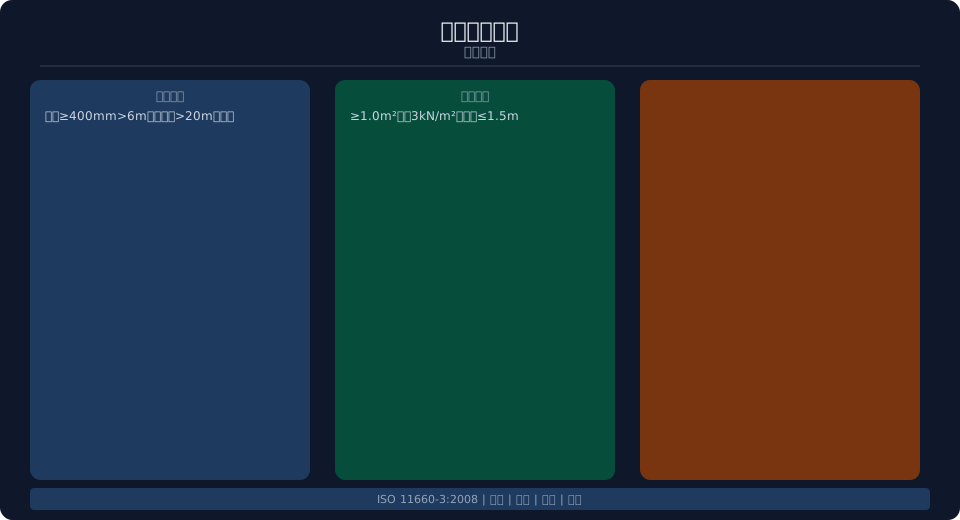
ISO 11660-3:2008 imposes stringent requirements on vertical access within the tower mast. Each mast section must be equipped with a fixed vertical ladder or inclined ladder, with a ladder width of ≥400 mm for square cross-section masts or ≥300 mm for triangular cross-section masts, and rung spacing between 250 mm and 300 mm. Vertical ladders exceeding 6 m must incorporate intermediate landing platforms (platform area ≥0.5 m², guardrail height ≥1100 mm) or be fitted with a fall protection cage (installed within the top 3 m of the ladder). Transition platforms (area ≥0.3 m²) must be provided at each mast section joint, allowing operators to pause and work safely during ascent and descent.

For fall protection on tower walkways — any access system exceeding 20 m in height must be equipped with an independent safety rope (stainless steel wire rope with a steel core diameter of ≥8 mm, anchored at both the top and bottom of the tower mast). Operators must use a safety belt with an energy absorber connected to the safety rope when traveling up or down the mast. The standard also mandates lighting within each mast section — illuminance of ≥50 lux (LED fixtures with a Protection Rating of IP65), mounted on the side of the walkway to avoid obstructing the passage.


Standard interpretation diagram


Anchorage Device Platform Specifications

Maintenance platforms must be installed at the anchorage device (where the tie-in struts connect to the building structure). Each platform must have an area of ≥1.0 m² (no less than 1 m × 1 m) and a load-bearing capacity of ≥3 kN/m². Guardrail height must be ≥1100 mm, with intermediate rails spaced at ≤550 mm and toe boards of ≥100 mm. The anchorage platform should be positioned no more than 1.5 m below the connection node between the tie-in strut and the tower mast, enabling maintenance personnel to safely inspect anchor bolts and weld seams. The gap between the platform and the building structure must not exceed 300 mm — if larger, transition plates or additional guarding must be provided.

Inspection and maintenance access must also be provided on the tie-in struts themselves. For struts with a cross-section height of ≥300 mm, an anti-slip walkway (width ≥300 mm) with handrails on both sides must be installed on the upper surface. For tower cranes with multiple anchorage levels, transition ladders connecting upper and lower anchorage platforms are required. Installation and removal of anchorage platforms must follow a special safety plan — platform components must be hoisted using the crane's own lifting capability, and maintenance personnel are prohibited from walking across unprotected tie-in struts.

Tower Ladder Width
≥400mm
Rung Spacing
250–300mm
Fall Protection Height
Safety rope above 20m
Landing Platform
Every 6m
Anchorage Platform
≥1.0m²
Lighting
≥50 lux
access system Component dimensional requirements guardsrequirements Lightingrequirements safety facilities
Tower mastvertical ladder Width≥400mm >6mlanding platform ≥50lux Fall Protectionsafety rope
Tower mastinclined ladder 45~60° Both Sideshandrail ≥50lux Safety Anchor Point
Tie-inplatform ≥1.0m² guardrail+toe board ≥100lux safety belt anchorage point
Tower Topplatform ≥0.8m² guardrail≥1100mm ≥100lux Independent Anchor Point
counter-jib walkway Width≥400mm handrail+anti-slip ≥50lux Fall Arrest System

Tower Head and Counter-Jib Walkway Access

Access requirements for the tower head (tower cap) area — a maintenance platform must be provided on the tower head for servicing the anemometer, tower head pulleys, and aviation obstruction lights. The platform shall have a minimum area of 0.8 m² and be equipped with guardrails and toe boards. The walkway from the tower head to the jib must be an anti-slip walkway with a minimum width of 400 mm. On the counter-jib, a full-length anti-slip walkway (minimum width 400 mm) shall be installed for inspection and maintenance of the hoisting mechanism, counterweights, and rope guide. The walkway must have handrails on both sides (or a handrail on one side plus a mid-rail rope on the other). Guardrails shall be provided around the counterweight area at the end of the counter-jib to prevent counterweights from falling and causing injury.

Trolley inspection access — for horizontal-jib tower cranes, a maintenance platform (minimum area 0.5 m²) shall be provided on the trolley for servicing the trolley pulleys and wire rope. The platform must travel with the trolley during operation. A dedicated safety belt anchorage point shall be fitted on the trolley maintenance platform. The standard also requires that a temporary safety rope be installable along the full length of the jib for use when inspecting jib pulleys and wire rope, with both ends secured to the jib tip and the tower head.


Safety Signs and Emergency Equipment

Safety signs and emergency facilities on tower cranes — a confirmation board shall be placed at the tower mast entrance requiring operators to sign off that they have fastened their safety belts before climbing. Directional indicators (up/down arrows) shall be installed every 10 m along the tower mast. The tower head shall be fitted with a wind-speed warning light (red flashing, automatically activated when wind speed reaches the early warning threshold) and an aviation obstruction light to mark the crane's position at night. The crane shall be equipped with controlled descent devices for emergency evacuation from height (rated load ≥ 150 kg, slow descent speed ≤ 2 m/s), with one unit located at the top of the tower mast and one near the operator cab.

Kelude tower cranes come with walkways and safeguarding comprehensively configured to ISO 11660-3:2008 — the tower mast vertical ladder is fitted with a fall protection system, the attachment platforms and tower head platforms are fully provided, the counter-jib walkway and trolley maintenance platform are designed according to the standard, and safety signs and emergency facilities are all in place.

inspection item Interval Inspection Item acceptance criteria
tower walkway Monthly Ladder Rung Tightening/Fall Protectionsafety rope No Looseness/Corrosion
Tie-inplatform At Tie-in Installation guardrail/toe board/Load-Bearing Perdesign Drawing Acceptance
safety rope Quarterly Rope diameter/anchor point/energy absorber ≥8mm/Fixing Secure
controlled descent device Annually functional test Load≥150kg
Lighting Semi-annually Luminaire/Wiring ≥50lux/IP65

FAQ

Q: At what tower mast walkway height is a dedicated fall protection system required?

A: A dedicated fall protection safety rope (steel-core stainless steel wire rope ≥8mm) must be installed when the tower walkway exceeds 20m in height. Operators climbing the tower mast must attach their safety belt with energy absorber to the safety rope. The standard also requires a landing platform every 6m.

Q: What access system requirements apply at anchorage device locations?

A: A maintenance platform (≥1.0m², load capacity ≥3kN/m², with full guardrails) must be provided where the anchorage struts connect to the building structure. Anti-slip walkways (≥300mm wide) are required on anchorage struts with a cross-section of ≥300mm. The anchorage platform must be located within 1.5m of a tower mast node.

Q: What emergency evacuation equipment is provided on tower cranes?

A: One controlled descent device is installed at both the tower top and near the operator cab (load capacity ≥150kg, slow descent speed ≤2m/s). Direction indicator signs are placed every 10m along the tower mast. Wind speed warning lights and aviation obstruction lights are mounted at the tower top. Operators should conduct regular emergency evacuation drills.

Q: What access system configuration does Kelude offer on its tower cranes?

A: The tower mast vertical ladder comes with a fall protection system, transition platforms at each standard section, anchorage maintenance platforms, anti-slip walkways on the balance arm, a trolley maintenance platform for the luffing mechanism, and controlled descent devices for emergency use. All are designed and manufactured in compliance with ISO 11660-3:2008.

Related News

contact

contact us

phone:
+86 13903802779

mail:3915269@qq.com

Working hours: Monday to Friday

Wechat
Wechat
SHARE
TOP