

Overhead Crane Brake Selection & Commissioning Guide
Overhead crane brakes may not seem like much, but when they fail, the consequences are serious—load slipping, runaway trolleys, or a cracked brake wheel can each bring operations to a halt. In our years of maintenance work, we've seen too many cases where an "abnormal noise from the brake" was ignored until it escalated into an emergency shutdown and thousands of dollars in losses. Only when the brake is properly selected and adjusted can the crane be considered safe. This article covers everything you need to know about overhead crane brakes—from braking torque calculations and model selection to installation and adjustment procedures, plus troubleshooting for load slipping.
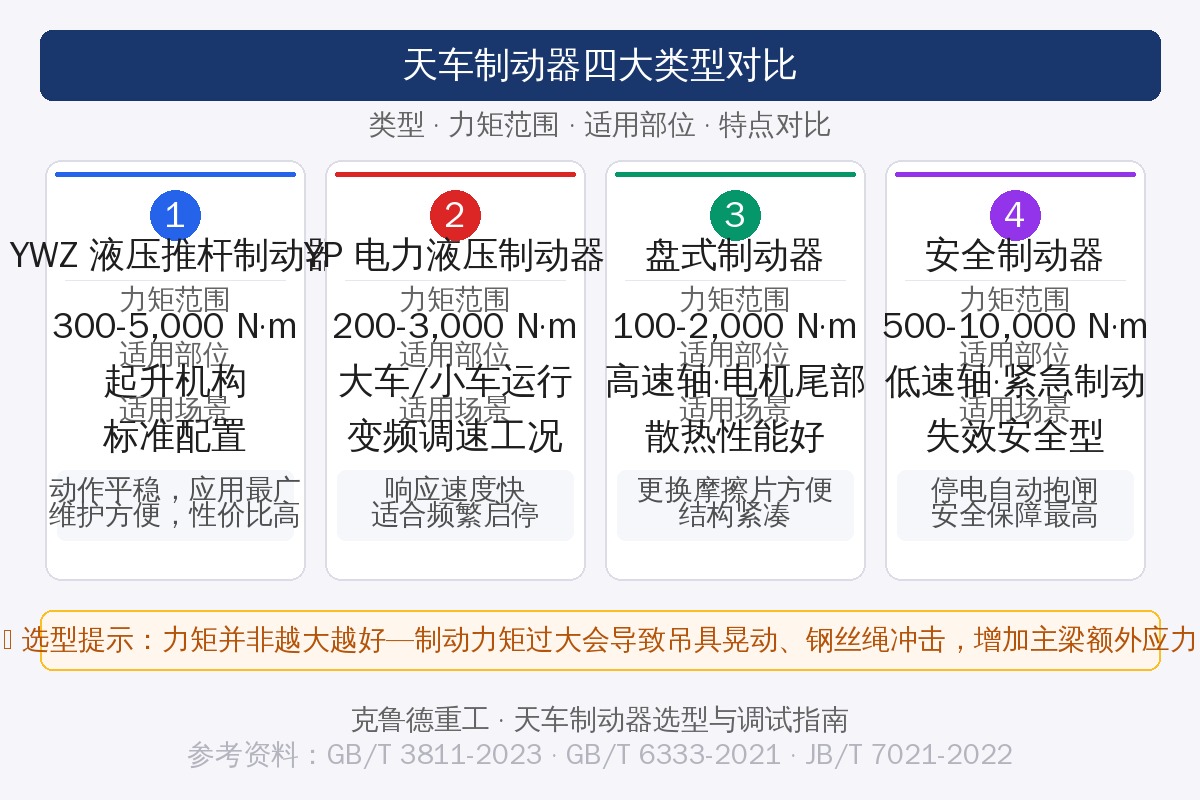
Overhead Crane Brake Types and Application Scenarios
| Type | Braking torque | Applicable Part | Features |
|---|---|---|---|
| YWZ Hydraulic Thrust Brake | 300-5,000 N·m | Hoisting mechanism·standard configuration | Smooth Operation, Most Widely Used, maintenance Convenient |
| YP Electric Hydraulic brake | 200-3,000 N·m | Crane Bridge/Trolley Travel Mechanism | Fast Response, Suitable For Variable Frequency Speed Controloperating conditions |
| Disc Brake | 100-2,000 N·m | High-Speed Shaft·Motor Rear End | Good Heat Dissipation, replacement Friction lining Convenient |
| Safety Brake | 500-10,000 N·m | low-speed shaft·Emergency Safety Braking | fail-safe type, Automatic on Power Failure Brake application |
When selecting a brake, bigger isn't always better. While a higher torque rating may seem safer, overly aggressive braking can cause the lifting spreader to sway, induce shock loads on the wire rope, and even create unwanted stress on the main girder structure. The right torque for the application is what matters.
Braking Torque Calculation with Worked Example
The core formula for brake selection per ISO 4301 (formerly ISO 4301):Tz ≥ K × Th
- Tz — Rated braking torque of the brake (N·m)
- K — Safety factor: 1.75 for hoisting mechanisms, 1.25 for travel mechanisms, 1.5 for slewing/luffing
- Th — Load torque (N·m) = rated load × drum radius ÷ rope reeving ratio ÷ efficiency
Worked example: A 32t double-girder bridge crane with the following hoisting mechanism parameters: rated load 32t, drum radius 0.32 m, rope reeving ratio 6, mechanical efficiency 0.9.
Th = 32,000 × 9.8 × 0.32 ÷ 6 ÷ 0.9 = 18,577 N·m
Tz ≥ 18,577 × 1.75 = 32,510 N·m
From the selection table: choose two YWZ-500/200 brakes installed in parallel, each providing 17,000 N·m, for a combined 34,000 N·m > 32,510 N·m. If this configuration doesn't meet the requirement, step up to the next size or add a dual-brake arrangement.
Brake Adjustment Procedure — Pre-Shift Checklist
| adjustment Item | characteristic value | adjustment method | Period |
|---|---|---|---|
| Brake shoe Release Distance | 0.5-1.0 mm | Adjust Push Rod Length, Uniform Release Distance on Both Sides | Per Shift |
| Compensationstroke | ≤50%Totalstroke | Spring Pre-compression Amountadjustment | Weekly |
| Braking Shim Thickness | ≥Original Thickness50% | Visual Inspection+Caliper Measurement, Insufficientreplacement | Monthly |
| Brake wheel Wear | ≤Original Diameter4% | Caliper Measurement, Out of Tolerance Turning Orreplacement | Quarterly |
| Thrusteroil level | Oil Gauge Centerline | Replenish YB-N46Hydraulic Oil | Monthly |
Load Slipping Troubleshooting Procedure
Load slipping is one of the most dangerous overhead crane faults. Follow this step-by-step troubleshooting procedure:
- Inspect brake lining wear — Open the brake and check; replace immediately if the lining thickness is insufficient.
- Check the brake spring — A relaxed spring reduces clamping force; adjust the pre-compression or replace the spring.
- Inspect the brake wheel surface — Clean oil contamination with anhydrous ethanol; replace the brake wheel if cracks are found.
- Check the electro-hydraulic thruster — Sticking or oil leakage prevents full thrust; repair or replace as needed.
- Verify electrical control — Confirm the brake open/close signals are correct and the release delay timing is properly set.
- Review VFD parameters — Ensure DC injection braking parameters are configured correctly.
Important note: Do not attempt to fix load slipping by simply increasing spring force. While a stronger spring may stop the slipping, it can reduce the brake shoe clearance, causing friction heating during operation and a sharp rise in brake wheel temperature — which ultimately leads to brake wheel cracking. We have seen this failure mode at least five times.
FAQ: Overhead Crane Brake Maintenance & Troubleshooting
Q: How often should overhead crane brakes be replaced?
A: It depends on the work duty and frequency of use. For classifications below A5, brake linings typically last 2–3 years; for heavy-duty cranes in A7–A8, replacement may be needed within six months. Brake wheels can usually be turned (machined) once or twice before replacement, giving a service life of about 5–8 years. Safety brakes must be periodically tested per the manufacturer's requirements and must not be used beyond the specified interval.
Q: What causes abnormal noise from the brake?
A: The most common cause is misalignment between the brake shoe and brake wheel, resulting in uneven wear. Another frequent cause is hard spots or grooves on the brake wheel surface. Release the brake and rotate the wheel by hand — a periodic "clunking" sound usually indicates uneven brake wheel wear. In severe cases, turn the brake wheel and replace the linings.
Q: What should I check if the brake fails to release?
A: First, inspect the electro-hydraulic thruster — low oil level or a blocked oil line can reduce thrust. Next, check the electrical control: verify the brake contactor is picking up and the rectifier module has not burned out. If the thruster operates correctly but the brake still will not release, the cause is likely mechanical binding (the brake shoe stuck against the brake wheel).
Q: Which standards do overhead crane brakes comply with?
A: Brake design follows the requirements of ISO 4301 Crane Design Standard, Section 6.7 (Braking). Product standards include GB/T 6333-2021 for electro-hydraulic block brakes, GB/T 33515-2017 for safety brakes, and JB/T 7021-2022 for disc brakes. Safety brakes must also meet the fail-safe requirements specified in ISO 4301.
