

Overhead Crane Safety: Pre-Shift Checks & Emergency Response
Overhead Crane Operator Safety Guide: Pre-Shift Checks, Operating Essentials & Emergency Response
Operating an overhead crane is a high-responsibility job. A single lapse in judgment can lead to serious injury, equipment damage, or even fatalities. This guide outlines the mandatory safety practices every overhead crane operator must follow—from pre-shift inspections and the "ten-never" lifting rules to safe operating techniques and emergency response procedures. Whether you're a seasoned operator or new to the role, these guidelines are your daily safeguard.
Pre-Shift Inspection Checklist for Crane Operators
Before starting any lifting operation, a thorough pre-shift inspection is non-negotiable. This routine check helps identify potential hazards before they become accidents. Walk around the crane and inspect the following components systematically:
| Component | What to Check |
| Wire rope & hooks | Look for broken wires, kinks, corrosion, or deformation. Verify the hook latch operates freely and shows no cracks or signs of stretching. |
| Brakes & clutches | Test both the hoist and trolley brakes. Ensure they engage promptly and hold the load securely without slipping. |
| Limit switches | Confirm the upper and lower limit switches function correctly by performing a slow, no-load test. |
| Control pendant / remote | Check all buttons and switches for proper response. Ensure the emergency stop button is functional and easily accessible. |
| Runway & end stops | Inspect the runway beams for any visible damage or obstructions. Verify end stops are in place and secure. |
| Warning devices | Test the horn or audible alarm to ensure it is loud and clear. |
If any defect is found during the inspection, tag the crane as "out of service" and report it to your supervisor immediately. Never operate a crane with a known fault.
The "Ten-Never" Lifting Rules Every Operator Must Know
These ten rules are absolute. Violating any of them is grounds for immediate disciplinary action and puts everyone on the shop floor at risk.
- Never lift loads exceeding the crane's rated capacity.
- Never lift, move, or suspend a load over personnel.
- Never operate a crane with a damaged hook, chain, or wire rope.
- Never drag a load sideways with the hoist.
- Never leave a suspended load unattended.
- Never use the crane to pull or lift personnel.
- Never operate the crane if the limit switches are malfunctioning.
- Never swing the load or allow it to spin uncontrollably.
- Never operate the crane while under the influence of drugs, alcohol, or fatigue-inducing medication.
- Never perform maintenance or repairs on a crane without following proper lockout/tagout procedures.
Safe Hoisting & Load Handling Techniques
Proper load handling is about more than just pulling levers. It requires constant attention, smooth movements, and clear communication with the ground crew.
Lifting off: Take up the slack slowly. Once the load is just off the ground, pause to check the rigging and ensure the load is balanced and secure. Only then continue lifting at a steady, controlled speed.
Moving the load: Keep the load as low as possible while traveling, typically 0.5–1 m above the highest obstacle in the path. Use the trolley and bridge movements in combination for smooth, diagonal travel rather than swinging the load. Avoid sudden starts and stops.
Communication: Use standardized hand signals or two-way radio communication with the designated signal person. If the signal is unclear, stop and confirm before proceeding.
Setting the load down: Lower the load slowly and ensure it is placed on a stable, level surface. Never use hands to guide the load into position—use tag lines or push sticks.
Emergency Response & Shutdown Procedures
Knowing how to react in an emergency can prevent a minor incident from becoming a major disaster. Every operator must be familiar with the following scenarios:
Power failure: If power is lost while a load is suspended, switch all controls to the "off" position. Do not attempt to lower the load manually unless you have been specifically trained and authorized to do so. Barricade the area beneath the load and notify supervision immediately.
Brake failure: If the hoist brake fails and the load begins to drift, sound the alarm and clear the area below. Use the emergency stop if available. Do not attempt to catch a falling load.
Load becoming unstable: If a load starts to shift or swing out of control, stop all crane movements immediately. Lower the load to the ground if safe to do so, or set it down on a stable surface. Re-rig the load before resuming operations.
End-of-shift shutdown: At the end of your shift, park the crane in the designated area. Raise the hook to a safe height, remove the load from the hook, and center the trolley. Turn off the main power switch and secure the control pendant. Report any issues observed during the shift to the next operator or your supervisor.
Operator Certification & Ongoing Training
Operating an overhead crane is a skilled trade that requires formal training and certification. In the U.S., OSHA requires operators to be trained and evaluated on the specific type of crane they operate. In Europe, similar requirements apply under the Machinery Directive and relevant national regulations. Refresher training should be completed at least every three years, or whenever a new crane type is introduced to the facility.
Certification is not just a piece of paper—it is proof that you understand the equipment, the risks, and the safe operating procedures. Stay current, stay sharp, and never stop learning.
Frequently Asked Questions (FAQ)
Q: How often should an overhead crane be inspected?
A: Beyond the daily pre-shift check, a documented periodic inspection should be performed monthly, with a more thorough annual inspection by a qualified inspector. Frequency may increase based on usage intensity and operating environment.
Q: What is the maximum wind speed for operating an outdoor overhead crane?
A: Generally, outdoor crane operation should stop when wind speeds reach 20 m/s (approx. 45 mph). However, this threshold can vary depending on the crane's design, rated capacity, and manufacturer specifications. Always consult the crane's manual and site-specific wind speed limits.
Q: Can I operate an overhead crane without formal certification?
A: No. Operating an overhead crane without proper certification is a violation of workplace safety regulations and puts you and your coworkers at risk. Always complete the required training and obtain certification before operating any crane.
Q: What should I do if I notice a defect in the crane during my shift?
A: Stop using the crane immediately. Tag it as "out of service" and report the defect to your supervisor. Do not attempt to repair it yourself unless you are a qualified maintenance technician following proper lockout/tagout procedures.
A: Operating an overhead crane isn't rocket science, but it's not a walk in the park either. We've worked with countless factories where operators come and go, and "safety training" amounts to a quick verbal handover before they're put to work—get lucky and nothing happens; get unlucky and it's a major incident. According to regulatory statistics, over 70% of overhead crane accidents result from improper operation, and most of these could have been prevented through proper procedures.
This guide lays out everything an overhead crane operator needs to know—what to check before each shift, what to watch for during lifting and transport, and how to respond in an emergency situation. New operators can use it to get up to speed; seasoned hands can use it to spot gaps in their routine.

Pre-Shift Inspection: A Daily Must-Do
Spending 10 minutes on an inspection before startup each day eliminates more than 80% of operational risks. Don't brush it off as a hassle—when an accident does happen, the cost far outweighs those 10 minutes.
Below is the routine inspection checklist. We recommend printing it out and keeping it in the operator's cab or on a handheld device:
| inspection Item | inspection content | Standard | Frequency |
|---|---|---|---|
| Wire Rope | visual inspection Full Lengthwire break, Crushing, Kinking, Corrosion | Samelay lengthwire break≤10%, No Severe Wear | Per Shift |
| Hook | Hook Mouth Deformation, Crack, Wear, Hook Latch | throat opening Enlargement≤15%, torsional deformation≤10° | Per Shift |
| Brake | Brake wheel/Brake shoe Clearance, Spring None Fracture | Uniform Clearance0.6~1.0mm, Braking Responsive | Per Shift |
| Crane Rail | Rail Joint, clamping plate, Obstruction Check | Joint Level, clamping plate No Looseness | Per Shift |
| Limit device | Hoisting Height Limiter, Travel Limit Switch, Overload Limiter | Reliable Operation, Alarm Normal | Per Shift |
| Controller/pendant | Zero Position Protection, Push Button/pendant Reset Normal | Zero-Position Start, No Sticking | Per Shift |
| Audible and Visual Warning | Electric bell, Warning Light, Buzzer | Energized Testing Alarm Normal | Per Shift |
Report any issues immediately upon discovery—never operate equipment with known defects. TB/T 2306-2020 Safety Technical Regulations for Lifting Appliances explicitly states that cranes with failed safety devices or defects in load-bearing components must be taken out of service.
Operating Regulations and Key Practices
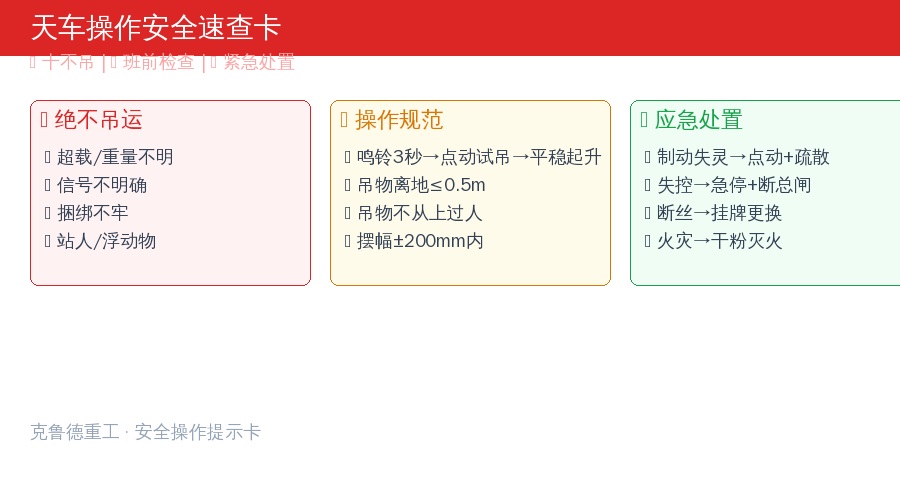
The Ten No-Lift Rules
These are the non-negotiable ground rules for every overhead crane operator, regardless of the plant or the crane in use. Never lift under the following conditions:
- Overloaded or unknown load weight—do not lift
- Unclear hand signals or multiple people giving directions—do not lift
- Improper or unbalanced rigging/slinging—do not lift
- People standing on the load or loose objects placed on top of it—do not lift
- Structural or component defects that compromise safe operation—do not lift
- Buried objects with unknown pulling force—do not lift
- Poor lighting at the worksite that obscures visibility of the area and hand signals—do not lift
- Sharp-edged loads in direct contact with the wire rope without protective padding—do not lift
- Flammable and explosive materials without proper safety measures—do not lift
- Wire rope without thermal insulation protection when lifting high-temperature or molten metal—do not lift
Startup and Traveling Operation
Before energizing the crane, verify that all controllers are in the zero position. Upon startup, sound the warning bell (for at least 3 seconds) and confirm no one is below before proceeding.
Key points for traveling operation:
- Hoisting action: Start with an inching/jog mode trial lift—raise the load 100–200 mm off the ground and pause. Confirm reliable braking, load balance, and no abnormal noise before proceeding with the full lift. Never raise or lower at high speed.
- Long Travel / Bridge Travel and Cross Travel / Trolley Travel: Accelerate smoothly and avoid sudden stops or starts. Decelerate to creep speed well before reaching the end of the crane rail. Use the travel switch/proximity switch to stop the crane rather than letting it hit the buffer.
- Combined operation: When operating Long Travel, Cross Travel, and Hoisting simultaneously, coordinate the speed of each motion to prevent excessive load swing.
- Lifting and transport route: Passing loads over people or equipment is the most common cause of accidents. Plan the route to avoid congested areas and expensive equipment whenever possible. If unavoidable, maintain a minimum safety distance of 1 m between the bottom of the load and any obstacles.
Safety Distance During Lifting and Transport
Keep the load just high enough to clear ground obstacles—generally no more than 0.5 m above the floor. When a load must pass over people, maintain a clearance of at least 2 m and sound the warning bell in advance. During Long Travel, keep load swing within ±200 mm; if swing exceeds this range, reduce speed or stop to re-stabilize.
Shutdown and End of Shift
- Never leave the operator's position until the load is fully landed—never leave a suspended load unattended
- Park the overhead crane in the designated position (not over access systems or where it interferes with other work)
- Raise the hook to near the upper limit switch (to avoid tripping hazards), but do not contact the limit switch
- Return all controllers to the zero position and disconnect the main power supply
- Complete the shift log (operating hours, abnormal conditions, issues found during inspection)
Emergency Situation Response
Brake Failure
If the hoisting brake fails, immediately sound the emergency alarm and repeatedly press the hoist button in inching/jog mode (using motor reverse braking), while evacuating personnel below. If the Long Travel brake fails, immediately cut off the power supply and allow the crane to coast to a stop. Never apply reverse braking—this can burn out the motor or cause coupling fracture.
Electric Hoist Runaway
Press the Emergency Stop Button to cut off the main circuit. If the emergency stop is ineffective, immediately trip the Circuit Breaker or the main disconnect. Operators should memorize the location of the Power Distribution Cabinet and the corresponding Circuit Breaker numbers—there is no time to search drawings in an emergency.
Wire Rope Derailment or Wire Break
If the wire rope jumps out of the pulley groove or exhibits abnormal vibration, stop the crane immediately and inspect. If wire breaks exceed the limits specified in GB/T 5972-2016, the crane must not be used. Tag it out and notify the maintenance department for replacement.
Fire
Cut off the main power supply immediately. Use a dry powder fire extinguisher (never water or foam—the crane is live). For small electrical fires, a CO₂ fire extinguisher may be used. If the fire gets out of control, call the fire department immediately and evacuate.
Common Violations and Their Consequences
The table below lists the most frequently observed violations during routine inspection—each one a lesson learned the hard way:
| Violation Operation | Common Causes | Potential Consequences | corrective measures |
|---|---|---|---|
| Operator Leaving During Suspended Load | Rushing, Complacency | Load Drop Injury, Equipment Damage | Must Before Leavinglowering the hook |
| skew lifting | Avoiding Repositioning, Lifting point Prohibited | wire rope derailment, structure Deformation, Overturning | Must Be Vertical Lifting, No Shortcuts |
| overload Operation | No Weighing, Inaccurate Estimation | main girder deflection, weld cracking, Overturning | retrofit Overload Limiter, Weigh Before Lifting |
| Use Limit switch As Normal Stop | Arbitrary Operation, Convenience | limit switch Failure Overhoist or Derailment | limit switch Backup Protection Only |
| Quick Reverse Operation(Plugging) | Rushspeed, Brake Failure | Motor Burnout, Coupling Fracture | Stop Before Reverse, No Need to Rush |
Final Thoughts
There are no shortcuts when it comes to overhead crane safety — every rule in the book was written because someone paid the price. For operators, one rule says it all: Don't rush those few seconds — safety first. For managers and business owners, safety training and daily inspections need to be part of the routine, not just a poster on the wall.
FAQ
Q: Is a special equipment operator certificate required to operate an overhead crane?
A: Yes. Under the Special Equipment Safety Law and TSG Z6001-2019 Special Equipment Operator Assessment Rules, operating an overhead crane (bridge or gantry type) is classified as special equipment work. Operators must hold a valid special equipment operator certificate (Q2 certification), which requires renewal every 4 years. Operating without certification is illegal, and both the operator and management bear legal liability in the event of an accident.
Q: How long does a pre-shift inspection typically take?
A: A skilled operator can complete the full daily inspection routine in about 8–12 minutes. That adds up to roughly 40 hours per year spent on inspections — while the direct cost of a single crane accident (equipment repair + downtime + possible penalties) can range from tens of thousands to over a million yuan. The time spent on inspections is time well invested.
Q: What if an older crane lacks safety devices?
A: ISO 4301 Crane Design Standard and TSG 51-2023 Crane Safety Technical Supervision Regulation impose mandatory requirements for safety devices. Older cranes can be retrofitted with: overload limiters (approx. $450–$1,200 per unit), hoisting height limiters (approx. $75–$225), travel limit switches (approx. $45–$120), and anti-collision devices (approx. $300–$750). The cost of retrofitting is far lower than the cost of an accident, and we recommend including these upgrades in your annual technical improvement plan.
