

Bridge Crane Lubrication Guide: Points & Intervals
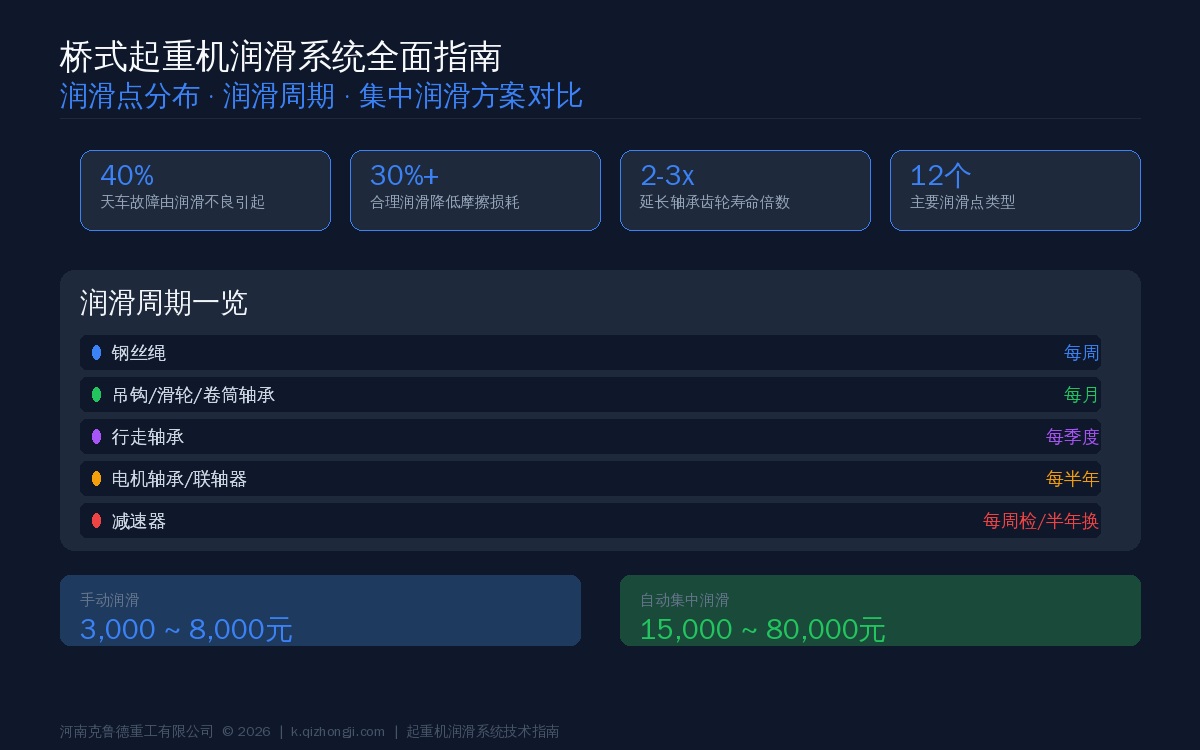
Regular lubrication of overhead cranes may seem straightforward, but most facilities get it wrong. We've seen countless cases where a missed grease pass, the wrong lubricant type, or an undetected blocked line led to bearing burnout and unplanned downtime. Industry data shows that roughly 40% of crane mechanical faults are directly linked to poor lubrication, while a well-executed lubrication program can cut friction losses by over 30% and extend bearing and gear service life by 2–3 times. This article covers every lubrication point on a bridge crane, how often each component needs attention, how to choose among three automated centralized lubrication systems, and how to calculate grease consumption—practical guidance your maintenance crew can put to use right away.
Why Crane Lubrication Matters
When an overhead crane fails, four out of ten times inadequate lubrication is the root cause—a far higher proportion than most people assume. In our years of maintenance work, the most common issues we encounter are skipped lubrication points, the wrong grease grade, or over-greasing that actually seizes the bearing. Get lubrication right, and you can cut friction losses by more than 30% while extending bearing and gear life by 2–3 times without any other changes.
Key Lubrication Points on an Overhead Crane
Taking a typical 20–50t bridge crane intelligent upgrade and retrofit solution as an example, lubrication points are distributed across the entire machine. The main points include:
- Bridge travel mechanism: 4–8 travel wheel bearings
- Trolley travel mechanism: 4–8 bearings
- Hoisting mechanism: 2 drum bearings + 4–8 pulley block bearings + 1 hook thrust bearing
- Reducers/gearboxes: 2–4 units
- Motor bearings: 4–8 bearings
- Wire rope surface: full-length coating
Each lubrication point requires a different lubricant type and service interval, so the lubrication plan must be tailored to the equipment's operating conditions and work duty classification. For QD-type double-girder bridge cranes rated at A6 and above, lubrication frequency must be increased accordingly. Wire ropes on hoisting mechanisms in high-duty service should be lubricated weekly—see our earlier article on online crane wire rope inspection technology for details—while slow-speed travel mechanism bearings can be serviced on a quarterly basis.
Crane Lubrication Schedule at a Glance
The table below summarizes the lubrication method, recommended lubricant, service interval, and operating notes for the 12 primary lubrication points on a bridge crane. Print it out and keep it with your maintenance log:
| Lubrication Point | Lubrication Method | Recommended Lubrication Agent | Interval | Remarks |
|---|---|---|---|---|
| Wire Rope | Surface Brushing | Wire Rope Specialized Grease(SKF LGEV 2 / Shell Tivela) | Weekly | Apply thin even coat after cleaning |
| Hook Thrust Bearing | Grease Gun | Lithium grease(2Grade) | Monthly | Disassembly Cover plate Refill After Disassembly |
| Sheave Bearing | Grease Gun | Lithium grease(2Grade) | Monthly | Dustproof Fill via Open Cover |
| drum bearing | Grease Gun | Lithium grease(2Grade) | Monthly | — |
| Reducer / Gearbox | Oil Levelinspection | N220 / N320 Gear Oil | Weekly Inspection / Semi-annual Change | Initial Operation1First Oil Change After Months |
| crane travel Bearing | Grease Gun | Lithium grease(2Grade) | Quarterly | Angle Typebearing housing Grease Fitting |
| trolley travel Bearing | Grease Gun | Lithium grease(2Grade) | Quarterly | — |
| motor bearing | Grease Gun | Motor Specialized Grease | Semi-annually | Do Not Overfill(1/3bearing clearance) |
| open gear | Surface Brushing | open gear Specialized Grease | Monthly | — |
| Coupling | Grease Gun | Lithium grease(2Grade) | Semi-annually | Gear Coupling |
| Crane Rail | Surface Oiling | Light Machine Oil | As Required | Friction Reduction, Anti-corrosion |
| Conductor Rail / Busbar | Cleaning | Anhydrous Ethanol | Quarterly | Cleaning Current Collector Mating Surface |
4. Centralized Lubrication Systems Compared
In workshops where multiple overhead cranes operate simultaneously, manual point-by-point lubrication is not only inefficient but also prone to skipped points and over-greasing. Below is a comparison of three mainstream centralized lubrication approaches—from budget-friendly manual systems to fully automated smart solutions—so you can choose based on your budget and operating conditions:
| Solution | Principle | Cost(RMB) | applicable working conditions | Pros and Cons |
|---|---|---|---|---|
| A: Manualcentralized lubrication | Manual Grease Gun Distributor Each Lubrication Point | 3,000 ~ 8,000 | A5Below, Single Unitoverhead crane | Low Cost but Manual Operation Required |
| B: Automaticcentralized lubrication | Electric Lubrication Pump + PLC Control + Progressive Distributor / Progressive Block | 15,000 ~ 30,000 | A6Above, Multiple Unitsoverhead crane | Timed and Metered, Labor-Free, Recommended SKF / Lincoln / Bekaert |
| C: Smartcentralized lubrication | BSolution + Flow Rate Sensor + Remote Monitoring | 30,000 ~ 80,000 | A7-A8, unmanned overhead crane | Automatic Blockage Alarm in Line, In Conjunction Withoverhead crane Digitalization Remote Monitoring And Cloud Platform SolutionSmart Based on Operating Hoursadjustment Lubrication Do Not Overfill |
When selecting a centralized lubrication solution, the difference in pipe run length between lubrication points on the same overhead crane should not exceed 30% to ensure even grease distribution. Each outlet of the progressive distributor is fitted with an independent metering element for precise control of the grease volume per cycle.
Estimating Grease Consumption
Grease consumption can be estimated using the following formula: Q = n × q × T
Where n is the number of lubrication points, q is the grease volume per point per cycle (characteristic value: 200–500 mm³), and T is the number of lubrication cycles per day (2–6 cycles).
Example calculation: For a 20t bridge crane with a A6 duty classification, approximately 25 lubrication points, a grease volume of 300 mm³ per point per cycle, and 4 cycles per day, daily consumption is about 30,000 mm³ (approximately 30 ml), or roughly 0.9 L per month. We recommend stocking 20% above this baseline to account for variations.
Related standards: GB/T 5909-2020 (Test method for water washout resistance of lubricating greases), GB/T 7324-2010 (General purpose lithium-based greases), and ISO 6743-9 (Lubricants, industrial oils and related products — Classification).
FAQ: Crane Lubrication Intervals & System Costs
How often should a bridge crane be lubricated?
Lubrication intervals vary by component — see the table below: wire rope weekly; hook, pulley, and drum bearings monthly; traveling bearings quarterly; motor bearings every six months. Check the gearbox oil level weekly and replace the oil every six months. For cranes with a duty classification of A6 or higher, shorten these intervals accordingly. We recommend keeping a lubrication chart near the equipment and ticking off each task as it is completed.
How much does an automatic centralized lubrication system cost?
Pricing depends on the system level: manual centralized lubrication systems range from approximately $450 to $1,200; electric automatic systems from $2,200 to $4,500; and smart centralized lubrication systems with flow sensors from $4,500 to $11,900. We recommend SKF, Lincoln, and Bekaert for their reliable quality and responsive after-sales support.
What grease should be used for crane wire rope?
Always use a grease specifically formulated for wire rope, such as SKF LGEV 2 or Shell Tivela. Clean the rope weekly and apply a thin, even coat. Avoid over-lubrication — applying too much grease is wasteful, and drips on the floor can create a safety hazard.
Q: What national standards apply to crane lubrication systems?
A: The main standards currently in effect include GB/T 5909-2020 (Test method for water washout resistance of lubricating greases), GB/T 7324-2010 (General purpose lithium-based greases), GB/T 5011-2018 (Installation and acceptance specification for lubrication systems), and ISO 6743-9 (Lubricants classification). For overhead cranes with a duty classification of A6 or higher, the lubrication requirements in ISO 4301 (Crane design specification) also apply.
