
Overhead Crane Selection for Aerospace: Engine Installation

Key Points Aerospace crane solutions across four production stages: ① QD-type 16t–50t for airframe manufacturing, with shock-proof large-component turnover and alignment; ② QD-type 10t–32t for aero engines, with VFD-controlled micro-motion for precision assembly; ③ LD-type 5t–16t for landing gear; ④ QD-type 32t–80t with multi-crane linkage for final assembly. Kelude configures low-vibration motors and elastic cushion lifting spreaders.

Industry Solution · Aerospace
Crane Selection Guide for the Aerospace Industry
Large-component alignment / engine hoisting / composite materials — three key applications
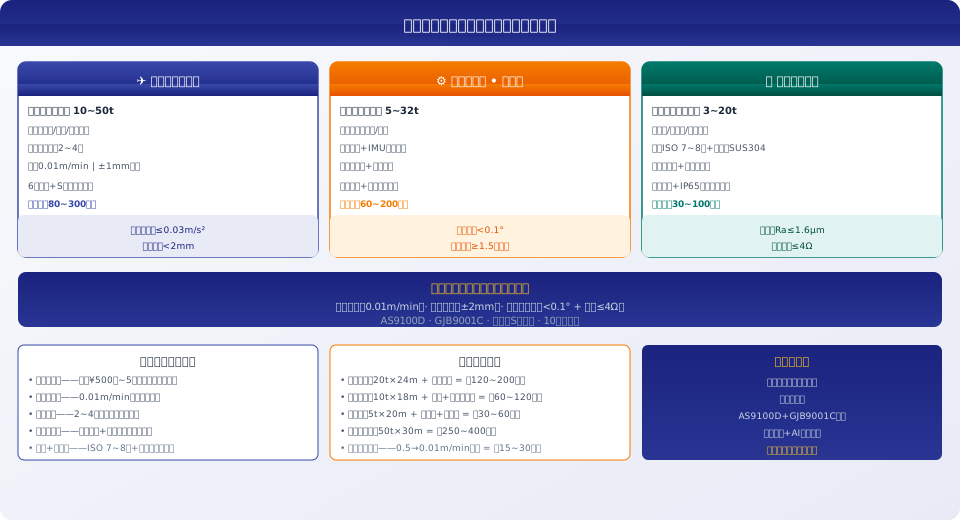
Coverage: Final assembly & alignment · Engine hoisting · Composite workshop Requirements: Creep speed 0.01m/min · ±1mm accuracy · Zero impact Certifications: AS9100D · GJB9001C · Dual-redundant safety

The aerospace industry imposes the most demanding requirements on lifting equipment of any sector — the loads handled include satellites, rocket components, and aircraft fuselage sections, with individual items valued anywhere from $740,000 to $74 million. Safety, reliability, and precision are pushed to the absolute limit. Overhead cranes must deliver creep-speed positioning (down to 0.01m/min), millimeter-level accuracy (±1–2mm), and zero-impact hoisting and braking (acceleration <0.05m/s²). Certain applications also require cleanroom compatibility. This article presents a crane selection framework for the aerospace industry across three core scenarios: large-component final assembly and alignment, aero engine hoisting, and composite materials production.

Aerospace IndustrycraneThree Major Application ScenariosconfigurationComparison

Aerospace Crane Applications: A Full Overview

Aerospace manufacturing spans aircraft final assembly, rocket integration, satellite testing, engine assembly, and composite molding — each stage placing distinctly different demands on overhead cranes. Kelude groups industry requirements into three core application scenarios:

Large-Component Final Assembly & Alignment
Aircraft fuselage/wing mating and rocket stage integration. Requires synchronized multi-crane operation (2–4 units), creep-speed hoisting, zero impact, and ±1mm positioning accuracy.
Aero Engine Hoisting
Engine assembly/disassembly and test bench handling. Requires anti-sway control, ultra-low-speed operation, real-time load and center-of-gravity monitoring, and dual-redundant braking.
Composite Materials Workshop
Handling of prepreg, honeycomb core, and large composite molds. Requires cleanroom compatibility (ISO Class 7–8), anti-static protection, dust-free lubrication, and temperature/humidity-controlled operation.

Large-Component Assembly Cranes: Multi-Crane Synchronization and Creep-Speed Control

Aircraft final assembly lines and rocket integration facilities place the most stringent demands on overhead cranes. Mating fuselage sections, wings, and rocket barrel segments requires millimeter-level precision with zero impact — any swing or shock can damage expensive components.

2.1 Multi-Crane Synchronized Linkage Control System

Large components — such as aircraft fuselage sections measuring 10–30m and weighing 10–50t — require coordinated lifting by 2–4 cranes. Kelude's multi-crane synchronized linkage system delivers the following key performance indicators:

  • Synchronization accuracy: Hoisting/lowering sync error <2mm between cranes; travel sync error <5mm
  • Control architecture: Master-slave control — the master crane receives operator commands, and slave cranes follow in real time via PROFINET (communication cycle <1ms)
  • Speed curve: S-curve acceleration/deceleration with hoisting acceleration ≤0.03m/s² and braking deceleration ≤0.05m/s² for zero-impact lifting
  • Fault protection: Automatic emergency stop if slave-master communication is lost (brake response <100ms), with the load held in position until operator commands resume

2.2 Ultra-Low-Speed Micro-Motion Hoisting

The final stage of large-component alignment demands extremely low speeds for precise positioning:

  • Micro-motion speed: 0.01–0.1m/min (1–10cm per minute), achieved via VFD plus high-resolution encoder (2048ppr)
  • Speed step selection: 6-speed switching — high speed 8m/min (no-load), medium 2m/min (light load), low 0.5m/min (approach), micro 0.1m/min (alignment), ultra-micro 0.02m/min (final adjustment), and zero-speed hover
  • Speed closed loop: Encoder feedback with closed-loop vector control on the VFD; speed accuracy ±0.5% (steady state); zero-speed hover position drift <0.1mm/10min

Aero Engine Hoisting Cranes: Anti-Sway and High Reliability

Hoisting aero engines — each valued at $740,000 to $4.5 million — demands exceptional anti-sway performance and braking reliability. Any lateral swing during horizontal transport risks collision with the assembly stand, causing irreversible damage.

3.1 Closed-Loop Anti-Sway System

  • Sensor configuration: Accelerometer + gyroscope IMU (inertial measurement unit) with 100Hz sampling frequency for real-time sway-angle detection
  • Control algorithm: Adaptive anti-sway control — automatically tunes sway parameters based on rope length (3–15m) and load weight (1–20t), with no manual adjustment required
  • Performance indicators: Residual sway angle <0.1° (vs. the <0.5° industry standard); active sway damping eliminates environmental disturbances such as wind loads and floor vibration

3.2 Dual-Redundant Braking System

Aerospace industry standards require a dual-redundant braking architecture on crane hoisting mechanisms:

  • The hoisting mechanism is fitted with two independent normally closed brakes — one service brake (electromagnetic disc brake with braking torque ≥1.5× rated torque) and one safety brake (hydraulic spring-applied brake with braking torque ≥1.25× rated torque)
  • The two brakes are powered from independent supplies, so either brake alone can safely hold the load if the other fails
  • Brake status is fed back to the PLC in real time; brake lining wear is monitored to ±0.1mm accuracy with early-warning alerts for replacement

Composite Materials Workshop Cranes: Cleanroom and Anti-Static Requirements

Aerospace composite production facilities — handling carbon-fiber prepreg, honeycomb core, and large composite molds — typically operate in temperature- and humidity-controlled cleanrooms (temperature 23±3°C, relative humidity 50±10%, cleanliness ISO Class 7–8). Lifting equipment must meet the following special requirements:

4.1 Cleanroom-Oriented Structural Design

  • Main girders and end carriages are made of Stainless Steel SUS304 or aluminum alloy with anodized surface treatment, achieving a Roughness of Ra≤1.6μm to prevent fiber dust accumulation
  • All Fasteners are countersunk Stainless Steel A2-70 with no exposed threads
  • Moving parts are equipped with fully Sealed bearings (2RS grade) and Food-grade grease (NSF H1 Certified) to eliminate grease leakage
  • The electric control cabinet features a Stainless Steel SUS304 enclosure with Protection Rating (IP) IP65, and heat dissipation is managed via a plate-type heat exchanger

4.2 Anti-Static Design

Carbon fiber is a conductive material that can accumulate static electricity during Lifting and transport, posing risks of electrostatic discharge damage to electronic equipment and ignition hazards:

  • The Hook, Wire Rope, and Main Girder are reliably Grounded via copper braided straps (Grounding Resistance ≤4Ω)
  • Sliding Grounding contacts (Carbon brush + copper slide wire) are installed between the Trolley and Crane Bridge to ensure equipotential bonding across the entire crane
  • The Electric Hoist and Hoisting Motor are anti-static type, with motor housing Grounding Resistance ≤1Ω
  • Control cables feature an anti-static shielding layer with both ends reliably Grounded

5. Acceptance Standard for Aerospace Crane Technology

Acceptance Project Industry Standard Kelude Indicator
Micro-motionspeed ≤0.1m/min 0.01m/min
Positioning Accuracy ±5mm ±1mm(AIVision Assistance)
Lifting Plusspeed ≤0.1m/s² ≤0.03m/s²
Multi-Crane Synchronization Tolerance ≤10mm ≤2mm
Residualsway angle ≤0.5° ≤0.1°(Active Anti-sway)
Brakingredundancy Dual Brake(Recommendation) Dual Brake+wear monitoring(Standard Configuration)
Certification System AS (Australian Standard)9100 aerospace quality management system D(Recommended) AS (Australian Standard)9100 aerospace quality management system D + GJB9001C
Traceability 5Yeardata storage 10Annual Full Operation Record

Kelude Aerospace & Aviation: Proven Case Studies

Kelude Heavy Industry has extensive project delivery experience in aerospace manufacturing, serving clients across large aircraft final assembly, engine manufacturing, and composite material forming.

Case 1: Multi-Crane Synchronized System for Large Aircraft Final Assembly

Project Overview: A major aircraft assembly plant equipped its new final assembly line with four QD-type double-girder bridge cranes (32t × 36m span), featuring a synchronized multi-crane control system.

Key Highlights: Synchronization accuracy of ±3mm between cranes; full VFD speed control with creep speed of 0.1m/min; dual-feedback positioning via laser distance measurement and encoders; anti-sway system with residual sway angle <0.2°.

Results: First-attempt success rate for large-component mating improved from 65% to 95%; assembly cycle time reduced by 30%; the synchronized multi-crane control system received technical certification from the Aviation Industry Corporation of China.

Case 2: Aero Engine Test Bench Hoisting System

Project Overview: An aero engine manufacturer installed two explosion-proof cleanroom bridge cranes (10t × 22m span) in its test bench area for engine lifting and maintenance operations.

Key Highlights: Explosion-proof certification (Ex d e ib ⅡB T4 Gb) combined with ISO Class 8 cleanroom design; stainless steel 316L hook and wire rope; fully sealed, lubrication-free bearings; dual protection via overload limiter and speed monitoring.

Results: Zero hoisting incidents in the test bench area over three years of operation; engine handling efficiency increased 4× compared to the previous forklift-based approach; equipment passed the Civil Aviation Administration of China's airworthiness audit for production equipment.

Case 3: Cleanroom Cranes for Composite Materials Facility

Project Overview: An aerospace composite manufacturer equipped its new cleanroom with three anti-static cleanroom bridge cranes (5t/10t/16t), operating under ISO Class 8 cleanroom management.

Key Highlights: Carbon-fiber anti-static slings; stainless steel structure with conductive coating and grounding; HEPA-filtered gearbox breather vents; IP65 stainless steel control cabinet; anti-static remote control.

Results: Cleanroom cleanliness maintained 100% compliance for 18 consecutive months; zero static discharge incidents during carbon-fiber prepreg handling; equipment passed Airbus supplier quality system audit on first attempt.

Kelude Service Advantages for Aerospace & Aviation

Kelude Heavy Industry provides full-chain support for aerospace manufacturing clients—from solution design through delivery and acceptance. Key advantages include:

0.1
mm/min creep speed control accuracy
±3
mm multi-crane synchronization accuracy
Ex
Explosion-proof + cleanroom dual certification
ISO8
Cleanroom crane solutions
  • Deep Scenario Customization: For the three core aerospace applications—large-component mating, engine hoisting, and composite workshops—Kelude Heavy Industry delivers tailored configurations including synchronized multi-crane control systems, explosion-proof plus cleanroom dual-certified solutions, and anti-static lifting equipment.
  • High-Precision Assurance: Kelude aerospace-series cranes come standard with full VFD speed control (creep speed 0.1m/min), laser distance measurement, and anti-sway systems, meeting the stringent positioning accuracy and operational stability requirements of aerospace manufacturing.
  • Compliance & Certification: All aerospace-industry cranes are supplied with complete compliance documentation, including explosion-proof certificates (Ex d e ib ⅡB T4 Gb), cleanroom inspection reports, and multi-crane synchronization accuracy test reports—satisfying supplier audit standards of international aerospace manufacturers such as Airbus and Boeing.
  • Lifecycle Service: From site survey, solution design, manufacturing and installation, commissioning and acceptance, to operator training and annual maintenance, Kelude Heavy Industry provides a 2-year full-machine warranty and 7×24 nationwide after-sales response.
Selection Recommendations: When selecting cranes for aerospace applications, precision indicators (creep speed, synchronization, anti-sway) and special-environment certifications (explosion-proof, cleanroom, anti-static) determine whether the equipment will pass aerospace manufacturing audits. We recommend having the Kelude technical team conduct an on-site survey during the solution phase—confirming cleanroom classification, lifting capacity and span, accuracy requirements, and explosion-proof zone ratings—before issuing a tailored selection and configuration proposal with quotation.

Kelude Heavy Industry: Overhead & Gantry Crane Solutions

Kelude Heavy Industry is a leading manufacturer of overhead cranes and gantry cranes, providing reliable material handling solutions for industrial facilities across the United States and Europe. Our product line covers a wide range of applications, from standard fabrication shops to demanding steel processing plants.

Related News

contact

contact us

phone:
+86 13903802779

mail:3915269@qq.com

Working hours: Monday to Friday

Wechat
Wechat
SHARE
TOP