

Kelude Crane Safety Monitoring System Achieves SIL3 Certification
Key Highlights: Kelude Heavy Industry's independently developed crane safety monitoring and management system has passed third-party SIL3 functional safety certification. Built on the Siemens S7-1500F safety PLC with dual-channel redundant circuit design, it covers all 7 safety monitoring functions required by GB/T 28264 and has helped 12 metallurgical and chemical companies complete installation acceptance and safety standard filing.
As national requirements for safety monitoring and management of lifting appliances continue to tighten, full implementation of the GB/T 28264 standard — Safety Monitoring and Management System for Lifting Appliances — has made crane safety monitoring systems a mandatory prerequisite for enterprise safety acceptance. Kelude Heavy Industry has developed a SIL3-certified crane safety monitoring system based on the Siemens S7-1500F safety PLC platform, delivering one-stop solutions from solution design to safety standard filing for the metallurgical, chemical, and port industries.
What SIL3 Certification Really Means
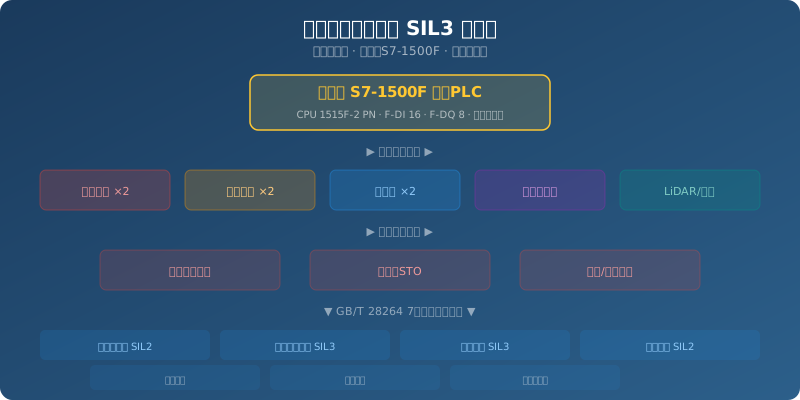
SIL3 is the third-highest safety integrity level defined by IEC 61508 and GB/T 20438. It requires the system to remain safe under single-fault conditions, with a probability of dangerous failure below 10⁻⁷ per hour. Kelude's safety monitoring system is built on the Siemens S7-1500F safety PLC platform, with a hardware configuration comprising the CPU 1515F-2 PN safety CPU, F-DI 16x24V safety digital input modules, and F-DQ 8x24V/2A safety digital output modules — all wired in dual-channel redundant architecture throughout the signal path.
The system covers all 7 safety monitoring functions mandated by GB/T 28264: capacity limitation, hoisting height limiter, travel limit switch, travel speed monitoring, anti-wind and anti-slip protection, interlock protection, and fault self-diagnosis. The emergency stop safety function achieves SIL3/PLe — dual-channel emergency stop buttons are wired through F-DI modules, and opening either channel triggers a safe stop that cuts the main contactor and VFD STO within 200 ms. Limit protection also meets SIL3, using a dual-channel configuration of mechanical limit switches plus inductive sensors. Overspeed protection and load limiting achieve SIL2/PLd, implemented through dual-channel encoder speed monitoring and load cell comparison logic.
One-Stop Service from Hardware to Acceptance
Kelude Heavy Industry provides full-process service covering solution design, hardware selection, on-site installation, PLC programming and commissioning, and preparation of filing documentation. Each system ships with a safety PLC control cabinet with all safety input signals — emergency stop, limit switches, door locks, light curtains, and LiDAR obstacle avoidance — pre-wired to the F-DI modules. Safety logic programs are fully tested in F-LADDER before delivery, so on-site installation only requires sensor wiring and joint commissioning before the system is ready for operation.
For the filing phase, Kelude provides customers with a complete GB/T 28264 inspection report template, HARA hazard analysis report, and SIL certificate, significantly shortening the safety standard filing cycle. Across 12 completed projects, the average time from contract signing to acceptance is 18 days — 6 days for electrical installation, 5 days for joint commissioning and testing, and 7 days for filing documentation — roughly 60% faster than organizing solution procurement and integration in-house.
Safety Level Comparison Table
| safety function | safety level | Implementation Method | Response time |
|---|---|---|---|
| Emergency Stop | SIL3/PLe | dual channel F-DI+F-DQ | <200ms |
| Hoisting Height Limiter | SIL3 | Machinerylimit switch+Proximity Switch / Inductive Sensor | <100ms |
| Travel Limit Switch | SIL3 | dual channel Limit switch | <100ms |
| Overspeed Protection | SIL2/PLd | Encoderdual channel Monitoring | <50ms |
| Capacity limitation | SIL2/PLd | Load Cell / Weighing Sensor Comparison Logic | <200ms |
Typical Application Cases
Across the 12 completed projects, our Safety Monitoring and Management Systems have been deployed in four key industries: steel and metallurgy (6 sites), chemical processing (3 sites), port operations (2 sites), and power generation (1 site). The overhead cranes involved range from 16t to 160t, with a total of 78 systems installed. At one steel plant, a fleet of 32t metallurgical overhead cranes equipped with Kelude Safety Monitoring Systems not only passed the local special equipment inspection authority's safety acceptance with ease, but also achieved seamless integration of safety monitoring data with the plant's MES system. This enables managers to check safety status and fault records anytime, anywhere via their mobile devices.
The system is designed in accordance with ISO 4301 Crane Design Standard and GB/T 28264 Safety Monitoring and Management System for Lifting Appliances, ensuring unified and standardized monitoring data and safety management practices. It also comes with pre-reserved interfaces for intelligent features such as crane anti-sway control and AI visual inspection, leaving ample room for future smart upgrades.
Deployment Statistics by Industry
| Industry | Number of Enterprises | installation Number of Units | tonnage Scope | Average Acceptance Period |
|---|---|---|---|---|
| Steelmetallurgical | 6 | 42 | 16t~160t | 16Day |
| Chemical | 3 | 18 | 20t~50t | 20Day |
| Port | 2 | 12 | 40t~160t | 22Day |
| Power | 1 | 6 | 32t~80t | 14Day |
Market Positioning
Kelude's Safety Monitoring and Management System is engineered for both new overhead crane installations and retrofit projects on existing equipment. For new cranes, the safety PLC control cabinet is fully integrated before delivery. For retrofits, an external mounting solution is used—a dedicated safety monitoring cabinet is installed alongside the existing electric control cabinet, operating independently without interfering with the original control system. The system is designed in accordance with IEC 61508 and GB/T 20438 functional safety standards, ensuring consistent safety integrity levels and full traceability.
Frequently Asked Questions
Q: What sets a SIL3-certified crane safety monitoring system apart from a standard monitoring system?
A: A SIL3 system features dual-channel redundancy in hardware, allowing it to maintain safe operation even under a single fault condition, with a probability of dangerous failure below 10⁻⁷ per hour. Standard monitoring systems, by contrast, lack a functional safety rating—a single point of failure can compromise the safety function, making them unable to meet mandatory safety standard acceptance requirements.
Q: Can a safety monitoring system be retrofitted onto an existing overhead crane?
A: Yes. Kelude offers an external mounting solution where a dedicated safety monitoring cabinet is added alongside the existing electric control cabinet. It operates independently without affecting the original control system. We have completed retrofits on over 50 existing overhead cranes, covering PLC systems from Siemens, Schneider Electric, Mitsubishi, and other major brands.
Q: What documentation is required for safety standard filing?
A: Kelude provides a complete set of GB/T 28264 inspection report templates, HARA (Hazard Analysis and Risk Assessment) reports, and SIL certificates. We also assist in preparing installation acceptance documentation, significantly streamlining the safety standard filing process for your company.
Q: Can the system integrate with a digital remote monitoring platform?
A: Yes. The system comes with pre-configured OPC UA and Modbus TCP interfaces, allowing seamless integration with Kelude's digital remote monitoring platform. This enables unified management of safety monitoring data and operational data, giving managers real-time visibility into safety status via mobile devices.
To learn more about crane safety monitoring system solutions and safety standard filing services, contact the Kelude technical team for customized solutions and a complimentary technical assessment.
Standard Basis: ISO 4301 Crane Design Standard | GB/T 28264 Safety Monitoring and Management System for Lifting Appliances | IEC 61508 Functional Safety of Electrical/Electronic/Programmable Electronic Safety-Related Systems
