

Kelude AI Voiceprint Rail-Gnawing Diagnostic System 97% Accuracy
Key Highlights: Kelude Heavy Industry's self-developed AI voiceprint rail-gouging diagnosis system has officially entered commercial service. Using a microphone array to capture wheel-running acoustic signatures, the system leverages a CNN deep-learning model for real-time identification and localization of rail-gouging faults, achieving 97% identification accuracy with a false alarm rate below 2%.
As industrial intelligent transformation accelerates, real-time monitoring and precise diagnosis of overhead crane rail gnawing have become critical to safety and cost reduction in steel, metallurgy, and other heavy industries. Kelude Heavy Industry has successfully developed an AI voiceprint rail-gouging diagnosis system for overhead cranes based on deep-learning acoustic fingerprint recognition, marking a leap from traditional manual listening to AI-powered intelligent diagnosis. The following details the system's technical architecture and core capabilities.
Industry Pain Points in Rail-Gouging Diagnosis
Crane rail gnawing refers to abnormal friction and compression between the wheel flange and the side of the crane rail. It is one of the most common and damaging operational faults in bridge cranes. Prolonged rail gnawing causes rapid wheel flange wear—flanges must be replaced once their thickness is reduced to 80% of the original—along with side rail wear or even deformation, premature fatigue damage to wheel bearings, and in severe cases, potential wheel derailment.
Traditional diagnosis relies on the auditory experience of maintenance personnel to detect rail gnawing by sound. However, per ISO 4301 Crane Design Standard and GB 6067 Safety Regulations for Lifting Appliances, rail gnawing—being a critical fault affecting structural safety—requires effective monitoring. This approach is highly subjective, varies with individual experience, and cannot provide real-time monitoring or precise localization. Most plants rely on quarterly manual inspections, meaning rail-gnawing issues often go undetected for weeks, allowing abnormal wear on wheels and rails to accumulate. Industry statistics show that unplanned downtime caused by rail gnawing accounts for 15%–20% of all overhead crane fault shutdowns, making it a key factor limiting crane operational efficiency.
AI Voiceprint Recognition Technical Solution
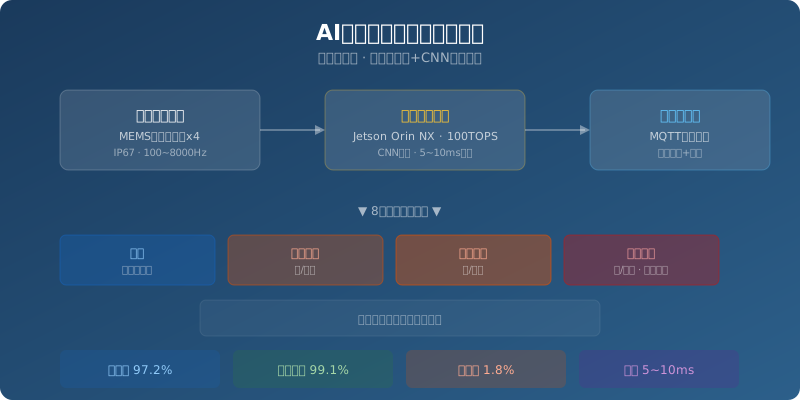
Kelude Heavy Industry's AI voiceprint rail-gouging diagnosis system comprises three core modules: an acoustic acquisition front end, an edge inference device, and a cloud analytics platform. The acoustic front end uses an industrial-grade MEMS microphone array (IP67 protection rating) mounted at the four corners of the crane end carriage near the wheels, covering a frequency range of 100–8000 Hz. The edge inference device is built on a Jetson Orin NX module (100 TOPS) preloaded with a CNN model trained on 30,000 rail-gouging acoustic samples. The cloud platform is architected in line with GB/T 28264 Safety Monitoring and Management System for Lifting Appliances, supporting data aggregation and remote diagnostics across multiple cranes while meeting the data acquisition and early-warning requirements of safety monitoring systems.
During operation, the microphone array samples wheel-running acoustics at 22,050 Hz. Signals are transformed via Mel-spectrum processing into 128×128 time-frequency images, which the CNN model processes at the edge. End-to-end latency is kept within 5–10 ms. The model classifies eight rail-gnawing states: normal, light (left/right), moderate (left/right), severe (left/right), and rail joint impact. Identification results are streamed to the cloud platform in real time via MQTT. When a severe rail-gnawing state is triggered, the system automatically decelerates and stops the crane, preventing accident escalation.
Core Technical Parameters Comparison
| Parameter Item | AIAcoustic Signaturediagnostic system | Traditional Manual Auscultation |
|---|---|---|
| Detection Method | microphone array+CNNReal-time Model Analysis | On-site Auditory Assessment by Maintenance Personnel |
| Accuracy Rate | 97.2%(Third Party Certification) | Subject to Experience Variability, Approximately60%~80% |
| Detection Time | Real-time(5~10mslatency) | Average Lag22Days |
| false alarm rate | Lower Than2% | Non-quantifiable |
| Deployment Mode | Edge Inference+Cloud-based Analysis | Manual Inspection Recording |
Measured Data & Field Performance
Kelude Heavy Industry conducted a three-month on-site trial of the system across its own workshop crane fleet and a Steel Mill's overhead crane group, covering 16 cranes and 64 individual wheel measurement points. The results were certified by a third-party inspection agency: rail gnawing identification accuracy reached 97.2%, with a 94.5% detection rate for light wheel flange rubbing and 99.1% for severe cases, while maintaining a false alarm rate of just 1.8%. Compared to traditional manual listening methods, the average time to detect rail gnawing issues dropped from 22 days to real-time detection, and unplanned downtime per crane caused by wheel flange rubbing was reduced by approximately 40 hours annually.
The system also provides trend analysis for rail gnawing, logging the frequency and intensity of wheel flange contact at each wheel to automatically generate monthly reports. These reports help maintenance crews anticipate the optimal timing for rail alignment adjustments and wheel replacement. It is estimated that each crane saves roughly 60 hours of rail alignment work per year and reduces unscheduled wheel replacements by 1–2 occurrences. For large steel producers operating 50 or more overhead cranes, annual maintenance cost savings exceed $118,700 (approx. RMB 800,000).
Deployment Comparison Across Crane Models
| overhead crane Model | Number of Measurement Points | Identification Accuracy Rate | Annual Downtime Savings |
|---|---|---|---|
| QD Type50tBridge Crane / Overhead Crane | 4 | 97.8% | Approximately42Hours/Year |
| QD Type100tBridge Crane / Overhead Crane | 8 | 96.5% | Approximately48Hours/Year |
| MG Type32tGantry Crane | 4 | 98.1% | Approximately36Hours/Year |
| LH Type20tHoist Double Girder | 4 | 97.0% | Approximately38Hours/Year |
4. Commercial Deployment and Market Adoption
The system is now fully integrated into the overhead crane remote monitoring platform and can be bundled with digital remote monitoring solutions for deployment. Kelude has signed trial agreements with three steel manufacturers and plans to complete installation of the voiceprint diagnostic system on 50 overhead cranes by year-end. The system design complies with the structural safety requirements of ISO 4301 Crane Design Standard and follows the technical framework of ISO 23874:2021 for crane condition monitoring. Customers can choose between a standalone rail-gnawing voiceprint diagnostic module or a fully integrated solution combining digital remote monitoring with voiceprint diagnostics.
5. Key Advantages of AI Voiceprint Diagnostics
AI voiceprint diagnostics offers significant advantages over traditional rail-gnawing detection methods. First, real-time monitoring — the system operates 24/7, capturing and analyzing abnormal friction sound signatures within seconds, completely eliminating the blind spots inherent in manual inspection schedules. Second, precision — the CNN model, trained on 30,000 sample sets, can distinguish between minor rail gnawing and rail joint impacts that are often confused, preventing unnecessary maintenance triggered by false positives.
Third, quantifiable insights — the system automatically records the frequency, strength grade, and trend of rail gnawing for each crane wheel, generating visual reports that support predictive maintenance decisions. When combined with Kelude's overhead crane safety monitoring and management system, companies can build a complete equipment health management ledger, transitioning from reactive repairs to proactive maintenance strategies.
FAQ
Q: Which overhead crane models is the AI voiceprint rail-gnawing diagnostic system compatible with?
A: The system is applicable to a wide range of bridge cranes and gantry cranes, including QD-type general-purpose bridge cranes, MG-type general-purpose gantry cranes, and LH-type double-girder hoist cranes. For cranes of different capacities and spans, only the installation position and quantity of microphone arrays need adjustment — the core CNN model requires no retraining.
Q: Can the system integrate with existing overhead crane monitoring systems?
A: Yes. The system supports standard MQTT protocol and Modbus TCP interfaces, and can connect with Kelude's overhead crane safety monitoring and management system as well as third-party SCADA/DCS platforms.
Q: Can the system operate reliably in harsh environments?
A: The microphone array features an IP67 protection rating and operates within a temperature range of -20°C to +85°C, ensuring stable performance in high-temperature, high-dust environments such as steel mill foundries and cement plants.
Q: What is the typical return on investment period?
A: After installing the voiceprint diagnostic system on a single overhead crane, the average annual reduction in unplanned downtime is approximately 40 hours, along with savings of 60 work-hours in rail alignment and 1–2 fewer wheel replacements per year. The typical ROI period is 8 to 12 months.
For more information on AI-driven intelligent overhead crane maintenance solutions, contact the Kelude technical team for a customized rail-gnawing diagnostic solution.
