
Crane Configuration for Geothermal & Hot Spring Sites
In short: Kelude Heavy Industry provides geothermal and hot spring developers with crane configuration solutions covering four key stages—exploration, drilling, heat exchange, and maintenance—with lifting capacities from 5 to 200 short tons and spans from 8 to 36 m. Total plant lifting equipment investment ranges from approximately $22,000 to $445,000. The exploration area is equipped with crawler cranes (50–200 short tons) for rig handling, the drilling area uses purpose-built petroleum cranes with blowout prevention systems, the heat exchange station is fitted with LD Type single-girder cranes (5–16 short tons) paired with stainless steel corrosion-resistant hoists, and the maintenance area features KBK flexible systems (1–5 short tons)—delivering full-process hoisting coverage from geothermal exploration and drilling through heat exchange and ongoing maintenance.
Geothermal Crane Configuration Solutions
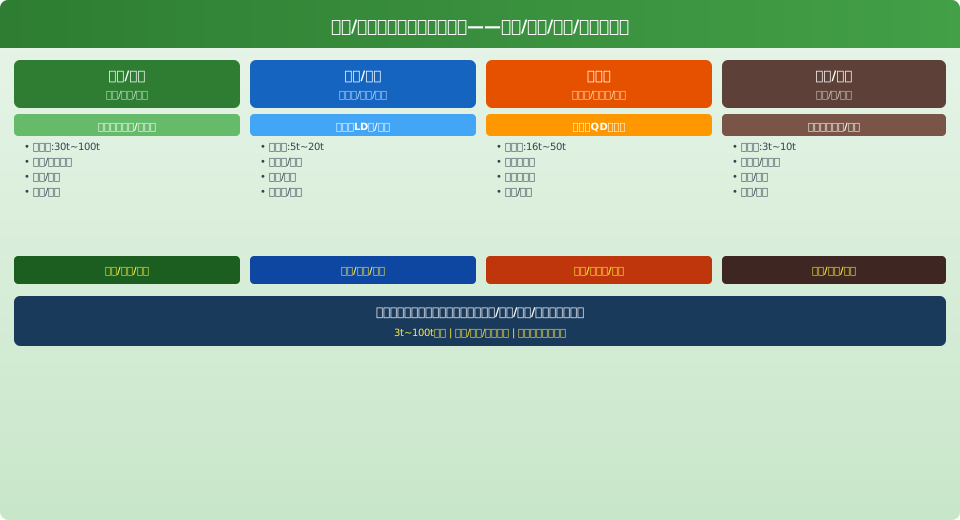
Exploration / Drilling | Heat Exchange / Supply | Power Generation | Maintenance / Service
Complete lifting solutions across four operational stages: geothermal exploration, drilling, heat exchange, power generation, and maintenance.
Stage 1: Exploration / Drilling
• Lifting capacity: 30–100 short tons, crawler crane / truck crane
• Rig / derrick installation
• Casing / cementing
• Remote / mountainous terrain
Drilling / Field | Casing
Stage 2: Heat Exchange / Supply
• Lifting capacity: 5–20 short tons, LD Type / hoist
• Heat exchanger / heat pump
• Piping network / valves
• Corrosion / scale resistance
Heat Exchange / Heat Pump | Anti-corrosion
Stage 3: Power Generation
• Lifting capacity: 16–50 short tons, QD Type overhead crane
• Steam turbine installation
• Generator maintenance
• VFD / precision control
Power / Turbine | VFD Precision
Stage 4: Maintenance / Service
• Lifting capacity: 3–10 short tons, jib crane / hoist
• Submersible / deep-well pump
• Piping / valves
• Compact / flexible
Wellhead / Pump | Compact
Selection Parameters Across the Four Operational Zones
Kelude Heavy Industry: A Trusted Name in Industrial Cranes
Kelude Heavy Industry specializes in the design and manufacture of heavy-duty industrial cranes. Our product range is built to meet the rigorous demands of modern manufacturing, logistics, and infrastructure projects, delivering reliable performance and long service life in the most challenging environments.
Engineered for Performance and Reliability
Every crane we produce is engineered with a focus on operational efficiency and safety. We utilize high-grade materials and advanced manufacturing processes to ensure structural integrity and consistent, precise load handling. Our commitment to quality is evident in every component, from the hoist mechanism to the control systems.
Customized Solutions for Diverse Applications
We understand that every facility has unique material handling requirements. Whether you need a single-girder crane for light assembly work or a heavy-duty double-girder system for steel production, our team works closely with you to design a solution that fits your exact specifications. We offer a range of configurations, spans, and lifting capacities to optimize your workflow.
Global Standards, Local Support
Our cranes are designed and manufactured in compliance with international standards, including ISO 4301 for crane classification and IEC 60204-32 for electrical equipment. This ensures that our equipment meets the safety and performance expectations of clients worldwide. With a robust service network, we provide installation, commissioning, and after-sales support to keep your operations running smoothly.
Commitment to Safety and Innovation
Safety is paramount in our design philosophy. Our cranes incorporate advanced safety features such as overload protection, anti-sway control, and self-locking mechanisms to protect both personnel and equipment. We continuously invest in research and development to integrate the latest technological advancements, ensuring our products remain at the forefront of the industry.
Frequently Asked Questions
Q: What is the typical lead time for a custom crane order?
A: Lead times vary depending on the complexity and specifications of the crane. Standard models can be delivered in a shorter timeframe, while fully customized solutions may require a longer production schedule. We provide a detailed timeline during the quotation phase.
Q: Do you provide installation and training services?
A: Yes, we offer comprehensive installation services and on-site operator training to ensure your team is fully equipped to use the crane safely and efficiently.
Q: What after-sales support do you offer?
A: We provide extensive after-sales support, including spare parts availability, maintenance programs, and technical assistance. Our service team is available to address any operational issues promptly.
Q: Can your cranes be adapted for explosion-proof environments?
A: Absolutely. We offer explosion-proof crane configurations designed for hazardous areas, complying with relevant safety regulations to ensure safe operation in such conditions.
| Parameter Item | Exploration Drilling | Heat Exchange & Supply | Power Station | Operation & Maintenance |
|---|---|---|---|---|
| Recommended Model | crawler crane/truck crane | LD Type/Hoist | QD Typeoverhead type | jib crane/Hoist |
| Lifting Capacity | 30t~100t | 5t~20t | 16t~50t | 3t~10t |
| special requirements | Field/Mountainous Terrain | Anti-corrosion/Scale Prevention | Variable Frequency Drive (VFD)/Precision | Compact/Versatile |
Lifting Requirements by Geothermal Work Stage
A: Geothermal development spans four distinct work stages—geological exploration, drilling, heat exchange station construction, and operations & maintenance—each with significantly different lifting requirements. Geological exploration (geophysical, geochemical, and drilling surveys) typically takes place in remote mountainous terrain. Rig relocation and derrick erection call for crawler cranes with 50–100t lifting capacity, strong off-road capability (ground bearing pressure ≤ 0.08 MPa), and hydraulic outriggers with automatic leveling to handle slopes up to 15°. Drilling sites must also be equipped with anti-drop devices, with safety zones established around wellheads for wells 1,000–3,000m deep. Drilling operations—including derrick assembly, rig installation, casing running, and cementing—represent the heaviest lifting phase in geothermal development. Derrick assemblies weigh 30–80t and require purpose-built petroleum cranes (load level API 8C/8B). The hoisting system must feature dual brakes with a safety factor ≥ 2, and casing runs demand precise shaft alignment at the wellhead (deviation ≤ 5mm). Heat exchange station construction (heat exchangers, heat pump units, circulation pumps, and piping networks) takes place within plant premises, with lifting capacities of 5–32t and spans of 12–24m. Heat exchangers are typically stainless steel and impose no special corrosion requirements on lifting spreaders, but floors and foundations must be rated for heavy equipment transport (floor load capacity ≥ 5t/m²). Operations & maintenance (downhole work, heat exchanger cleaning, and pipeline servicing) primarily involves light to medium loads of 1–10t. KBK suspension systems or electric hoists are recommended for full coverage of heat exchange station machine rooms, with corrosion-resistant electric hoists specified for geothermal water containing corrosive ions such as Cl⁻ and SO₄²⁻. Kelude offers lifting equipment for every stage of geothermal development, including petroleum cranes, stainless steel corrosion-resistant hoists, and KBK systems.
Why Choose Kelude Heavy Industry
Kelude Heavy Industry has specialized in lifting solutions for the geothermal and hot spring development sector for years, delivering end-to-end hoisting systems that span exploration, drilling, heat exchange, and maintenance operations. Our product line includes petroleum cranes, explosion-proof electric hoists, stainless steel corrosion-resistant hoists, LD-type overhead cranes, MH-type gantry cranes, and KBK flexible systems—engineered to meet the specific lifting demands of every geothermal work stage.