
Crane Selection & Parameter Configuration for Power Plants

Key Takeaways Crane selection across four power-sector applications: For thermal power boiler houses, choose QD-type dual-hook cranes rated 32–100 t (approx. $500,000–$1.8 million / VFD + anti-sway / high-temp IP55); for wind tower fabrication, MG-type double-girder gantry cranes rated 50–160 t with spans of 30–50 m (approx. $800,000–$3 million / twin-trolley configuration); for PV module plants, LD/LH-type single-girder cranes rated 3–10 t installed in parallel (approx. $80,000–$300,000 per unit / light-load high-frequency duty / pendant or radio remote control); for nuclear power plants, polar cranes rated 200–500 t (custom-engineered / nuclear-safety-class / seismic and radiation resistant). All fall under special equipment regulatory oversight.

The power generation industry is a major application field for overhead cranes—from boiler maintenance in thermal plants to wind turbine component manufacturing, from PV module production lines to installation of critical equipment in nuclear facilities, each scenario demands a distinctly different crane solution. This article examines crane selection key points, technical parameters, and price ranges across the four major power-sector applications: thermal, wind, solar, and nuclear.

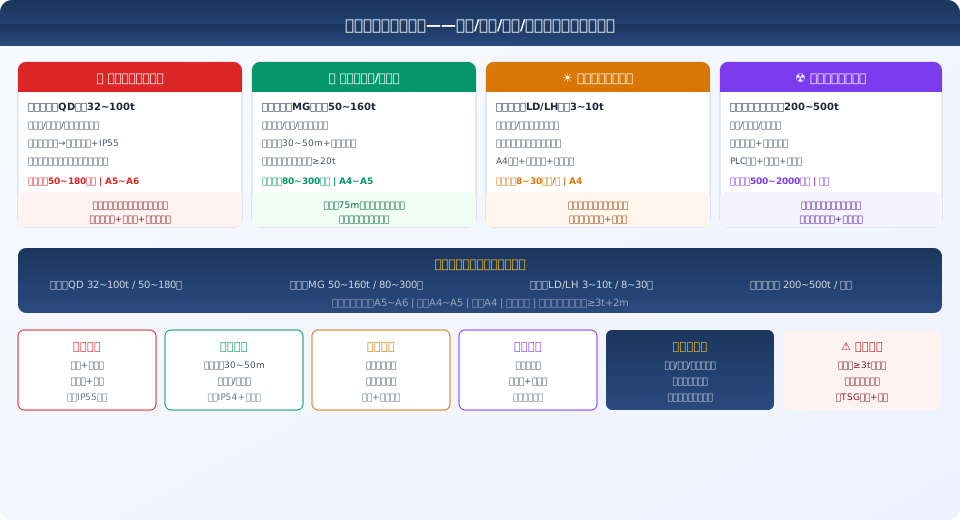
Power Industrycrane selectionandparameter configuration——Thermal Power/Wind Power/Solar PV/nuclear powerFour Major Application ScenariosHoistingReference

Thermal Power: Boiler House & Turbine Hall Maintenance Cranes

Crane requirements in thermal power plants (coal-fired, gas-fired, and biomass) are concentrated in the boiler house and turbine hall. Boiler house cranes handle boiler internals maintenance (water wall replacement, pulverizer repair, fan servicing), while turbine hall cranes support installation and overhaul of turbine-generator sets (rotor lifting, diaphragm replacement, condenser maintenance).

Recommended Model: QD-type double-girder bridge crane with a lifting capacity of 32–100 t (typically 50–100 t in boiler houses / 32–75 t in turbine halls), span determined by building width (standard 22–31 m), and lifting height of 12–20 m. Work duty classification A5–A6 (concentrated use during maintenance outages with high load factors). Thermal plant environments involve elevated temperatures (boiler houses can reach 50°C) and dust (coal ash), requiring cranes to be equipped with closed air-conditioned cabins, IP55-rated electrical systems, and IP55-rated motors.

Configuration Essentials: A dual hook configuration is standard for thermal power plant cranes—the main hook handles heavy overhaul components (e.g., 50 t turbine rotors) while the auxiliary hook manages smaller parts (e.g., bearing housings and bolts). Variable frequency speed control combined with anti-sway control delivers the positioning accuracy required for rotor alignment (±3 mm). The recommended operation mode is dual control via cabin plus radio remote—operators use the cabin for precise positioning during maintenance, and the remote control for routine floor-level lifting. Kelude has supplied QD-type maintenance cranes with closed cabins and high-temperature protection solutions to multiple thermal power plants.

Wind Power: Gantry Cranes for Tower, Blade & Nacelle Manufacturing

Wind turbine component manufacturing (towers, blades, nacelles) demands cranes with exceptionally wide spans, high lifting capacities, and the ability to handle extremely long workpieces. Tower sections measure 20–40 m and blades reach 60–80 m in length—spans that conventional overhead cranes cannot cover.

Recommended Model: MG-type double-girder gantry crane with a lifting capacity of 50–160 t (tower sections typically 50–80 t / nacelles 80–120 t), span of 30–50 m (with cantilever extensions for broader coverage), and lifting height of 15–25 m. Wind component plants typically combine indoor and outdoor work areas, with gantry cranes running across both. Work duty classification A4–A5 (wind manufacturing involves mass production but short individual lift cycles).

Configuration Essentials: Twin-trolley or main/auxiliary hook arrangements (main hook for tower sections and blades, auxiliary hook ≥20 t for fittings). Extra-long workpieces (e.g., 75 m blades) require two gantry cranes working in tandem at opposite ends. The outriggers on wide-span gantry cranes use a rigid/flexible design to release thermal stress. Outdoor sections must be fitted with rail clamps and anti-wind anti-slip devices. Kelude provides MG-type wide-span gantry cranes with synchronized dual-crane lifting control systems for wind energy manufacturers. For detailed specifications on MG-type double-girder gantry cranes, refer to the MG-type double-girder gantry crane tonnage, parameters, pricing, and structural features comparison table.

Solar PV: Light-Duty Bridge Cranes for Module & Rack Manufacturing

Crane requirements in the solar PV industry center on two scenarios: PV module production facilities (solar panel assembly lines) and PV racking manufacturing workshops (galvanized steel rack welding lines). Module plants handle loads in pallet/packing case units (individual loads ≤1 t), while racking facilities primarily lift structural steel and finished racks (individual loads ≤5 t). Both scenarios share common characteristics: light loads, high duty frequency, and multiple cranes operating in parallel.

Recommended Model: LD-type single-girder electric crane (3–5 t) or LH-type electric hoist bridge crane (5–10 t), with spans of 18–25 m, lifting heights of 6–10 m, work duty classification A4, variable-frequency speed control, and radio remote control. A typical workshop is equipped with 6–15 bridge cranes (configured according to assembly line length and workstation density). PV workshops maintain constant-temperature cleanroom conditions (some facilities are Class 1,000 cleanrooms), requiring cranes with dustproof designs (sealed electrical cabinets with gaskets, IP54-rated motors, and dust-free lubricating oil).

Configuration Essentials: When multiple bridge cranes operate in parallel within the same bay, anti-collision devices (infrared sensors or laser distance measurement) are mandatory, with a minimum clearance of 1 m between cranes. Remote controls must support multi-channel switching so a single unit can operate any of several cranes. Variable frequency speed control ensures smooth start/stop cycles, minimizing load swing that could disrupt assembly line rhythm. Kelude's PV industry solutions have been deployed at multiple leading module manufacturers.

Nuclear Power: Polar Cranes & Nuclear-Grade Lifting Equipment

Nuclear power plant cranes represent the most safety-critical lifting equipment in the power sector—the reactor building polar crane handles nuclear-safety-class components including pressure vessels, steam generators, and reactor coolant pumps. Design and manufacturing must comply with RCC-M (French nuclear island design and construction rules) or ASME NQA-1 standards, and must pass safety reviews by the nuclear regulatory authority.

Recommended Model: Polar cranes (for the reactor building) with lifting capacities of 200–500 t, spans of 35–42 m (matched to reactor containment diameter), and lifting heights of 18–25 m. Conventional island cranes are similar to thermal plant units (QD-type, 75–160 t). Cranes in nuclear fuel handling buildings require radiation-proof sealed cabins and remote monitoring systems. Nuclear crane work duty classifications follow no unified standard (life management is tailored to specific equipment handling frequencies).

Configuration Essentials: Dual brake redundancy (two independent brakes on each mechanism), fall protection devices (wire rope break protection plus anti-derailment), seismic design (verified for SL-2 ground motion above 0.3 g), and radiation-proof sealing (in-reactor equipment must withstand 200 kGy radiation exposure). Nuclear plant cranes command premium pricing (approx. $5 million–$20 million) and are supplied exclusively by manufacturers holding nuclear safety qualifications. Kelude supports the nuclear sector with conventional island cranes and joint bid assistance.

Four-Scenario Comparison & Investment Reference

Kelude Heavy Industry: Overhead & Gantry Crane Solutions

Kelude Heavy Industry is a leading manufacturer of industrial cranes, specializing in the design, engineering, and production of overhead cranes, gantry cranes, and electric hoists. With a strong focus on safety, reliability, and performance, we deliver tailored material handling solutions for a wide range of industries, including manufacturing, logistics, and energy.

Engineered for Performance and Safety

Our cranes are built to meet the highest international standards, ensuring safe and efficient operation in demanding environments. We utilize advanced technology and high-quality materials to provide equipment that maximizes productivity while minimizing downtime. Each crane is rigorously tested to guarantee compliance with global safety regulations.

Customized Material Handling Solutions

We understand that every facility has unique requirements. Our team of experienced engineers works closely with clients to design and manufacture cranes that precisely fit their specific operational needs. From single-girder overhead cranes for light-duty applications to heavy-duty double-girder and gantry systems, we offer a comprehensive range of customizable options.

Global Reach, Local Support

With a global footprint, Kelude Heavy Industry provides comprehensive after-sales support, including installation, commissioning, maintenance, and spare parts. Our commitment to customer satisfaction extends beyond the initial purchase, ensuring your equipment operates reliably for years to come.

Frequently Asked Questions

Q: What types of cranes does Kelude manufacture?
A: We manufacture a wide variety of cranes, including single-girder and double-girder overhead cranes, gantry cranes, and electric wire rope hoists, all customizable to meet specific application requirements.

Q: Can you provide cranes for explosion-proof environments?
A: Yes, we offer specialized explosion-proof crane systems designed for hazardous areas, complying with international safety standards such as IEC 60204-32.

Q: What is the typical lead time for a custom crane?
A: Lead times vary depending on the complexity and specifications of the crane. Please contact our sales team with your detailed requirements for an accurate timeline.

Q: Do you provide installation and maintenance services?
A: Absolutely. We offer complete installation, commissioning, operator training, and ongoing maintenance services to ensure optimal performance and longevity of your equipment.

← Scroll left / right to view full table →
Application recommended model Lifting Capacity Span Work Duty / Classification Protection Rating (IP) Specialconfiguration Reference Price(10K)
Thermal PowerQDoverhead type32~100t22~31mA5~A6IP55Double Hook+anti-sway control+Enclosed Cabin / Operator Cab50~180
Wind PowerMGGantry Crane50~160t30~50mA4~A5IP54Twin Trolley+Twintandem lifting+Rail clamp80~300
Solar PVLD/LHoverhead type3~10t18~25mA4IP54anti-collision+Multiaccess systemremote control+Cleanroom8~30/Unit
nuclear powerCircular Crane200~500t35~42mCustomIP55+RadialDual Brake+seismic resistance+Radiation-Proof+redundancy500~2000

Frequently Asked Questions (FAQ)

Q: Why is a closed operator cab mandatory for bridge cranes in thermal power plants?

A: Ambient temperatures in the boiler and turbine halls of a thermal power plant can reach 40–55°C, especially near the top of the boiler house. These areas also have high concentrations of coal dust and a risk of steam pipe leakage. In an open cab, operators simply cannot work under these conditions—extreme thermal radiation, dust inhalation, and the danger of steam burns are constant hazards. A closed cab with an industrial air conditioner keeps the interior below 28°C, while positive-pressure ventilation prevents dust ingress and sound insulation reduces equipment noise to under 75 dB.

Q: Why is a gantry crane recommended over an overhead crane for wind turbine blade manufacturing?

A: Wind turbine blades typically measure 60–80 m in length, with some reaching 100 m. An overhead crane's span is constrained by the factory building structure, making it impossible to cover such a long working area. Gantry cranes offer distinct advantages: ① their span is not limited by the building structure (they can reach 50 m plus cantilever); ② they can travel both indoors and outdoors—critical when blade molds extend beyond the building envelope; ③ two gantry cranes can perform tandem lifting of extra-long workpieces. Kelude's MG series gantry cranes for the wind power sector come standard with twin trolleys and a coordinated tandem lifting control system.

Q: How is an anti-collision plan implemented for multiple cranes operating in parallel in a PV module workshop?

A: When multiple overhead cranes operate side-by-side in the same bay, the anti-collision plan is implemented in three tiers: ① Hard limit switch protection—travel switches mounted at both ends of the crane cut off the traveling power supply upon contact; ② Laser or infrared distance measurement—real-time detection of the gap between adjacent cranes triggers automatic deceleration when the distance falls below a set value (e.g., 3 m) and automatic shutdown below 1 m; ③ PLC-based zone control—an upper-level computer assigns dedicated working zones to each crane, preventing cross-zone operation. PV workshops typically adopt the two-tier approach of laser distance measurement plus PLC control, at a cost of approximately $740–$2,970 per crane.

Q: What is the biggest difference between a nuclear power plant polar crane and a standard bridge crane?

A: The key difference lies in the level of safety redundancy. Polar cranes for nuclear power plants are designed on a "zero-failure assumption" principle—even if a single failure occurs (such as brake failure or motor burnout), the suspended load must not drop. To achieve this, every mechanism is equipped with two independent braking systems (if one fails, the other responds immediately), dual-winding motors (if one winding is damaged, the other allows emergency operation), and seismic design capable of withstanding an SL-2 earthquake with 0.3 g acceleration. A single polar crane costs 5–10 times more than a standard QD-type overhead crane, and the design and manufacturing cycle takes 2–3 years.

Related News

contact

contact us

phone:
+86 13903802779

mail:3915269@qq.com

Working hours: Monday to Friday

Wechat
Wechat
SHARE
TOP