
Crane Fleet Configuration & Delivery for a Steel Structure Plant

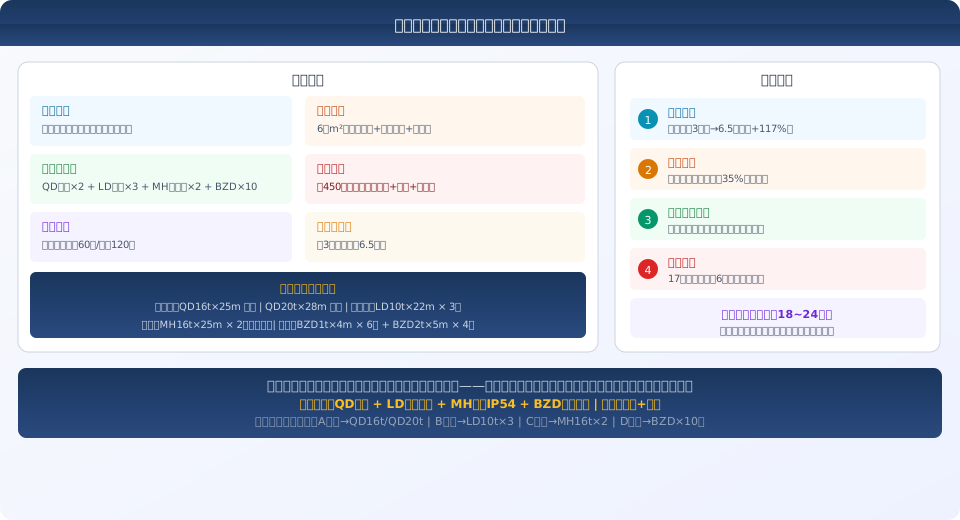
Key Points A steel structure group purchased 17 cranes from Kelude Heavy Industry for its new plant: QD16t + QD20t double-girder bridge cranes (heavy-duty zone) ×2, LD10t bridge cranes (light-duty zone) ×3, MH16t gantry cranes (storage yard) ×2, and BZD jib cranes (workstations) ×10. Scope includes rail foundation, installation & commissioning, and TSG inspection, with a total contract value of approximately $667,000. Delivery is split into two phases: Phase 1 at 60 days / Phase 2 at 120 days. After startup, annual production capacity will increase from 30,000 to 65,000 tons, and the workstation jib cranes free up 35% of bridge crane operating time.

In early 2026, a steel structure group began building a new plant in central China, planning an annual output of 60,000 tons of steel structures. The group's existing facility, constrained by an inefficient crane layout (four LD bridge cranes covering all processes), could no longer keep pace with expansion demands. Kelude Heavy Industry was awarded the contract to design, manufacture, and install all 17 cranes for the new plant — marking Kelude's first full-process, one-stop crane fleet project, from solution design and parallel multi-model manufacturing to on-site installation coordination.

A Certainsteel structureGroup's New Plant AreacraneGroupconfigurationand Delivery Cases

Project Background and Requirements Analysis

The new plant covers approximately 60,000 m² and produces H-Beam, box girder, and cruciform column steel structural components. The old facility's pain point was typical: four LD bridge cranes served the entire workshop, with large and small components sharing the same cranes, causing constant scheduling bottlenecks — as one workshop manager put it, "Welders sometimes wait 20 minutes for a crane to become available."

New plant requirements: The layout is organized into four zones — Zone A: heavy fabrication (H-Beam assembly + box girder welding, max component ~12t); Zone B: light fabrication (purlins, girts, etc., load ≤5t); Zone C: outdoor storage yard (steel plate, sections, and finished goods storage, load ≤10t, all-weather operation); Zone D: workstation-level lifting (welding positioner loading and unloading, loads 0.5–2t). All cranes require variable-frequency speed control and radio remote control, with phased investment to ease upfront capital pressure.

Crane Fleet Configuration Solution

Zone A — Heavy fabrication (QD type double-girder bridge cranes): Two QD type double-girder bridge cranes — QD16t×25m (main hook 16t / auxiliary hook 3t, dual hook configuration, variable-frequency speed control + radio remote control, A5 duty) and QD20t×28m (main hook 20t / auxiliary hook 5t, variable-frequency speed control + cabin + remote dual control, A5 duty). The 16t unit handles routine H-Beam lifting; the 20t unit serves box girder assembly. The dual hook configuration allows large components to be lifted with the main hook while smaller fittings are handled simultaneously with the auxiliary hook.

Zone B — Light fabrication (LD type bridge cranes): Three LD10t×22m bridge cranes (radio remote control, variable-frequency speed control, A4 duty). The three cranes are distributed across three bays (each approximately 80m long), providing full coverage with no blind spots. The LD cranes in Zone B handle only light component transport between bays and finished product packaging/loading — they do not participate in Zone A's heavy lifting, keeping responsibilities clearly separated.

Zone C — Outdoor storage yard (MH type gantry cranes): Two MH16t×25m gantry cranes (outdoor model, IP54 protection, rail clamps + rail wedges for wind resistance and anti-slip, remote control + cabin dual operation). Each crane runs on a 120m rail, covering both the raw material unloading area and the finished product storage area. The outdoor gantry crane foundations are designed with C25 concrete, with drainage channels at the rail base. Rainproof electrical control boxes and stainless steel operation panels are fitted.

Zone D — Workstation lifting (BZD type jib cranes): Ten BZD jib cranes — six BZD1t×4m and four BZD2t×5m — covering welding assembly stations and drilling/notching stations respectively. The jib crane foundations are poured simultaneously with the workshop floor, with anchor bolts embedded in the column bases. The core value of the Zone D solution is freeing the bridge cranes from frequent small-load lifts — data shows that after adding jib cranes, bridge crane productive operating time increased from 65% to 88%.

Phased Delivery and Installation

Phase 1 (60 days): QD16t + QD20t (Zone A) + LD10t ×3 (Zone B). Priority is getting the indoor production lines running — after the bridge cranes arrive, rail installation and crane assembly begin immediately, with installation & commissioning and TSG inspection for all five bridge cranes completed within 15 days. The customer can start steel structure production right after Phase 1 delivery.

Phase 2 (120 days): MH16t ×2 (Zone C) + BZD ×10 (Zone D). The outdoor storage yard has a longer construction period (28 days of concrete curing), which runs in parallel with indoor production. The BZD jib crane foundations are synchronized with the workshop floor construction, with all ten column bases poured in a single operation. The entire project — all 17 cranes — completes installation acceptance within 120 days.

For a detailed selection logic on four-zone crane configurations for steel structure workshops, refer to Steel Fabrication Workshop Crane Configuration Solutions.

Operational Results and Customer Feedback

Production capacity gains: Production data from the first six months shows average monthly output rising from 2,500 tons at the old plant to 5,400 tons (annualized 65,000 tons) — a 117% capacity increase. Labor hours per ton of steel structure dropped from 8.5 to 4.2 hours. The dual hook configuration on the Zone A QD16t and QD20t cranes enables large component lifting and auxiliary fitting in a single operation, cutting H-Beam assembly lifting time by 40%.

Operational reliability: In six months of operation, the 17 cranes have recorded zero major failures — only three remote control battery replacements and one current collector carbon brush replacement. The smooth start/stop of the variable-frequency speed control system has significantly reduced brake and gearbox wear — six-month inspections show brake gaps remaining within the normal 0.5–1.0mm range.

Customer feedback: The group's equipment director commented: "The lifting bottlenecks at the old plant are completely resolved at the new facility. The jib crane solution exceeded expectations — welders no longer wait for an overhead crane to move their workpieces; they handle it themselves with the jib crane. Overall production line flow efficiency is 15% above design expectations." Kelude Heavy Industry has since been engaged to design the crane solution for the group's old plant retrofit.

FAQ

Q: How do you coordinate production lead times across different crane models in a fleet project?

A: This project involves 17 cranes across four models (QD/LD/MH/BZD) manufactured at the same facility. The key coordination strategies are: ① Production scheduling follows delivery order — bridge cranes are produced first (critical path), with gantry and jib cranes following; ② Standardization of common parts — QD and LD cranes share the same series of electrical components, frequency inverters, and remote controls, simplifying spare parts management; ③ Early preparation of rails and foundations — rail installation for bridge and gantry cranes is precisely aligned with crane arrival dates. As a result, the five bridge cranes were delivered 45 days ahead of the gantry cranes, allowing the customer to begin production earlier.

Q: Why is a dual hook configuration recommended over a single hook for steel structure workshops?

A: Large component lifting in steel structure workshops often requires coordinating smaller parts—for example, when assembling H-Beams, the main hook handles the Main Girder while the auxiliary hook positions the stiffening plate. With a single hook, each small part must be set down and re-rigged before lifting, wasting 3–5 minutes per cycle. A dual hook configuration allows the main hook to lift the large component while the auxiliary hook assists with positioning, eliminating the need to set down and re-rig. This saves 15–20 minutes per component. At a production rate of 100 components per day, the dual hook setup saves 25–30 hours of crane time daily—far outweighing the additional cost of roughly $4,500–$7,400 for the dual hook configuration.

Q: How is the anti-corrosion treatment executed for outdoor Gantry Cranes in this project?

A: Both MH Gantry Cranes in this project operate fully outdoors. The anti-corrosion solution follows C3 classification (general industrial atmosphere): Shot Blasting to Sa2.5, Epoxy Zinc-Rich Primer at 80 μm, Epoxy MIO Intermediate Coat at 60 μm, and Polyurethane Topcoat at 60 μm (total dry film thickness ≥ 200 μm). Bolts and connectors are Hot-Dip Galvanized, and electrical cabinets are IP55-rated with Rain Covers. After 6 months of operation, the coating remains intact with no visible Corrosion. Given the client's inland atmospheric environment, C3-level Anti-corrosion is sufficient. Coastal locations would require upgrading to C5 (increasing coating thickness to ≥ 280 μm).

Q: What is the after-sales maintenance plan for the new crane fleet after delivery?

A: The after-sales service plan for this project includes: ① A 12-month Warranty Period (from Completion Acceptance), covering free repairs and replacement parts; ② Monthly on-site Inspections for the first 6 months (checking mechanism operation, Brake clearance, Cable Wear, Conductor Rail carbon brushes, etc.); ③ Quarterly Inspections for the remaining 6 months; ④ After the warranty expires, an annual maintenance contract is available (including semi-annual comprehensive Maintenance and annual TSG Inspection agency service). The client reports high satisfaction with the maintenance Response time—technicians arrive on-site within 4 hours of a service call.

Related News

contact

contact us

phone:
+86 13903802779

mail:3915269@qq.com

Working hours: Monday to Friday

Wechat
Wechat
SHARE
TOP