
Lifting Equipment for EV Manufacturing

At a glance: Kelude Heavy Industry provides crane configuration solutions for new-energy vehicle (NEV) manufacturers, covering all four production shops — stamping, body-in-white (BIW), painting, and final assembly. Solutions accommodate lifting capacities from 2 to 50 t and spans from 12 to 36 m, with a complete-plant hoisting equipment investment of approximately $89,000 to $890,000. The stamping shop is equipped with double-girder overhead cranes (20–50 t); the BIW shop uses a KBK system with aluminum-body-specific spreaders (1–3 t); the painting shop employs explosion-proof stainless steel cranes (2–5 t); and the final assembly shop features KBK and electric hoist systems with battery-pack-specific lifting spreaders (0.5–5 t) — all engineered to meet the special process requirements of NEV battery pack hoisting, aluminum body loading, and electric motor assembly.

Crane Solutions for NEV Manufacturing Plants

Stamping Shop | BIW Shop | Painting Shop | Final Assembly Shop

Each of the four production shops in an NEV plant places distinct demands on overhead lifting equipment: the stamping shop requires high-frequency inching for die changes; the BIW shop needs reliable handling of body assemblies; the painting shop demands explosion-proof and clean-room-compatible operation; and the final assembly shop calls for precision handling of power batteries.

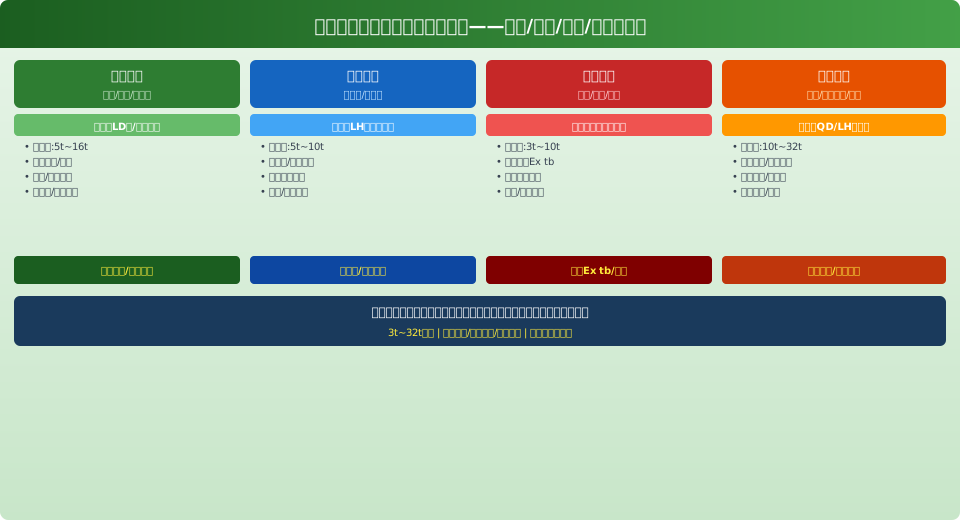
New Energy Vehicle Complete VehiclemanufacturingcraneSolution——Stamping/Welding Shop/Coating / painting/Final AssemblyFourWorkshop

Scenario 1 — Stamping Shop

• Lifting capacity: 5–16 t, LD-type / electric hoist

• Die change / blanking

• Coil / sheet handling

• High-frequency / inching operation

Die change | Coil handling | High frequency

Scenario 2 — BIW Shop

• Lifting capacity: 5–10 t, LH-type hoist overhead crane

• Welding line / fixture change

• Body assembly lifting and transport

• Multi-point / multi-line coverage

Welding line | Body handling | Multi-line coverage

Scenario 3 — Painting Shop

• Lifting capacity: 3–10 t, explosion-proof electric hoist

• Explosion-proof coating area (Ex tb)

• Paint / solvent explosion protection

• Clean / dustproof design

Ex tb protection | Clean | Solvent-safe

Scenario 4 — Final Assembly Shop

• Lifting capacity: 10–32 t, QD/LH-type overhead crane

• Power battery / motor hoisting

• VFD inching / anti-sway control

• Precision alignment / assembly

Battery hoisting | VFD inching | Precision assembly

Selection Parameters by Production Area

Kelude Heavy Industry: Engineered for Demanding Industrial Applications

Kelude Heavy Industry specializes in the design and manufacture of heavy-duty industrial cranes and material handling solutions. Our product lineup is built to deliver exceptional performance, reliability, and safety in the most challenging operational environments.

Robust Double-Girder & Single-Girder Crane Systems

Our core range includes both double-girder and single-girder overhead cranes, engineered for superior load control and operational efficiency. These systems are available in various configurations to meet specific facility requirements, from general manufacturing to heavy fabrication shops.

FeatureBenefit
High-Strength Steel ConstructionMaximizes durability and service life under continuous heavy use.
Precision-Machined ComponentsEnsures smooth, accurate positioning and reduces maintenance downtime.
Modular DesignSimplifies installation, future upgrades, and routine service access.

Explosion-Proof & Low-Headroom Hoist Solutions

For specialized environments, Kelude offers explosion-proof hoists compliant with international safety standards, ensuring safe operation in hazardous areas. Our low-headroom hoist designs maximize lifting height within existing facility constraints, providing an efficient solution for plants with limited vertical space.

Advanced Control & Safety Systems

Every Kelude crane is equipped with advanced control technology for precise load handling. Our variable-frequency drives (VFDs) enable smooth acceleration and deceleration, reducing mechanical stress. Integrated safety features, including overload protection and anti-sway technology, enhance operational safety and cargo security.

Customized Material Handling & After-Sales Support

We understand that every operation is unique. Kelude provides customized crane solutions tailored to your specific load capacities, span lengths, and duty cycles. Our commitment extends beyond the initial sale, with comprehensive after-sales support including installation supervision, operator training, and readily available spare parts.

For more information on how Kelude Heavy Industry can optimize your material handling processes, contact our engineering team today.

Parameter ItemStamping WorkshopWelding Assembly WorkshopPainting WorkshopFinal Assembly Workshop
recommended modelLD Type/Electric HoistLH Type Hoistoverhead typeExplosion-proof electric hoistQD/LH Typeoverhead type
Lifting Capacity5t~16t5t~10t3t~10t10t~32t
special requirementsHigh Frequency/Inching / Jog ModeMulti-linecoverageExplosion-proof Ex tb/CleanroomVariable Frequency Drive (VFD)/anti-sway control
control modeFloor-mountedremote controlFloor-mountedremote controlremote controlremote control+Operator Cabin
Kelude SolutionInching / Jog Mode UpgradeMulti-linecoverageExplosion-proof CleanroomBattery Lifting spreader+anti-sway control
$890K–$8.9M
Total Plant Investment
2–50 t
Lifting Capacity Range
12–36 m
Span Range
A5–A7
Work Duty Classification
Explosion-Proof + Cleanroom
Special Requirements
100K–500K units/yr
Vehicle Production Capacity

Stamping & Body Shop Crane Solutions

Stamping presses require frequent die changes—typically every 2 to 4 hours—demanding high-frequency hoisting cycles. Kelude's LD Type cranes are equipped with an inching upgrade module that delivers a jog response time of under 50 ms. In the body shop, LH-type under-running cranes handle body-in-white and sub-assembly lifting across multiple welding lines.

Painting & Final Assembly Cranes

Solvent evaporation zones in the painting workshop require Ex tb explosion-proof electric hoists. In the final assembly line for new-energy vehicles, battery pack lifting (300–800 kg) demands variable frequency inching control (0.3–1.0 m/min) and an anti-sway system for precise, safe positioning.

Kelude Heavy Industry – Service Advantages

Kelude Heavy Industry has years of experience delivering crane solutions for new-energy vehicle manufacturing. We serve both passenger and commercial EV plants across all four production stages—stamping, body shop, painting, and final assembly—with specialized expertise in battery pack handling, aluminum body panel loading, and e-drive assembly.

Dedicated Battery Pack Lifting System
EV battery packs (200–800 kg) demand exceptional lifting safety—any impact or drop could trigger thermal runaway. Kelude integrates a KBK flexible system with a specialized battery spreader featuring insulation monitoring, a fall-prevention mechanical lock, and an inclination angle sensor. The contact surface uses flame-retardant polyurethane cushioning, with a cycle time of ≤30 seconds per lift.
Aluminum Body KBK Loading System
New-energy vehicles rely heavily on aluminum body panels—30%–40% lighter than steel—but the soft surface is prone to dents and scratches. Kelude's KBK system with a vacuum lifter uses polyurethane-coated suction cups with adjustable suction force to adapt to varying panel curvatures. Operators can precisely position doors, hoods, and side panels with simple manual push-and-pull motion.
E-Drive KBK Assembly Solution
The three-in-one e-drive unit (motor + gearbox + inverter, 50–150 kg) requires high-precision assembly with coaxiality of ≤0.05 mm. Kelude's KBK system incorporates an electric balancer and guided positioning devices, offering stepless speed regulation (0.5–5 m/min) so operators can control the lowering and alignment with pinpoint accuracy, preventing damage to splines and bolt holes.

FAQ

Q: What are the safety requirements for hoisting EV battery packs?
A: Safety requirements for hoisting battery packs (NMC/LFP, 200–800 kg) include: ① Lifting spreader grounding resistance ≤ 4 Ω (anti-static); ② Built-in insulation monitoring device (alarm and stop when insulation resistance 3°); ⑤ Polyurethane cushioning pads to protect the battery pack housing. Kelude's specialized battery pack spreader is verified to a safety factor of 5 per ISO 4301 Crane Design Standard.
Q: For aluminum body panels, should we use a KBK crane or an overhead crane with an electric hoist?
A: Aluminum body panels—doors, hoods, and fenders—typically weigh between 5 and 25 kg each. For this application, we recommend a KBK crane paired with a vacuum lifter. The vacuum lifter offers a lifting capacity of 60–120 kg with multiple suction cups, and its adjustable suction force prevents deformation of thin sheets. The polyurethane coating on the suction cups protects the aluminum surface from scratches. Compared to an overhead crane with an electric hoist (where the minimum 1 t lifting capacity is excessive for the job), the KBK + vacuum lifter solution cuts investment costs by 60%–80%.
Q: What are the lifting accuracy requirements for a three-in-one geared motor unit?
A: The coaxiality of the three-in-one electric drive assembly (motor + gearbox + inverter) must be ≤0.05 mm, and the spline coupling demands extremely high assembly precision. Kelude's KBK system combined with an electric balancer delivers: infinitely variable vertical lifting speeds from 0 to 5 m/min, no-load lifting point deviation of less than 2 mm, and an alignment guide cone that automatically centers the spline during engagement. Assembly pass rates improve from 95% to over 99.5%.
Q: What special environmental requirements apply to cranes in EV plants?
A: EV plants, particularly battery assembly workshops, require low-humidity environments (dew point ≤ -40°C). Under such conditions, standard crane electrical components are prone to condensation and short circuits. Kelude addresses this by using nitrogen-purged, hermetically sealed electrical control boxes with integrated heating dehumidifiers, preventing condensation in low-dew-point environments. In welding workshops, aluminum alloy welding produces spatter that demands stainless steel anti-spatter shields to protect wire ropes and cables.

Related News

contact

contact us

phone:
+86 13903802779

mail:3915269@qq.com

Working hours: Monday to Friday

Wechat
Wechat
SHARE
TOP