How to Select a Hydropower Station Overhead Crane
Quick Summary: Kelude Heavy Industry provides a complete crane configuration solution for hydroelectric power stations, covering four key work areas: the main powerhouse, dam crest, tailrace, and unit installation. The solution supports lifting capacities of 10–500t for main powerhouse overhead cranes, 5–40t for dam crest gantry cranes, 3–20t for the tailrace area, and 5–80t for dedicated unit installation equipment. The total crane equipment investment ranges from approximately $150,000 to $3 million. The main powerhouse is equipped with a QD-type double-trolley bridge crane (50–500t main hook with 10–50t auxiliary hook), the dam crest features a gantry crane (5–40t), the tailrace area uses an electric hoist bridge crane (3–20t), and the unit installation phase utilizes a dedicated spreader beam and rotor lifting spreader. This configuration meets all hoisting needs from civil construction to unit maintenance throughout the power station's lifecycle.
Hydroelectric Power Station Crane Selection Guide
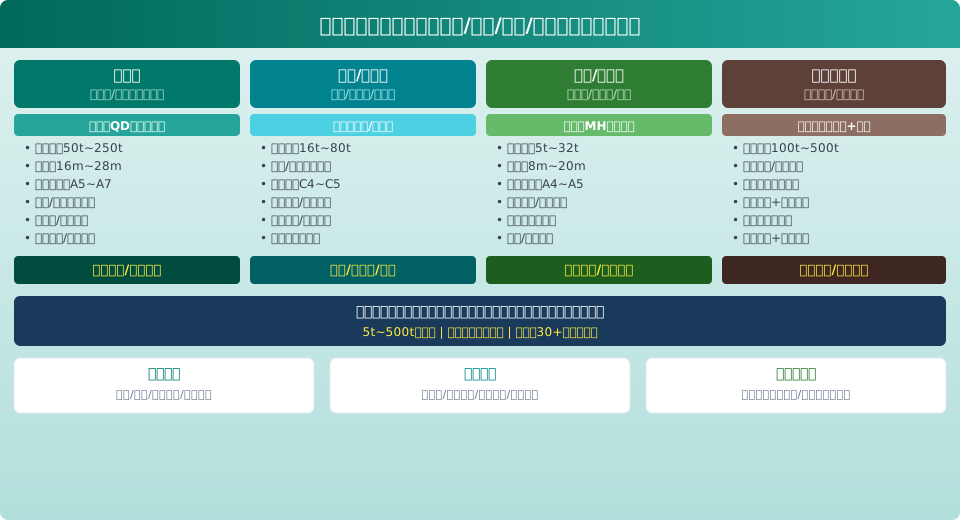
Main Powerhouse | Dam Crest / Intake | Tailrace / Maintenance Area | Unit Installation Area
Crane selection for hydroelectric power station construction and maintenance must address four distinctly demanding operating conditions: ultra-large tonnage lifting (e.g., 500t-class generator rotor installation), high outdoor humidity (tailrace area), precision positioning (unit installation and alignment), and wind resistance (dam crest operations). Kelude Heavy Industry holds dedicated design and manufacturing qualifications for hydroelectric power station cranes, enabling customized lifting solutions for each work area—from individual equipment selection to fully integrated plant-wide configurations.
Scenario 1: Main Powerhouse
• Lifting capacity: 50t–250t, QD-type double-girder bridge crane
• Integral rotor/stator lifting
• Dual-trolley / tandem lifting synchronized design
• Work duty classification: A5–A7
• Variable frequency drive (VFD) / micro-motion positioning
• Kelude Heavy Industry supplies synchronized lifting control system
Ultra-large tonnage 50–250t | Dual-trolley tandem lifting | VFD micro-motion
Scenario 2: Dam Crest / Intake
• Lifting capacity: 16t–80t, gantry crane / hoist
• Outdoor duty + wind-resistant design
• Corrosion protection level: C4–C5
• Gate lifting / precise positioning
• Variable frequency control / slow-speed hoisting
• Kelude Heavy Industry supplies hydraulic rail clamps + anemometer interlock
Outdoor wind resistance | Gate hoisting | Slow-speed precision
Scenario 3: Tailrace / Maintenance Area
• Lifting capacity: 5t–32t, MH type gantry crane
• Humid environment + moisture-proof motor
• Mobile, flexible operation
• Remote control / floor-level dual control
• Anti-corrosion lubrication / stainless steel wire rope
• Kelude Heavy Industry offers moisture-proof electrical upgrade solution
Humid environment | Flexible mobility | Dual-control operation
Scenario 4: Unit Installation Area
• Lifting capacity: 100t–500t, dedicated double-girder crane + lifting spreader
• High-precision positioning for unit assembly
• Specialized rotor lifting beam and spreader
• Synchronous lifting capability for large components
• Variable frequency inching for precise alignment
• Kelude Heavy Industry provides full-station lifting configuration
Ultra-large tonnage 100–500t | Precision alignment | Synchronous lifting
• Special lifting beam / balancer spreader
• Synchronization control for dual-crane tandem lifting
• Hydraulic rail clamp + wind anchoring
• Millimeter-level micro-motion alignment
• Kelude Heavy Industry designed & manufactured lifting beam system
Ultra-large tonnage 100–500t | Specialized spreader | Millimeter-level alignment
Selection Parameter Comparison Across Four Regions
| Parameter Item | Main Factory building | Dam Crest/Intake | Tailwater/Maintenance Bay | Unitinstallation Maintenance Bay |
|---|---|---|---|---|
| recommended model | QD Typedouble-girder bridge crane | gantry type/Hoist | MH type gantry crane | Dedicated Double Girder+Lifting spreader |
| lifting capacity range | 50t~250t | 16t~80t | 5t~32t | 100t~500t |
| Work Duty / Classification | A5~A7 | A4~A6 | A4~A5 | A5~A7 |
| special requirements | rotor Integral Hoisting | Gate Hoisting/Wind Resistance | Humid/Traveling | special lifting beam/Synchronization |
| control mode | Operator Cabin+remote control | remote control+Operator Cabin | remote control/Floor-Mounted | Operator Cabin+Interlocked |
| Kelude Advantage | synchronous lifting System | Hydraulic Rail Clamp+Anemometer | Moisture-Proof Electrical Upgrade | special lifting beam Design & Manufacturing |
Key Selection Criteria for Heavy-Duty Overhead Cranes in the Main Powerhouse
The overhead crane in the main powerhouse of a hydropower station handles the most critical lifting tasks — placing and servicing the generator rotor, hydraulic turbine runner, head cover, and other core components. Individual components can weigh anywhere from 100 t to 250 t and require millimeter-level positioning accuracy. The QD-type double-girder bridge crane is the industry standard for main powerhouse applications, and the twin-trolley configuration enables synchronized tandem lifting. Kelude equips these cranes with variable-frequency speed control and smooth hoisting/lowering functionality, ensuring safe and precise handling of ultra-heavy loads.
Dam Crest Gantry Cranes and Tailrace Equipment Solutions
Dam crest gantry cranes and hoists face two primary challenges: strong outdoor winds and high humidity. Wind speeds at the dam crest can reach Force 6–8 on the Beaufort scale, while relative humidity in the tailrace area often exceeds 85% year-round. Kelude's hydraulic rail clamps interlock with the anemometer — when wind speed reaches the preset threshold, the clamps automatically engage to lock the crane in place. For the tailrace area, the MH-type gantry crane is equipped with moisture-proof motors, stainless steel wire ropes, and fully sealed electrical control boxes to ensure reliable, maintenance-free operation in persistently humid conditions.
Specialized Lifting Spreaders and Synchronized Control for the Unit Installation Bay
The unit installation bay handles ultra-large (100 t–500 t) and irregularly shaped rotor and stator components. Kelude designs custom lifting beams and balanced spreaders for each hydropower project, paired with a dual-crane synchronized control system. A PLC monitors the hoisting height and load distribution of both cranes in real time, triggering an automatic shutdown and alarm if deviation exceeds the allowable limit. Hydraulic rail clamps and wind anchoring devices provide additional safety during outdoor installation work.
Kelude — Service Advantages for Hydroelectric Power Station Cranes
Kelude Heavy Industry has specialized in crane systems for the water conservancy and hydropower sector for many years. The company holds a manufacturing license for hydraulic engineering hoists and is fully qualified in the design and manufacturing of large-scale overhead cranes for hydropower stations. Its product line covers the full range of main powerhouse overhead cranes, dam crest gantry cranes, and tailrace cranes, with more than 50 hydropower projects completed to date — spanning conventional hydro plants, pumped-storage stations, and run-of-river facilities.
FAQ
Q: How is the lifting capacity determined for overhead cranes in a hydropower plant's main powerhouse?
A: The lifting capacity is determined by taking the heaviest component — either the generator rotor or the hydraulic turbine runner — and multiplying its weight by a safety factor of 1.1 to 1.25. For medium-sized hydropower plants (100 MW class), a QD-type overhead crane with a capacity of 100t to 160t is typically required. For large plants (300 MW and above), a QD-type crane rated at 200t to 250t is needed. Kelude recommends building in an additional 10% to 15% safety margin.
Q: Why is an anemometer interlock system essential for dam crest cranes?
A: Dam crests are open-air work areas where wind speeds frequently reach Force 6 to 8 on the Beaufort scale. Per ISO 4301 Crane Design Standard, outdoor crane operations shall be stopped when wind speeds exceed 13.8 m/s (Force 6). The anemometer interlock system installed by Kelude triggers an audible and visual alarm when wind speed exceeds the preset threshold, and automatically cuts off the power supply and engages the rail clamps if the limit is surpassed.
Q: What moisture-proofing requirements apply to cranes in tailrace areas?
A: Relative humidity in tailrace areas typically exceeds 85% year-round, posing a significant threat to the electrical system. Kelude offers a moisture-proof electrical upgrade solution: motors with IP55 protection or higher, heating dehumidifiers inside the electrical control box, moisture-proof treatment on terminal blocks, 316 stainless steel wire rope, and hot-dip galvanized crane rails for corrosion resistance.
Q: Do hydropower unit installations require specialized lifting spreaders?
A: In most cases, yes. Generator rotors and hydraulic turbine runners have irregular geometries that prevent a plain hook from distributing load evenly. Kelude custom-designs balanced lifting beams and spreaders based on component drawings, incorporating load distribution sensors and tilt angle monitoring to ensure the component remains stable and evenly loaded throughout the hoisting process.