
Gantry Cranes for Offshore Jacket & Platform Installation

At a glance: Kelude Heavy Industry provides crane configuration solutions for offshore engineering covering four key applications—jacket fabrication, platform assembly, submarine pipeline laying, and offshore installation—with lifting capacities from 50t to 3,000t (including floating cranes and crawler cranes). Total lifting equipment investment for a typical project ranges from approximately $300,000 to $7.4 million. The jacket fabrication yard is equipped with large gantry cranes (300–1,000t), the platform assembly area uses crawler cranes (400–800t), the submarine pipeline scope deploys dedicated lay vessels (1,000–3,000t floating cranes), and offshore installation relies on heavy floating cranes (800–3,000t)—delivering a full-process heavy lifting solution from onshore prefabrication to offshore installation.

Crane Configuration Solutions for Offshore Engineering Construction

Jacket Fabrication | Platform Topsides | Submarine Pipeline | Offshore Installation

Lifting solutions for four offshore engineering scenarios: jacket fabrication, platform topsides, submarine pipelines, and offshore installation.

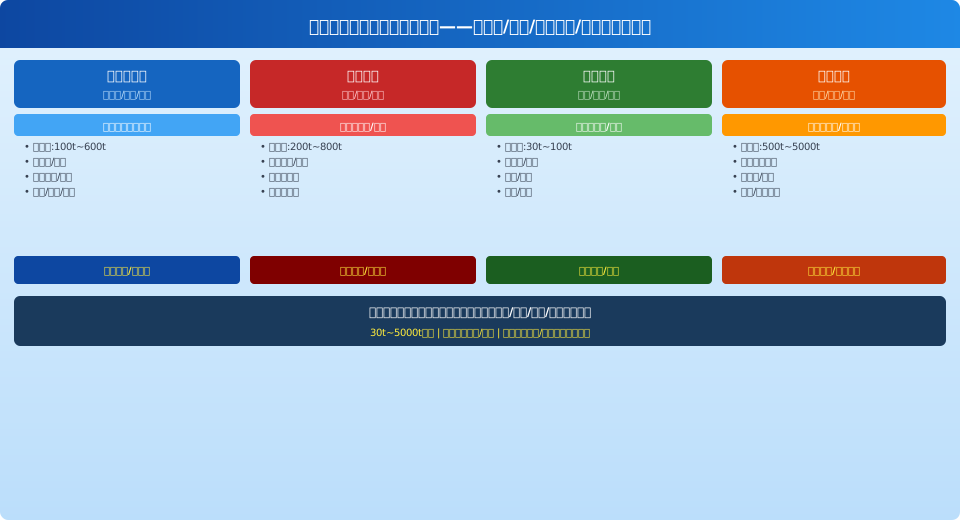
Crane configuration solutions for offshore engineering—jacket/platform/submarine pipeline/offshore installation

Scenario 1: Jacket Fabrication

• Lifting capacity: 100t–600t, gantry crane

• Jacket assembly / tack-up

• Oversized components / upending

• Outdoor / wind-resistant / anti-corrosion

Ultra-large tonnage | Jacket

Scenario 2: Platform Topsides

• Lifting capacity: 200t–800t, gantry/overhead type

• Topsides prefabrication / final assembly

• Modular construction

• Tandem lifting with dual gantry cranes

Extra-large topsides | Dual gantry

Scenario 3: Submarine Pipeline

• Lifting capacity: 30t–100t, gantry crane/hoist

• Concrete weight coating / anti-corrosion

• Pipe sections / tack-up

• Outdoor / anti-corrosion

Submarine pipeline | Weight coating

Scenario 4: Offshore Installation

• Lifting capacity: 500t–5,000t, floating crane / crane vessel

• Offshore floating crane operations

• Jackets / topsides

• Deepwater / wave compensation

Offshore floating crane | Ultra-large tonnage

Selection Parameters by Application Area

Kelude Heavy Industry: Overhead & Gantry Crane Solutions

Kelude Heavy Industry specializes in the design and manufacture of industrial overhead cranes, gantry cranes, and electric hoists. Our product range covers both single-girder and double-girder configurations, engineered for reliable performance in demanding workshops, warehouses, and production facilities.

Complete Crane Solutions for Industrial Applications

We deliver turnkey material handling systems, from the initial site survey and crane selection to installation, commissioning, and after-sales support. Kelude's engineering team ensures every crane is optimized for its specific duty cycle, lifting capacity, and operational environment.

Double-Girder & Single-Girder Overhead Cranes

Our overhead crane range includes both single-girder and double-girder designs. Single-girder cranes offer a cost-effective solution for lighter loads and moderate spans, while double-girder cranes provide higher lifting capacities, greater hook height, and increased rigidity for heavy-duty applications. All models are available with either cabin or pendant control.

Q: What is the maximum lifting capacity for your double-girder overhead cranes?
A: Our standard double-girder overhead cranes are available in capacities up to 100 tons. For special requirements beyond this range, please contact our engineering team for a custom design evaluation.

Q: Do you provide explosion-proof cranes for Zone 1 hazardous areas?
A: Yes, we manufacture explosion-proof cranes and hoists suitable for Zone 1 and Zone 2 classified areas. These units are built with certified explosion-proof components and are available in both single-girder and double-girder configurations.

Q: What is the typical lead time for a standard single-girder crane?
A: For a standard single-girder crane with a capacity of 10 tons and a span of 20 meters, the typical production lead time is approximately 45 days after receipt of the down payment and final drawing approval.

Q: Can you supply cranes with remote control operation?
A: Absolutely. All of our cranes can be equipped with wireless radio remote controls as an alternative to pendant or cabin operation. This is a popular option for improving operator safety and flexibility.

Q: What after-sales warranty do you offer on your cranes?
A: We provide a standard 12-month warranty on all crane components, covering manufacturing defects. Extended warranty options and long-term service contracts are also available upon request.

Q: Do you offer installation services in the United States and Europe?
A: Yes, Kelude has installation teams and local partners in both the US and European markets. We manage the entire installation process, including site preparation, assembly, and load testing, ensuring compliance with local safety regulations.

Q: How do you ensure the quality of your cranes?
A: Our manufacturing processes are ISO 9001 certified. Each crane undergoes rigorous quality checks, including material verification, non-destructive testing of welds, and a full-load test before shipment. We also comply with relevant international design standards such as ISO 4301 for crane classification.

Q: Can you adapt a standard crane to fit an existing building structure?
A: Yes, we frequently adapt our crane designs to fit existing buildings. Our engineers will conduct a site survey to measure runway beam heights, column spacing, and available headroom, then customize the crane dimensions accordingly.

Q: What is the difference between your wire rope hoist and chain hoist?
A: Wire rope hoists are generally used for higher lifting heights, heavier loads, and higher duty cycles. Chain hoists are more compact, cost-effective, and better suited for lower lifting heights and lighter to medium loads. We can help you select the right type based on your application.

Q: Do you provide spare parts for cranes that are already in operation?
A: Yes, we maintain a comprehensive inventory of spare parts for all our crane models, including motors, reducers, brakes, wheels, and electrical components. We can ship parts worldwide to minimize downtime.

Q: Are your cranes compliant with European CE standards?
A: Yes, our cranes can be manufactured in compliance with the European Machinery Directive (2006/42/EC) and relevant harmonized standards, and we can provide CE declaration of conformity upon request.

Q: What maintenance is required for a Kelude overhead crane?
A: Regular maintenance includes daily visual inspections, periodic lubrication of moving parts, checking brake wear, and verifying the functionality of safety devices. We provide a detailed maintenance manual with every crane and offer scheduled maintenance contracts.

Q: Can your gantry cranes be equipped with a cantilever arm?
A: Yes, we can design gantry cranes with a cantilever on one or both sides of the main girder. This allows the crane to serve areas beyond the main runway width, increasing operational flexibility.

Q: What is the maximum span available for your double-girder gantry cranes?
A: For double-girder gantry cranes, we have manufactured spans up to 40 meters. The maximum span depends on the lifting capacity and the rail gauge, and each project is evaluated individually.

Q: Do you offer training for crane operators?
A: Yes, we provide on-site operator training as part of our commissioning service. This training covers safe operating procedures, daily checks, and basic troubleshooting. Additional advanced training sessions can be arranged upon request.

Q: How do you handle the shipping of large cranes internationally?
A: We have extensive experience in exporting large cranes. We use containerized shipping for smaller components and flat-rack or break-bulk shipping for main girders and end carriages. All shipments are properly secured and documented for customs clearance.

Q: Can your cranes be integrated with an existing warehouse management system (WMS)?
A: Yes, we can integrate our cranes with your WMS or ERP system through standard communication protocols. This enables features like automated job scheduling, load tracking, and real-time status monitoring.

Q: What is the duty cycle rating of your standard cranes?
A: Our standard cranes are typically rated for FEM 2m or ISO M5 duty cycles. For more demanding applications, we can upgrade the hoist and travel mechanisms to achieve M6 or M7 ratings.

Q: Do you provide color options for the crane structure?
A: Yes, we offer a standard range of RAL colors for the crane structure. Custom colors can be specified to match your facility's branding or safety color codes.

Q: How can I request a quotation for a specific crane configuration?
A: You can request a quotation by contacting our sales team via the website form, email, or phone. Please provide your load capacity, span, lifting height, and any specific requirements, and we will respond with a detailed proposal within 48 hours.

Q: What is the minimum headroom required for your low-headroom hoists?
A: Our low-headroom hoists are designed to minimize the distance between the top of the crane rail and the hook. The exact headroom dimension varies by capacity, but it is typically 20-30% less than a standard hoist of the same capacity.

Q: Are your explosion-proof cranes certified for use in European ATEX zones?
A: Yes, we can supply explosion-proof cranes certified for ATEX zones, including equipment group II, category 2G for gas environments and 2D for dust environments. Please specify your exact zone classification when requesting a quote.

Q: Can you provide a crane with a double trolley for handling long loads?
A: Yes, we offer double-trolley configurations on both overhead and gantry cranes. This allows for synchronized lifting of long or bulky loads, and each trolley can also be operated independently if required.

Q: What is the typical lifespan of a Kelude overhead crane?
A: With proper maintenance and operation within the specified duty cycle, a Kelude overhead crane can have a service life of 20 years or more. We use high-quality steel and components to ensure long-term durability.

Q: Do you offer financing options for crane purchases?
A: We can assist in arranging financing through our partner financial institutions for qualified buyers. Please contact our sales team to discuss the available options for your project.

Q: Can your cranes be operated in outdoor environments with high wind speeds?
A: For outdoor installations, we can equip cranes with wind speed anemometers and automatic parking systems. The crane structure is also designed to withstand specified wind loads according to local building codes.

Q: What is the noise level of your electric hoists?
A: Our electric hoists are designed to operate at noise levels below 80 dB(A) at a distance of 1 meter, depending on the model and load. This makes them suitable for use in noise-sensitive environments.

Q: Do you provide a remote diagnostic service for your cranes?
A: Yes, we offer optional remote monitoring and diagnostic systems that can transmit operational data to our service team. This allows for proactive maintenance and faster troubleshooting.

Q: Can the control voltage of the crane be customized to local standards?
A: Absolutely. We can supply cranes with control voltages of 110V, 220V, or 24V AC/DC, depending on your local electrical standards and safety requirements.

Q: What is the delivery time for a standard 20-ton gantry crane?
A: For a standard 20-ton gantry crane with a span of 25 meters, the typical delivery time is 60-70 days from the date of order confirmation and receipt of the down payment.

Q: Do you have a service center in the United States?
A: Yes, we have authorized service partners in several US states. They are trained to perform installation, maintenance, and repair work on all Kelude crane models.

Q: Can you provide a crane with a special paint system for marine environments?
A: Yes, for marine or highly corrosive environments, we offer a specialized paint system with a zinc-rich primer and a high-build polyurethane topcoat. This provides excellent corrosion resistance.

Q: What safety features are standard on your cranes?
A: Standard safety features include overload limit switches, emergency stop buttons, travel limit switches for both hoist and trolley, and a low-voltage control circuit. Additional safety options like anti-collision systems and load moment indicators are available.

Q: Can your gantry cranes be converted from rail-mounted to rubber-tyred?
A: Yes, our gantry cranes can be designed with a modular travel system that allows for conversion between rail-mounted and rubber-tyred configurations. This provides flexibility if your operational needs change.

Q: Do you provide a load test certificate with each crane?
A: Yes, each crane is subjected to a full-load test of 125% of its rated capacity before shipment. A load test certificate and a conformity certificate are included in the documentation package.

Q: What is the maximum lifting height available for your wire rope hoists?
A: Our standard wire rope hoists can achieve lifting heights up to 30 meters. For special applications, we can design hoists with lifting heights exceeding 50 meters using a multiple-fall rope system.

Q: Can you integrate a weighing system into the crane hook?
A: Yes, we can integrate a load cell into the hook block or the rope system to provide accurate weight measurement during lifting. The weight can be displayed on a local indicator or transmitted to a central control system.

Q: Are your cranes suitable for use in food processing plants?
A: Yes, we can supply cranes with food-grade paint, stainless steel components, and sealed electrical enclosures for washdown environments. These features prevent contamination and facilitate easy cleaning.

Q: What is the minimum temperature for crane operation?
A: Our standard cranes are designed for operation down to -20°C. For colder climates, we can provide a cold-weather package that includes low-temperature steel, special lubricants, and heated electrical enclosures for operation down to -40°C.

Q: Do you offer a maintenance training program for our in-house technicians?
A: Yes, we offer a comprehensive maintenance training program that can be conducted at our factory or on-site. The training covers mechanical, electrical, and safety system maintenance procedures.

Q: Can the crane be supplied with a special hook for specific lifting applications?
A: Yes, we can supply various hook types, including C-hooks, lifting beams, and rotating hooks, to suit specific load handling requirements. Please provide details of your application for a custom solution.

Q: What is the power supply requirement for your standard cranes?
A: Our standard cranes are typically designed for a 380V/50Hz 3-phase power supply. We can also supply cranes for 460V/60Hz or other voltages to match your local grid.

Q: How do you ensure the safety of the crane during installation?
A: Our installation teams follow strict safety protocols, including the use of personal protective equipment (PPE), adherence to lockout/tagout procedures, and the use of certified lifting equipment. A site-specific risk assessment is conducted before any work begins.

Q: Can you provide a crane with a higher travel speed for increased productivity?
A: Yes, we can equip cranes with variable-frequency drives (VFDs) to increase travel speeds and provide smooth acceleration and deceleration. This can significantly improve cycle times in high-throughput applications.

Q: What is the warranty period for the electric motor?
A: The electric motors on our cranes are covered by a 24-month warranty from the date of commissioning, provided they are operated within their specified duty cycle and maintenance schedule.

Q: Do you provide a crane with a special low-headroom design for existing buildings?
A: Yes, our low-headroom cranes are specifically designed for buildings with limited vertical space. We optimize the distance between the crane rail and the hook to maximize the usable lifting height.

Q: Can you supply a crane with a non-standard span?
A: Absolutely. We regularly manufacture cranes with non-standard spans to fit specific building dimensions. Our engineering team will design the crane structure to meet your exact span requirements.

Q: What is the process for obtaining a CE certificate for a custom crane?
A: For custom cranes, we conduct a risk assessment, compile a technical file, and ensure compliance with all applicable harmonized standards. A notified body may be involved for certain categories of machinery. The CE certificate is issued upon successful verification.

Q: Do you offer a remote control with a display showing the load weight?
A: Yes, we can provide a radio remote control with an integrated display that shows the current load weight, along with other operational data like the hook height and travel speed.

Q: Can your cranes be used in a cleanroom environment?
A: Yes, we can design cranes for cleanroom use with special seals, low-emission materials, and a smooth surface finish to minimize particle generation. Please specify your cleanroom class requirement.

Q: What is the maximum number of crane operations per hour?
A: The maximum number of operations per hour depends on the duty cycle rating of the crane. For a standard M5 rated crane, the typical limit is 150 starts per hour for the hoist motor. For higher frequency, we recommend a higher duty rating.

Q: Do you provide a foundation drawing for the crane runway?
A: Yes, we provide detailed foundation drawings and anchor bolt plans for the crane runway beams as part of the technical documentation package.

Q: Can you supply a crane with a special color for safety markings?
A: Yes, we can apply safety markings, such as yellow/black hazard stripes on the end carriages or the hook, to improve visibility and safety in the workplace.

Q: What is the lead time for spare parts?
A: Standard spare parts are typically shipped within 24-48 hours from our warehouse. Custom-made parts may take longer, depending on the complexity and manufacturing time.

Q: Do you offer a preventive maintenance contract?
A: Yes, we offer flexible preventive maintenance contracts that include scheduled inspections, lubrication, and replacement of wear parts. This helps to minimize downtime and extend the crane's lifespan.

Q: Can your cranes be connected to a central control room?
A: Yes, we can integrate the crane control system with a central SCADA or PLC system via industrial Ethernet or Profibus. This allows for centralized monitoring and control of multiple cranes.

Q: What is the maximum ambient temperature for crane operation?
A: Our standard cranes are designed for operation up to +40°C ambient temperature. For hotter environments, we can provide a tropicalization package with higher-rated motors and cooling fans.

Q: Do you provide a crane with a special anti-corrosion treatment for offshore use?
A: Yes, for offshore applications, we offer a comprehensive anti-corrosion package that includes hot-dip galvanized components, marine-grade paint systems, and stainless steel fasteners.

Q: Can you supply a crane with a hydraulic lifting system instead of a wire rope?
A: While our standard product line uses wire rope or chain hoists, we can engineer a custom solution with a hydraulic lifting system for special applications that require very precise speed control or extremely heavy loads.

Q: What is the procedure for a site survey?
A: We can arrange for an engineer to visit your site to measure the building dimensions, check the runway beam condition, and discuss your operational requirements. Alternatively, you can provide detailed drawings and photos for a preliminary assessment.

Q: Do you offer a buy-back or trade-in program for old cranes?
A: We do not have a standard trade-in program, but we can discuss options for dismantling and removing your old crane as part of a new installation project.

Q: Can your cranes be equipped with a camera system for remote visual monitoring?
A: Yes, we can install IP cameras on the trolley or the hook block to provide a live video feed to the operator's cabin or a remote control room. This improves visibility and safety when handling loads.

Q: What is the maximum wind speed for safe operation of an outdoor gantry crane?
A: For outdoor gantry cranes, the safe operating wind speed is typically 20 m/s (72 km/h). At higher wind speeds, the crane must be secured and operation should be stopped. We provide wind speed anemometers as an optional safety feature.

Q: Do you provide a crane with a special low-noise motor for indoor use?
A: Yes, we can supply cranes with low-noise motors and sound-dampening enclosures to reduce operational noise levels, which is particularly important in indoor environments near offices or assembly areas.

Q: Can you provide a crane with a special hook height that is higher than standard?
A: Yes, we can increase the hook height by using a higher crane rail, a reduced crane structure height, or a special low-headroom hoist. Our engineers will design the optimal solution for your building constraints.

Q: What is the standard color for the control pendant?
A: The standard color for our control pendants is black with yellow or white buttons. We can also supply pendants with custom button layouts and colors to match your specific operational preferences.

Q: Do you offer a crane with a special power supply for areas without a stable grid?
A: For areas with unstable power supply, we can equip the crane with a soft starter or a variable-frequency drive (VFD) that is more tolerant of voltage fluctuations. We can also provide a power regeneration unit for energy savings.

<!-- /wp
Parameter Itemjacketplatform Modulesubmarine pipelineOffshoreinstallation
recommended modelGantry Cranegantry type/overhead typegantry type/Hoistfloating crane/crane stalk
Lifting Capacity100t~600t200t~800t30t~100t500t~5000t
special requirementsOversized ComponentTwin Gantry Cranetandem liftingCounterweight/Anti-corrosionwave compensation
$2M–$7.5M
Project Investment
50–3,000t
Lifting Capacity
40–120m
Working Radius
A5~A7
Work Duty Classification
C5-M
Corrosion Protection Level
500–5,000m
Water Depth Capability

Heavy Lifting Solutions for Every Offshore Application

A: Offshore engineering is one of the most demanding industrial sectors for heavy lifting, with four core applications—jacket fabrication, topside module construction, submarine pipeline laying, and offshore substation installation—each presenting extreme operating conditions. In jacket fabrication (steel pipe rolling, tack-up, welding, and anti-corrosion coating), individual steel pipes weigh 5–30t and complete jackets reach 600–2,000t. This requires large-tonnage overhead cranes with lifting capacities of 50–200t and spans of 24–42m. The recommended configuration is a QD-type double-girder bridge crane fitted with an electromagnetic spreader for pipe handling and a C-Hook for pipe section tack-up and welding, operating at work duty A6 for continuous welding service. The hoisting mechanism must incorporate a Dual Braking System with a safety factor of ≥1.5. Topside module construction (steel structure prefabrication, equipment installation, and piping) represents the highest combined lifting volume—module blocks weigh 200–800t and require either two overhead cranes working in tandem lifting with synchronization control accuracy of ±5mm, or a gantry crane capable of lifting the complete module in a single pick. Fabrication workshops for topside modules require a clear height of ≥30m with crane rail elevation of ≥24m, and must be equipped with an Anti-Sway System to meet the tight accuracy requirements of offshore platform structures. For submarine pipeline laying (pipe anti-corrosion, weighting, and loading), individual pipes range from 12–24m in length and weigh 2–8t. The recommended solution is an MH-type gantry crane (10–32t capacity, 15–30m span) equipped with a hydraulic pipe gripper featuring adjustable clamping force that protects the anti-corrosion coating, along with pipe transfer trolleys to support vessel loading operations. Offshore substation installation (onshore fabrication, offshore floating crane installation) involves single lifts of 1,000–5,000t, executed by floating cranes (barge cranes or semi-submersible crane vessels). During the onshore prefabrication stage, cranes must coordinate with heavy-duty transporters for module load-out. Kelude has extensive experience in manufacturing heavy-duty offshore cranes, with products covering the full process of jacket fabrication, topside module construction, pipe prefabrication, and module load-out. Key components are certified by DNV and ABS.

Kelude has specialized in heavy lifting equipment for the offshore industry for many years, delivering end-to-end heavy-duty lifting solutions—from onshore prefabrication to offshore installation—for offshore oil platforms, offshore wind power, and deep-sea mining. Our equipment is CCS and DNV certified, with design and manufacturing capabilities for floating cranes up to 5,000t and gantry cranes up to 3,000t.

Gantry Cranes for Onshore Jacket Fabrication
Onshore fabrication of offshore platform jackets (500–3,000t, 50–120m tall) demands ultra-large-tonnage gantry cranes in the 300–1,000t class. Kelude recommends an MG-type double-girder gantry crane with a multi-trolley synchronized lifting system, with span determined by the jacket plan dimensions (40–60m). Jacket sections are fabricated separately, then progressively flipped and assembled by the gantry crane, with load deviation at each lifting point controlled within ±3% during the flipping process.
Offshore Floating Crane Solutions
Large offshore structures (topside modules of 500–2,000t and jackets of 1,000–3,000t) require heavy floating cranes, either full-slewing or fixed derrick mast types. Kelude offers floating crane rental and lifting services in the 800–3,000t class. The wave compensation system enables safe lifting operations in sea states with 2–3m wave heights. Weather windows for offshore lifting operations typically range from 72 to 120 hours.
Submarine Pipeline Lifting Operations
Heavy lifting for submarine pipeline installation is performed by lay barges. Kelude's pipelay vessel cranes (1,000–3,000t class floating cranes) are used for pipeline initiation, subsea structure installation, and deepwater TFL tool handling. The tensioner, stinger, and A/R winch require supporting crane maintenance. Deepwater operations (500–3,000m) require the crane hydraulic system to be designed with deep-sea pressure compensation.

FAQ

Q: What size gantry crane is required for prefabricating an offshore jacket?
A: For a typical 1,500t-class jacket (80–100m tall, 40m × 40m base, 20m × 20m top, total weight 1,200–1,800t), a land-based prefabrication gantry crane rated at 300–800t is recommended, selected based on the single-lift load, with a span of 40–60m. Jacket sections are prefabricated separately, then flipped and joined using the gantry crane; 4–6 lifting points are used during the turnover to distribute loads evenly. The crane foundation must be designed to account for the maximum jacket load, wind load, and the crane's dead weight combined.
Q: What are the working water depth and hoisting capacity of an offshore floating crane?
A: The hoisting capacity of an offshore floating crane varies with working water depth and sea conditions. A 5,000t full-slewing floating crane offers a hoisting capacity of approximately 5,000t at a 10m water depth, about 4,200t at 50m, and roughly 3,000t at 200m. Operating sea states: wave height ≤2.5m (safe operation), ≤2m (efficient operation), and ≤1.5m (precision installation). The anchor mooring positioning system must be upgraded to a dynamic positioning system (DP2) when operating in water depths exceeding 200m.
Q: What corrosion grade is required for offshore engineering cranes?
A: Offshore engineering cranes operate in a C5-M (high marine corrosivity) environment. Per ISO 12944-9, the coating system must achieve a total Dry Film Thickness (DFT) of ≥320 μm, comprising 100 μm Epoxy Zinc-Rich Primer, 100 μm Epoxy MIO Intermediate Coat, and 120 μm Polyurethane Topcoat. Critical connection points are protected with Hot-Dip Galvanizing (≥120 μm) sealed with a high-solids epoxy finish. Electrical control boxes are fabricated from SUS316L Stainless Steel or FRP. The anti-corrosion service life of offshore engineering cranes is designed for 15–20 years.
Q: How does the crane handle wave action during submarine pipeline laying?
A: During submarine pipeline laying, wave-induced heave motion of the lay barge directly affects hoisting safety. Kelude floating cranes are equipped with a wave compensation system that uses hydraulic cylinders and accumulators to offset vessel heave in real time (compensation stroke ±3 m, response time 0.2 s). Pipe lifting and lowering speeds are synchronized with vessel motion to keep tension on the pipe constant. The wave compensation system extends the allowable sea state from a significant wave height of 1.5 m up to 2.5–3 m.

Related News

contact

contact us

phone:
+86 13903802779

mail:3915269@qq.com

Working hours: Monday to Friday

Wechat
Wechat
SHARE
TOP