ISO 24817:2019 Weld Repair for Crane Steel Structures

ISO 24817:2019, the technical specification for crane steel structure repair, sets out the repair methods, welding procedures, flaw detection requirements, and acceptance standards for crane steel structures exhibiting cracks, deformation, or corrosion. It covers primary load-bearing components including the main girder, end carriage, and outriggers.


Repair Method Classification

ISO 24817:2019 defines four repair methods for crane steel structures. Weld repair is applicable to crack and fracture repairs, using low-hydrogen electrode J507 or flux-cored wire with CO₂ gas-shielded welding. The welding procedure qualification record (WPQR) must cover the mechanical performance requirements of both the base metal and the weld seam. Patch plate reinforcement is used for sections with reduced cross-section due to corrosion—typically on the main girder web plate or flange plate—where a reinforcing plate is welded to the outer surface. The patch plate material must match the base metal strength, with a thickness of 1.0–1.2 times the original plate thickness. Component replacement applies to members with severe deformation or fatigue fracture, such as stiffeners at the main girder ends or trolley rail support beams. Temporary support must be arranged before replacement. Deformation correction addresses insufficient camber or lateral bending of the main girder through flame straightening or mechanical correction. Flame straightening is performed at 600–800°C, with the heated zone width not exceeding 5 times the plate thickness. The selection of repair method should be based on a technical and economic comparison of the damage cause and extent.


Steel structure repair


Welding Procedure Requirements

Key process requirements for weld repair: Pre-weld preparation—drill stop holes at both ends of the crack (diameter ≥5mm), then grind a V-shaped or U-shaped groove along the crack with a groove angle of 60°–70°. Preheating—for base metal thickness ≥20mm, preheat to 100–150°C; for thickness ≥30mm, preheat to 150–200°C, verified with a contact thermometer. Interpass temperature must be controlled within preheat temperature +50°C. Post-heating—immediately cover the weld with asbestos blanket for slow cooling; post-heat at 200–250°C for 1 hour. Welding sequence—weld from both crack ends toward the center to minimize welding stress and deformation. Non-destructive testing is performed 24 hours after welding. The weld quality level must not be lower than Grade II. Weld reinforcement ≤1mm, ground flush with the base metal. Post-weld deformation correction is carried out after cooling, with flame straightening temperature not exceeding 800°C.

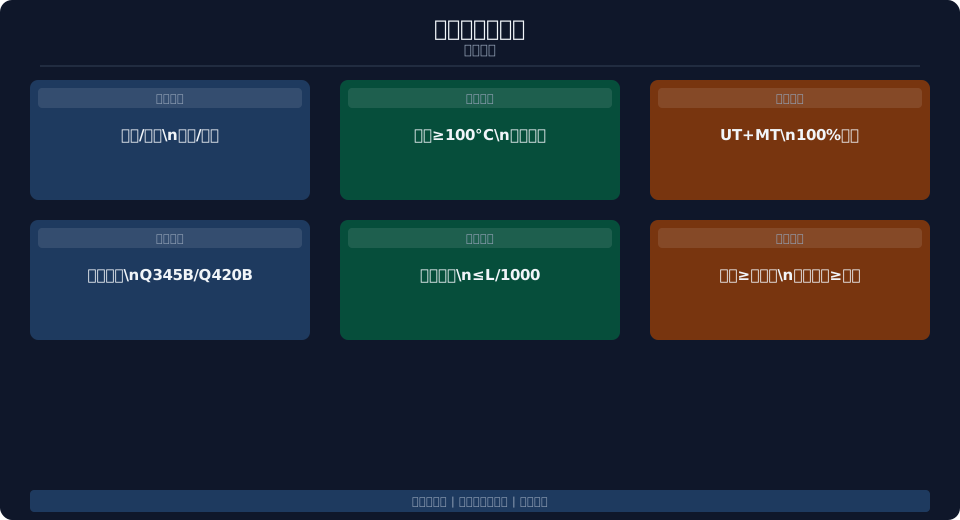
Repair Method
Welding / Patching / Replacement / Straightening
Preheating
100–150°C for ≥20mm
Interpass Temperature
Preheat +50°C
Post-Heating
200–250°C / 1h
Welding Consumables
J507 / E5015
Flaw Detection
UT + MT after welding
Repair Method Applicable Conditions Criticalrequirements Acceptance Standard
weld repair Crack/Fracture Preheating+post-heating+Flaw detection Weld SeamⅡGrade/UTⅠGrade
Reinforcement by Patch Plate cross-section Thinning Equal Strength Matching/1.0~1.2Times Strength≥Originaldesign
Member Replacement Severe Deformation/Fracture Temporary Support Scheme dimensional tolerance Comply With
Deformation Straightening Camber Insufficient/Bending 600~800°CHeating ≤L/1000

Flaw Detection & Acceptance Testing

After repair, the weld seams must undergo 100% ultrasonic testing (UT) and 100% magnetic particle testing (MT) for surface flaws. Fillet welds used in patch-plate reinforcement require 100% MT inspection. Butt welds on replaced structural members must pass both 100% UT and 100% MT. Acceptance criteria: the tensile strength of repaired weld seams must be at least 95% of the parent material's characteristic value. After patch-plate reinforcement, the load-bearing capacity of the cross-section must not fall below 100% of the original design. Following distortion correction, the main girder camber must be ≥ L/2000, and lateral deflection must be ≤ L/2000. The repaired area must be coated to meet the original design's corrosion protection level. Detailed repair records—including location, method, welding parameters, flaw detection results, and acceptance conclusions—must be documented and retained in the equipment file. Kelude Heavy Industry provides crane steel structure repair services.

Repair Type Flaw detection Repair Method coverage Ratio Acceptance
weld repair UT+MT 100% Tensile≥Base Metal95%
Reinforcement by Patch Plate MT 100% Load-Bearing≥Originaldesign100%
Member Replacement UT+MT 100% dimensional tolerance Comply With
Deformation Straightening Dimensional Measurement 100% Camber≥L/2000

FAQ

Q: What repair methods are covered by ISO 24817:2019?

A: Weld repair (cracks/fractures), plate patching (cross-section thinning), component replacement (severe deformation/fracture), and deformation correction (insufficient camber/bending). The selection of method should be based on the root cause of damage and a technical-economic comparison.

Q: What are the critical process requirements for weld repair?

A: Preheating to 100–150°C for plate thickness ≥20mm, interpass temperature maintained at preheat +50°C, post-heating at 200–250°C for 1 hour, welding from both crack ends toward the center, and 100% UT + MT flaw detection 24 hours after welding. Weld seam quality: Class II.

Q: What are the acceptance standards after repair?

A: For weld repair: 100% UT + MT, tensile strength ≥95% of base metal. For plate patching: 100% MT, load-bearing capacity ≥ original design. After deformation correction: camber ≥ L/2000, bending ≤ L/2000. Repair records are kept in the equipment file.

Q: Does Kelude offer steel structure repair services?

A: Yes. Kelude provides crane steel structure repair services covering weld repair, plate patching, and deformation correction for primary load-bearing members such as the main girder, end carriage, and outriggers. All work is performed in accordance with ISO 24817:2019 process requirements, and a repair report is issued upon completion.

Related News

contact

contact us

phone:
+86 13903802779

mail:3915269@qq.com

Working hours: Monday to Friday

Wechat
Wechat
SHARE
TOP