

Crane Configuration Solutions for the Rubber and Tire Manufacturing Industry—Four Processes: Internal Mixing, Calendering, Molding, and Vulcanization
📌 Crane configurations for the rubber and tire manufacturing industry must address two major challenges: carbon black dust in the internal mixing workshop and high-temperature mold changes in the vulcanization workshop. For the internal mixing workshop, we recommend TEFC fully enclosed motors paired with positive-pressure dust-proof electrical control cabinets (for carbon black dust environments). for vulcanization shops, we recommend a combination of an LD bridge crane (3–10 metric tons) and a BZD jib crane (2–5 metric tons) (for rapid mold change). Krude Heavy Industry’s cranes for the rubber industry have been field-tested and proven in operation at numerous tire manufacturers.
The production process in the rubber and tire manufacturing industry (passenger car tires, truck tires, construction tires, and rubber products)—from internal mixing to vulcanization—requires the use of lifting equipment throughout the entire chain for equipment maintenance and material handling. The internal mixing workshop is characterized by high levels of carbon black dust, the calendering workshop by high temperatures, and the vulcanization workshop by the presence of hydrogen sulfide gas—each production stage imposes specific safety requirements on cranes. Tire molds (movable molds/two-piece molds) weigh between 0.5 and 10 metric tons, and precise lifting by cranes is required when replacing molds in vulcanizers. This article is organized according toInternal Mixing, Calendering, Molding, VulcanizationThe four-step process provides crane configuration solutions.
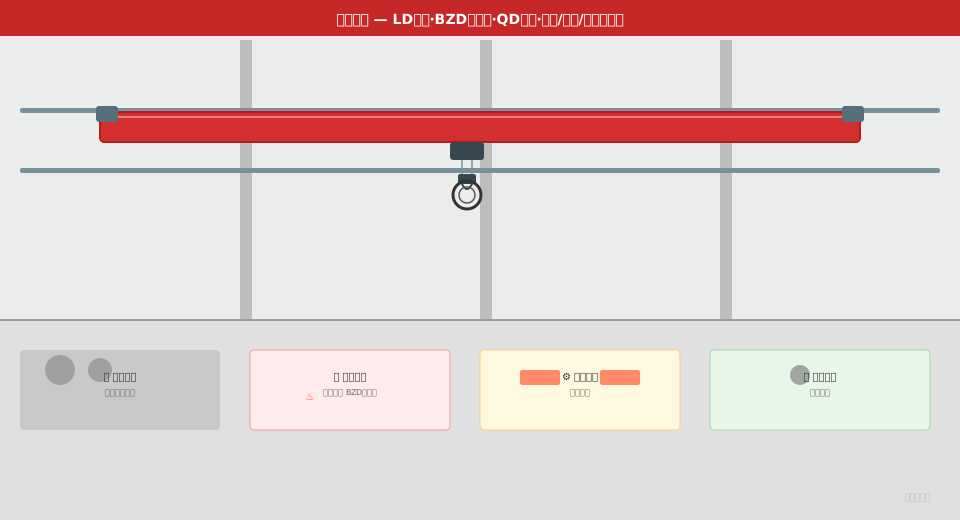
Comparison of Crane Configurations for Rubber-Tire Manufacturing
| Dimensions of Comparison | Internal Mixing Workshop | Calendering Shop | Molding Shop | Vulcanization Shop |
|---|---|---|---|---|
| Recommended Models | TEFC Dust-Proof LD/QD Bridge-Type | LD/LH Type Bridge-Type + Heat-Resistant | LD-Type Overhead Crane + KBK | LD Gantry Crane + BZD Jib Crane |
| Lifting Capacity Range | 10–32 metric tons | 5–16 metric tons | 3–10 metric tons | 3–10 t + 2–5 t cantilever |
| Key Protection Measures | Carbon Black Dust IP54+TEFC | High temperature (60–80 degrees) + calendering oil | None | High Temperature + Quick Mold Change |
| Motor Requirements | Fully Enclosed, Self-Cooled TEFC | Class F Insulation | Standards | Class F Insulation |
| Lifting Object | Carbon Black / Raw Rubber / Rubber Sheets | Rollers/Curtain Fabric/Steel Wire | Blank/Forming Drum | Molds/Finished Tires |
| Suggested Price | 150,000–500,000 yuan | 80,000–200,000 yuan | 50,000–150,000 yuan | 80,000–140,000 + 20,000–50,000 per unit |
I. Cranes in the Internal Mixing Workshop—Carbon Black Dust Environment
The carbon black dust concentration in the internal mixer workshop (carbon black/raw rubber/compounding agents → internal mixer → open mill → sheet cooling) is high (5–50 mg/m³). Since carbon black is a conductive dust, special protective measures are required for electrical equipment:
- Recommended Models:LD/LH-Type Overhead Cranes (5–16 t), Duty Class A4–A5, Span 18–24 m
- Preventing Carbon Black Dust:Electrical control cabinet: IP55 + positive pressure dust protection (a slight positive pressure prevents carbon black dust from entering); motor: TEFC fully enclosed with surface cooling fins and a dust cover; all electrical connection points are sealed.
- Anti-static:Carbon black is a conductive dust (with a resistivity of approximately 10⁵–10⁸ Ω·cm); the crane’s grounding resistance must be ≤1 Ω to prevent sparks caused by static electricity buildup.
- Suggested Price:LD Model 10t/22m+ with dust protection: approximately 120,000–180,000 yuan
II. Cranes in the Vulcanization Shop—Dedicated to Mold Replacement
The vulcanization shop is the core process in tire manufacturing—green tires are vulcanized to completion on vulcanizing machines through heating and pressurization. Each vulcanizing machine is equipped with a set of molds (live-side molds or two-half molds). Molds weigh between 0.5 and 10 metric tons. The vulcanization shop is characterized by high ambient temperatures, and the fumes generated during vulcanization are corrosive to equipment, placing special demands on the crane’s heat resistance and corrosion resistance:
- Recommended Models:A combination of an LD-type single-girder bridge crane (3–10 t) and a BZD-type fixed-column jib crane (2–5 t), where the bridge crane travels the full length of the mold aisle and the jib cranes are mounted on the columns in front of each vulcanizing machine.
- High-Temperature Resistance and Corrosion Resistance:The surface temperature of the vulcanizing machine reaches 80–120°C, and the vulcanizing fumes contain corrosive gases such as hydrogen sulfide. It is recommended that the crane’s electrical control cabinet be moved out of the vulcanizing area or that an IP55-rated stainless steel cabinet be used. Cables should have oil- and corrosion-resistant outer sheaths, and galvanized, rust-resistant steel wire ropes should be used.
- Quick Mold Change:Each vulcanizing machine may change molds 1 to 2 times per shift, and the time required for the change directly affects production efficiency. The LD overhead crane transports new molds from the mold storage area to the aisle in front of the vulcanizing machine, and the BZD jib crane moves the molds from the aisle to the vulcanizing machine’s worktable. The entire replacement cycle takes approximately 30 to 60 minutes, saving more than 50% in time compared to using forklifts alone.
- Suggested Price:LD-type 5-metric-ton/18-meter crane: approximately 80,000–140,000 yuan + BZD jib crane (3 metric tons): approximately 20,000–50,000 yuan per unit × 20 units = approximately 400,000–1,000,000 yuan; total investment: approximately 480,000–1,140,000 yuan
III. Cranes in the Calendering Shop—High-Temperature Protection
The calendering shop (where calenders are used to press rubber compounds into sheets or fabrics of a specific thickness) is equipped with large calenders, including tire cord calenders, steel cord calenders, and others. The rollers of the calenders are heavy (weighing 5–15 metric tons each), and the frame weighs 30–80 metric tons, requiring a crane for lifting during assembly and maintenance. The ambient temperature in the calendering shop is high (60–80°C), and there is oil contamination near the calenders:
- Recommended Models:LD/LH-type overhead cranes with capacities of 5–16 metric tons, duty classes A4–A5, and spans of 18–24 meters, equipped with variable-frequency micro-speed control (0.5–2 m/min) to enable precise roller installation
- High-Temperature Configuration:Motor with Class F insulation (temperature rating: 155°C) + control cabinet with IP54 rating. It is recommended to install the control cabinet in the low-temperature zones on both sides of the calender head plate, away from the high-temperature zones of the calender.
- Items to be lifted:Primarily handles the hoisting of equipment components such as rollers, frames, and fabric shafts for calenders, as well as the loading and unloading of fabric and steel wire coils.
- Suggested Price:LD Model, 10 metric tons/22 meters: approximately 80,000–200,000 yuan
IV. Cranes in the Forming Shop—Blank Handling and Coordination
The molding shop (where molding machines combine rubber sheets, fabric plies, and steel rings to form green tire blanks) is the most highly automated process in tire manufacturing. The molding machines themselves are equipped with built-in devices for picking up and flipping the tire blanks; cranes are primarily used for equipment maintenance and transporting material racks:
- Recommended Models:LD-type single-girder bridge crane, 3–10 metric tons, duty class A4–A5, span 16–22 meters, equipped with two-speed hoisting (5/0.8 m/min)
- Handling of Casting Blanks:Raw tire blanks produced by the molding machine (weighing 10–80 kg each, depending on the tire size) are typically transported to the inspection station via an automated conveyor line; cranes are used only as a backup in the event of equipment failure or when switching production lines.
- Material Rack Handling:In the molding shop, there is a high volume of material handling for racks containing film, wire rings, fabric layers, and other materials. It is recommended to install a KBK overhead rail system combined with a 0.5–2-metric-ton chain hoist in the rack area to load and unload the racks.
- Suggested Price:LD model, 5 metric tons/18 meters: approximately 50,000–150,000 yuan; KBK + 0.5-metric-ton hoist: approximately 20,000–50,000 yuan per set
V. Krude’s Competitive Advantages in the Rubber Tire Industry
- Carbon Black Dust Protection Solutions:The electrical solution for Krude Heavy Industry’s internal mixing workshop has been validated by multiple tire manufacturers—a combination of TEFC fully enclosed self-cooled motors, positive-pressure dust-proof control cabinets, and stainless steel dust covers—enabling continuous and stable operation in environments with carbon black concentrations of 10 mg/m³ or higher. Motor service life has been extended from 6 to 12 months to 3 to 5 years, and the failure rate of the electrical control cabinets has been reduced by approximately 80%.
- Modular Solutions for Quick Mold Change:Krud Heavy Industries’ combined solution for mold replacement in vulcanization shops (LD overhead crane 3–10 t + BZD jib crane 2–5 t) has been implemented in the vulcanization shops of several tire manufacturers—the LD overhead crane handles long-distance transport of molds from the mold storage area to the front of the vulcanizing machine, while the BZD jib crane handles short-distance replacement immediately in front of the vulcanizing machines, reducing mold replacement time by approximately 40%. This combined solution is more cost-effective than a setup consisting entirely of overhead cranes.
- Explosion-Proof Solution Capabilities:Krude Heavy Industry can provide comprehensive explosion-proof solutions for tire factories based on explosion-proof zoning diagrams—such as Ex d e mb IIB T4 for solvent warehouses and Ex d e mb IIB T3 for rubber compound preparation rooms. The price of explosion-proof cranes is approximately 1.5 to 2 times that of standard models. This reduces safety risks caused by carbon black dust and solvent vapors.
Frequently Asked Questions
Q: What harm does carbon black dust in the internal mixing workshop cause to electric motors?
Answer: Hazards of carbon black dust to electric motors: When carbon black is drawn in by the fan, it accumulates at the ends of the rotor and on the surface of the stator windings—since carbon black is a conductive dust, its accumulation reduces insulation resistance (leading to inter-turn short circuits or ground faults); Carbon black accumulates in the motor’s ventilation openings, blocking heat dissipation channels, which causes the motor’s temperature rise to exceed standards and accelerates insulation aging. Krude Heavy Industry recommends that internal mixing workshops use TEFC (Totally Enclosed Fan-Cooled) motors (which have no external fan and do not draw in carbon black), and that stainless steel dust covers be installed on the motor cooling fins. After implementing these measures, the service life of motors in carbon black environments can be extended from 6 to 12 months to 3 to 5 years.
Q: Should the LD bridge crane or the BZD cantilever crane be used for mold changes in the vulcanization shop?
Answer: In the tire vulcanization workshop, there is a mold aisle between the two rows of vulcanizers. Recommended solution: Install an LD-type single-girder overhead crane (3–10 t) above the mold aisle to move along the aisle and hoist molds to the front of any vulcanizer; In front of each vulcanizing machine, install a BZD-type fixed-column jib crane (2–5 metric tons) to handle short-distance mold changes. The LD overhead crane handles long-distance transport, while the jib crane handles positioning in front of the machine. This combined solution is more cost-effective than equipping every machine with an overhead crane.
Q: What special protective measures are required for the electrical system in the internal mixer workshop?
Answer: Due to the high carbon black concentration and high ambient temperature in the internal mixing workshop, the electrical system has the following special requirements: Electrical control cabinets must be positive-pressure, dustproof models with an IP rating of IP54 or higher; variable frequency drives (VFDs) must be derated to 20%–30% when ambient temperatures exceed 40°C; connectors must be IP67 waterproof types; and control cables must have oil- and heat-resistant outer sheaths. Krude Heavy Industry’s electrical control cabinets for internal mixing workshops come standard with a positive-pressure dustproof design and a water-cooled heat dissipation solution, enabling long-term, stable operation in environments with carbon black concentrations of 10 mg/m³ or higher.
Q: Do cranes in the rubber tire industry require explosion-proof design?
Answer: Most areas of the tire manufacturing workshop do not have explosion-proof requirements, but the solvent warehouse and the adhesive mixing room are classified as explosion-hazardous areas—the concentration of volatile gases from solvents (gasoline, toluene, xylene) may reach the lower explosive limit. The solvent warehouse requires an explosion-proof crane rated Ex d e mb IIB T4, while the rubber compound preparation room requires an Ex d e mb IIB T3-rated crane. The price of an explosion-proof crane is approximately 1.5 to 2 times that of a standard model.
