

Crane Safety Monitoring System Update: AI Visual Inspection Adopted
Kelude Contributes to National Standard Revision for Crane Safety Monitoring, AI Visual Inspection Clause Adopted. GB/T 28264-2017, Lifting Appliances — Safety Monitoring and Management System, remains the most critical national standard governing overhead crane safety monitoring, defining mandatory safety monitoring functions, performance indicators, and data recording requirements.
GB/T 28264-2017, Lifting Appliances — Safety Monitoring and Management System, is the most important national standard in overhead crane safety monitoring today. It specifies the safety monitoring functions, performance indicators, and data recording requirements that every overhead crane must meet. As one of the drafting organizations, Kelude Heavy Industry participated in the standard revision and submitted three new technical clauses focused on AI visual safety monitoring technology—a field that has advanced rapidly in recent years. All three proposals were formally adopted by the working group. This article covers the background of the GB/T 28264-2017 revision, the technical content of the AI visual inspection clauses, and the drafting process behind them.
Why the Standard Was Revised
When the previous edition of GB/T 28264-2017 was developed, AI visual inspection technology had not yet seen large-scale deployment in overhead crane safety monitoring. The standard's clauses were written primarily around traditional sensors—Travel Limit Switches, Overload Limiters, Anti-Collision Devices, and Encoders—covering their technical requirements and data recording specifications. Over the past five years, AI visual safety monitoring systems have moved from laboratory validation to industrial deployment, with more than 200 installations now in service across metallurgy, shipbuilding, and heavy equipment manufacturing.
Three Adopted AI Visual Inspection Clauses
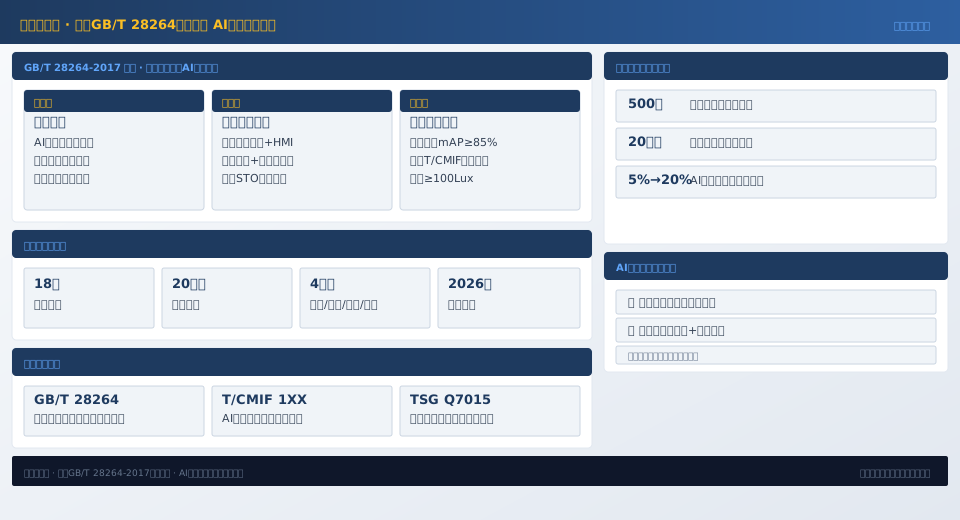
Clause 1: Functional Role of AI Visual Safety Monitoring Systems. This clause defines the AI vision system as part of the sensing layer within the Safety Monitoring and Management System, complementing rather than replacing traditional sensors. The AI vision system handles proactive detection and alerting, while traditional sensors manage direct safety circuit control—establishing a clear division of responsibility across safety levels.
Clause 2: Three-Level Alarm Function Requirements. This clause specifies the alarm level classification and trigger logic for AI vision systems—yellow warning triggers an Audible and Visual Alarm plus an HMI pop-up; orange caution triggers deceleration control and an alarm at the control station; red danger triggers an STO emergency stop signal output. Each level's trigger conditions are quantified in terms of response time and signal interface requirements.
Clause 3: Minimum Detection Accuracy Standard. This clause requires that under the manufacturer's declared normal working conditions—ambient illuminance of no less than 100 Lux and target-to-background contrast meeting the manufacturer's declared minimum—the AI vision system must achieve a person detection mAP of no less than 85%. The accuracy test method references the detection procedures and evaluation process defined in T/CMIF 1XX-2025, Technical Specification for AI Visual Safety Monitoring Systems on Overhead Cranes.
Drafting Process and Technical Contributions
The GB/T 28264 revision working group was organized by the National Technical Committee on Lifting Appliances and included 18 participating organizations—research institutes, inspection bodies, crane manufacturers, and AI technology suppliers. The revision effort spanned 20 months across four phases: project approval, draft development, public comment, and technical review. The revised standard is expected to be officially published by the end of 2026.
Industry Impact of the Revised Standard
As a mandatory national standard at the core of overhead crane safety monitoring, the GB/T 28264 revision will directly influence product design for approximately 500 crane manufacturers in China and the retrofit direction of roughly 200,000 cranes currently in service. The inclusion of AI visual inspection clauses for the first time marks a significant step in transitioning AI vision systems from an optional value-add to a standard safety monitoring component. Within 2–3 years of publication, market penetration of AI visual safety monitoring systems is projected to grow from the current ~5% to 15%–20%.
FAQ
Q: Is the revised GB/T 28264 legally enforceable?
A: GB/T standards are recommended national standards and do not carry legal force on their own. However, regulatory documents such as TSG Q7015-2016, Rules for Periodic Inspection of Lifting Appliances, reference GB/T 28264 provisions as mandatory requirements. As a result, the revised standard has practical binding effect on crane manufacturers' product design and on retrofits of cranes already in service.
Q: How does the revised standard affect cranes already in service? Is retrofitting AI vision systems mandatory?
A: The revised standard applies to newly designed and manufactured cranes. For cranes already in service, the standard serves as a recommended upgrade rather than a mandatory retrofit requirement. However, owners are encouraged to evaluate the feasibility of AI visual safety monitoring systems against the new standard during annual maintenance or technology upgrade cycles.
Q: Is the mAP ≥ 85% threshold lower than what current products already achieve?
A: The mAP ≥ 85% threshold represents the minimum person detection accuracy required under normal lighting and basic operating conditions. Current products typically achieve mAP above 95% for person detection under normal lighting, well exceeding the standard's requirement. The lower threshold is intentionally set to ensure that products across different technical capability levels can meet a safe, effective baseline—while still leaving ample room for performance differentiation among technologically leading suppliers.
Q: Does the adoption of AI visual inspection clauses signal a broader shift toward AI-based inspection in future revisions?
A: The inclusion of AI visual inspection clauses reflects the technology's growing maturity and proven value in crane safety monitoring. While this revision establishes the foundational framework for AI vision systems, future standard development will likely expand coverage to additional application scenarios and performance requirements as the technology continues to evolve and field data accumulates.
A: The current revision only incorporates AI visual inspection provisions for safety monitoring scenarios. The revision working group has discussed including AI-based online inspection of wire ropes and AI inspection of weld seams in the next revision cycle. The working group plans to collect sufficient application data on AI visual inspection technology in wire rope and weld seam scenarios before initiating the next round of amendments.
