
ISO 12489:2016 Crane Spiral Rope Specs
ISO 12489:2016, "Spiral Rope for Cranes—Technical Specification," is the dedicated technical standard for spiral-strand wire ropes used in crane applications. It defines the structural types, diameter series, breaking forces, technical requirements, test methods, and inspection rules for spiral ropes, making it applicable to hoisting applications where resistance to rotation is critical.
Spiral Rope Structural Types
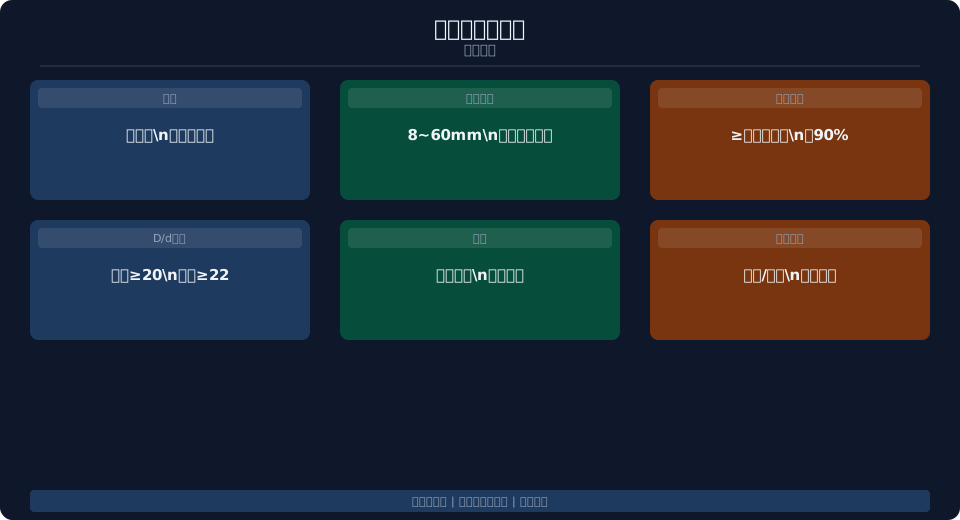
Spiral rope, also referred to as spiral-strand wire rope under ISO 12489:2016, is constructed from multiple layers of steel wire helically wound in the same lay direction, with no strand core. Based on the number of wire layers, spiral rope is classified into two types: single-layer spiral rope, which has a smaller diameter and is used for guide sheaves and equalizer sheaves, and multi-layer spiral rope, which can reach diameters up to 60 mm and is used in hoisting mechanisms. The key advantage of spiral rope is its superior resistance to rotation—the hook does not spin during lifting—making it ideal for applications requiring stable load orientation, such as the main hoist of tower cranes and the hoisting mechanism of gantry cranes. The breaking force of spiral rope is at least 90% of the sum of the breaking forces of all individual wire layers, since each layer carries load uniformly without the gap losses typical of stranded ropes. The elastic modulus of spiral rope is approximately 110±10 GPa, placing it between that of ordinary wire rope and steel strand.
Diameter Series and D/d Ratios
The standard specifies a diameter series for spiral rope ranging from 8 mm to 60 mm, covering 15 sizes: 8, 10, 12, 14, 16, 18, 20, 22, 24, 26, 28, 32, 36, 40, and 60 mm. The diameter tolerance is 0 to +5%, with no negative tolerance permitted. For spiral rope, the required drum diameter ratio (D/d) is ≥20, and the sheave diameter ratio (Dp/d) is ≥22—both higher than the D/d ≥18 and Dp/d ≥18 required for ordinary wire rope. This is because spiral rope has greater structural rigidity and lower bending flexibility, necessitating larger bending radii to reduce bending stress in the wires and extend service life. For tower cranes with large lifting heights, a D/d ratio of ≥25 is recommended for spiral rope. The tensile strength grades of spiral rope steel wire are 1570, 1770, and 1960 N/mm², with 1770 N/mm² being the most commonly used grade.
| Parameter | spiral rope | ordinary wire rope |
|---|---|---|
| construction | multi-layer Steel wirelang lay | strand+rope coreconstruction |
| resistance Rotation | excellent | poor(guard against Rotation) |
| D/dratio | ≥20 | ≥15~18 |
| Dp/dratio | ≥22 | ≥18 |
| Breaking forceefficiency | ≥90% | 82~88% |
| Elastic Modulus | 110GPa | 90~100GPa |
Lubrication & Inspection
Internal lubrication of spiral rope is applied during manufacturing, with grease coated between each layer of steel wire to provide lifelong corrosion protection inside the rope. An additional anti-corrosion coating is applied externally for extra protection. In-service maintenance mainly involves external inspection and regular lubrication of the rope surface. Wear on the steel wires is checked by measuring the diameter with a caliper at intervals of 5 m along the rope length, starting at a point no less than 2 m from the rope end. The rope is considered unfit for service when the wear amount exceeds 7% of the nominal diameter. Discard criteria for spiral rope: if the number of broken wires on the outer layer exceeds 5% of the total wire count within one lay length, the rope must be discarded. Because spiral rope offers superior rotation resistance, any wire break on the outer layer poses a greater hazard than with ordinary wire rope, as the remaining wires in a spiral rope must carry a significantly higher load. Kelude Heavy Industry provides selection calculation and technical support services for spiral rope applications.
| inspection item | method | acceptance criteria |
|---|---|---|
| diameter Wear | caliper5msingle point | ≤7% |
| outer layerwire break | visual inspection+magnifying glass | >5%condemned |
| Corrosioninspection | visual inspection | no pitting or spalling |
| Lubricationcondition | visual inspection | no dryness/rust traces |
Spiral Rope FAQ: Key Differences, Sizing & Maintenance
Q: What is the core difference between spiral rope and ordinary wire rope?
A: Spiral rope consists of multiple layers of steel wire helically wound in the same direction with no strand core, offering superior rotation resistance—the load does not rotate during lifting. Breaking force efficiency is ≥90%, higher than the 82–88% typical of ordinary wire rope. It requires a higher D/d ratio: ≥20 for drums and ≥22 for pulleys.
Q: What diameter range and D/d requirements apply to spiral rope?
A: Diameters range from 8 to 60 mm across 15 specifications, with a tolerance of 0 to +5%. Drum D/d ≥20, pulley Dp/d ≥22, and ≥25 is recommended for tower cranes. Spiral rope is stiffer and requires a larger bending radius.
Q: What are the discard criteria specific to spiral rope?
A: The rope must be discarded when outer wire breaks exceed 5% of the total wire count within one lay length—stricter than the 10% threshold for standard regular lay rope. Diameter wear must not exceed 7%. Once outer wires begin to break, internal wires carry a greater share of the load, significantly increasing the risk.
Q: How should spiral rope be lubricated and maintained?
A: The rope is lubricated internally during manufacturing and receives an anti-corrosion coating on the outside. In service, external lubrication and periodic inspection are required. Check diameter and wire breaks monthly, and perform electromagnetic testing (EMT) annually. Kelude Heavy Industry provides spiral rope selection calculations and technical support.