

Interpretation of the ISO 24039:2020 Standard, “Methods for the Seismic Design of Cranes”
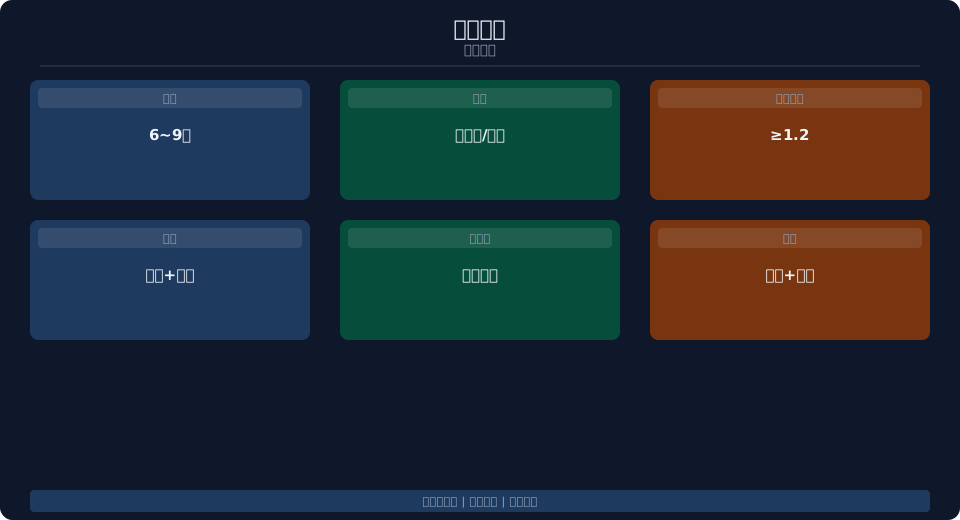
📌ISO 24039:2020, “Cranes—Seismic Design Methods,” is the standard for the seismic design of cranes. It specifies the calculation of seismic actions (response spectrum method or time-history analysis), structural seismic verification (strength, stability, and deformation), seismic structural measures (foundation anchoring, derailment prevention, and limit devices), and a safety factor of ≥1.2 for the seismic design of cranes in regions with seismic intensity levels of 6 to 9.
Seismic Design Methods
Seismic design of cranes is a critical aspect of ensuring structural safety under seismic loads. This standard applies to regions with seismic intensity levels of 6 to 9. The recommended response spectrum method involves selecting a design response spectrum based on site category and seismic grouping to calculate the effects of seismic loads. For important or large cranes, the time-history analysis method shall be used to select ≥3 seismic waves (at least 2 natural waves and 1 artificial wave), and the envelope value of the time-history integral shall be taken. Seismic actions shall consider components in two horizontal directions and the vertical direction (set at 0.65 times the horizontal component). The seismic safety factor shall be ≥1.2. The load combination is G + E + 0.5Q. Structural verification includes strength, stability, and inter-story deformation. Structural measures include foundation anchoring to prevent overturning, track end protection against derailment, and ductile connections to prevent brittle failure. Krude Heavy Industry provides seismic design services.
Construction Measures and Inspection
Site classification has a significant impact on seismic design: for Class I hard soil, the factors should be multiplied by 1.0 to 1.5; for Class IV soft soil, by 2.0 to 3.0. Seismic design should be based on the seismic motion parameters specified in the site seismic safety assessment report. Krude Heavy Industry provides tailored seismic design solutions based on site conditions.
| Design Parameters | Requirements |
|---|---|
| Earthquake Intensity | 6–9 degrees |
| Methods | Reaction Spectroscopy/Time-Resolved Analysis |
| Safety Factor | >=1.2 |
| Load Combinations | G+E+0.5Q |
| Structure | Anchoring + Derailment Prevention + Ductile Joints |
| Venue Category | Magnification |
|---|---|
| Class I (Hard Soil) | 1.0~1.5 |
| Class II (Medium Hardness) | 1.5~2.0 |
| Class III (Zhongruan) | 2.0~2.5 |
| Class IV (Soft Soil) | 2.5~3.0 |
The combination of seismic action directions is a critical aspect of seismic design. Standards require that seismic actions in two orthogonal horizontal directions (X and Y) and the effects of vertical seismic components be considered simultaneously. Vertical seismic forces are typically taken as 0.65 times the horizontal seismic forces. For long-span cranes and tall structures (such as the gantry of a gantry crane and the tower of a tower crane), the effects of vertical seismic forces cannot be ignored. The load combination for seismic design is G + E + 0.5Q (permanent load + seismic action + variable load combination factor of 0.5). Connection nodes should use friction-type high-strength bolt connections or ductile welded connections to ensure that brittle fracture does not occur under repeated seismic actions.
Frequently Asked Questions
Q: In which situations are the response spectrum method and the time-history analysis method specified in ISO 24039:2020 applicable, respectively?
Answer: The response spectrum method is suitable for the seismic design of conventional cranes—by selecting a design response spectrum based on site category and seismic grouping, the seismic effects for each mode of vibration are calculated, and then the total seismic effect is obtained through the SRSS or CQC combination. This method is highly efficient and involves clear, well-defined steps. The time-history analysis method is suitable for important or large-scale cranes (such as cranes in nuclear power plants, large port cranes, or cranes in high-seismic-intensity zones). At least three seismic waves are selected for time-history integration analysis, and the envelope value is taken as the design seismic action.
Q: What is the basis for setting the seismic safety factor at 1.2?
Answer: The reason the seismic safety factor of 1.2 is lower than the conventional load safety factor of 1.5 is that seismic actions are accidental loads with a low probability of occurrence and a short duration (typically ranging from tens of seconds to several tens of seconds). Structures are permitted to enter the elastic-plastic range under seismic action, dissipating seismic energy through plastic deformation, rather than being required to remain fully elastic. However, plastic deformation must be controlled within acceptable limits to ensure that the structure does not collapse as a whole and can be restored to service after post-earthquake inspection and repair.
Q: How do different site categories affect seismic design?
Answer: Site classification directly affects the seismic acceleration amplification factor—for Class I sites (rock/hard soil), the amplification factor is the lowest, at approximately 1.0 to 1.5 times. For Class IV sites (soft soil/silt), the amplification factor can reach a maximum of 2.5 to 3.0 times. Therefore, cranes on soft soil sites require greater seismic resistance for the same seismic intensity. Krude Heavy Industry conducts targeted seismic design based on the parameters in the site’s seismic safety assessment report.
Q: What seismic design services for cranes does Krude Heavy Industry offer?
Answer: Krude Heavy Industries provides crane seismic design services in accordance with the ISO 24039:2020 standard, including seismic action calculations (using either the response spectrum method or time-history analysis, selected based on the importance of the equipment and site conditions), structural seismic verification (covering three states: strength, stability, and deformation), and the design of seismic structural measures (foundation anchoring to prevent overturning, rail derailment prevention, and ductile design of joints) to meet seismic design requirements for seismic intensity zones 6 to 9, and issues a seismic design calculation report.
